
The Elemental Plane of Water
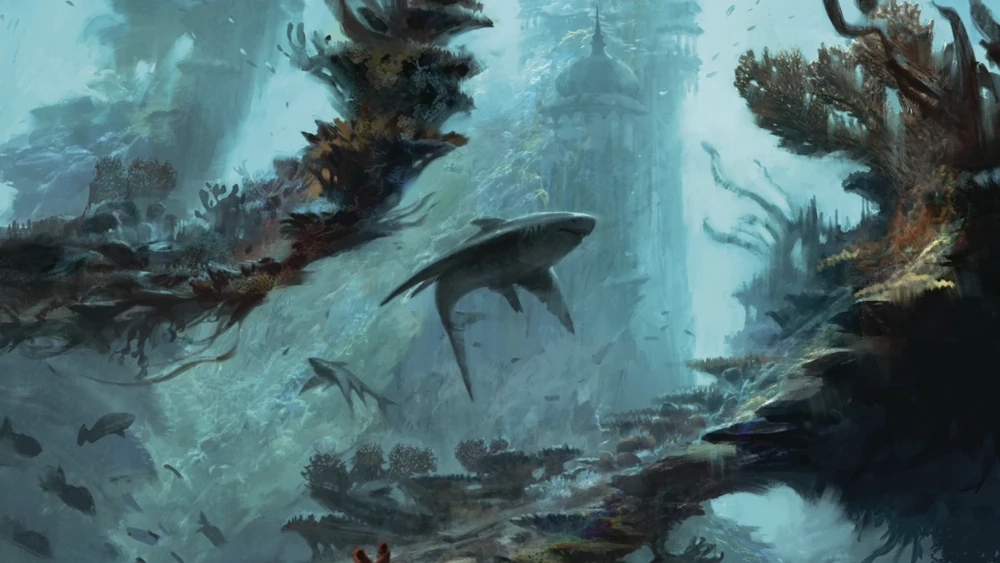
The Elemental Plane of Water is one of the four Inner Planes and the elemental source most closely associated with water, currents, tides, and aquatic environments.
The plane is an immense body of water with no known surface or floor. Travelers can move in any direction, and a diffuse light reaches through much of its more accessible regions despite the absence of a visible sun.
Local conditions vary considerably in temperature, salinity, and current. Farther into the plane, suspended earth and other foreign matter become increasingly scarce as elemental water comes to dominate the surrounding environment.
The Coral Sanctum, domain of Nerissa, Primarch of Water, travels through the plane with its major currents.
Structure and Environment
The Plane of Water has no conventional coastline, seabed, or surface. Water extends in every direction, broken only by suspended structures, drifting material, settlements, and other formations carried through the plane.
There is no consistent sense of up or down across much of the plane. Pressure is generally experienced from all directions and does not increase according to depth as it would in a Material Plane ocean.
The water itself can differ greatly between regions. Some expanses are fresh or saline, while others contain heavy concentrations of minerals or suspended matter. Temperature also varies widely, creating enormous areas with distinct local conditions.
Deeper regions contain progressively less foreign material and fewer familiar landmarks, eventually giving way to vast expanses of uninterrupted elemental water.
Currents and Travel
Currents form much of the practical geography of the Plane of Water. Some move slowly across enormous distances, while others become powerful streams or rotating systems capable of carrying creatures, debris, and even settlements far from their previous positions.
Experienced travelers use reliable currents as routes between known regions, but changes in direction or strength can alter established journeys considerably. A settlement that was easily reached during one season may require a very different route later.
Natural swimmers have a significant advantage, while other travelers depend on magic, specialized equipment, or assistance from native inhabitants. Navigation relies heavily on known currents and recognizable landmarks, many of which may themselves be moving.
Settlements
Permanent communities usually develop around substantial structures suspended within the water. Natural rock, coral, wreckage, or material brought from elsewhere can provide foundations for construction, while some settlements drift freely with the currents.
Air-filled chambers are maintained in certain communities for inhabitants and visitors unable to breathe water, though such spaces require careful construction or magical support.
Because settlements may follow different currents over time, relationships between communities can change with their movement. Regular neighbors may drift apart for long periods before their routes bring them together again.
Connections to the Material Plane
Natural vortices can connect the Plane of Water to the Material Plane, usually where large concentrations of water create suitable conditions.
Deep oceans, underwater trenches, isolated underground lakes, and powerful whirlpools are common sites for temporary crossings. Some vortices remain stable for long periods, while others appear only under particular tidal, magical, or environmental conditions.
Many natural crossings lie underwater on the Material Plane side, so travelers may need to overcome difficult access and underwater conditions before reaching the portal itself. Established crossings provide more reliable entry when available.
Elemental Confluences
The Plane of Water gradually blends with neighboring Elemental Planes along transitional regions of the Elemental Chaos.
Toward Air, temperatures fall and suspended ice becomes increasingly common. Open water may give way to enormous frozen formations, drifting ice, and violent regions of freezing currents and weather.
Toward Earth, sediment and mineral content increase until clear water becomes thick with mud, silt, and suspended stone. Movement and visibility can become severely restricted as the distinction between liquid water and saturated earth grows less clear.
These confluences remain part of the surrounding elemental planes, with their extent and conditions shifting as the balance between elements changes. Elemental creatures adapted to ice, mud, and other mixed forms are especially common along these boundaries.
Inhabitants
Water elementals are among the most common native creatures of the plane and move freely through its waters and currents.
Marids are also strongly associated with the Plane of Water. They establish settlements and domains throughout its more accessible regions and possess considerable control over water and aquatic environments.
Nerissa, Primarch of Water, was the first Marid and remains the most important divine figure associated with them in Eldareth's traditions.
Aquatic life is widespread wherever local temperature and water conditions permit it, while large predators such as krakens inhabit more remote regions. Creatures that require air face many of the same difficulties as other outsiders unless they possess a reliable means of breathing underwater.
Language
Aquan is the language traditionally associated with the Plane of Water.
It is a form of Primordial spoken by marids, intelligent water elementals, and many other beings connected to elemental water. Travelers who regularly visit native settlements often learn it for communication, guidance, and trade.
The Coral Sanctum
The Coral Sanctum is the domain of Nerissa, Primarch of Water.
Formed largely from living coral, the realm travels through the plane with the major currents. Its route follows recurring patterns without remaining identical from one cycle to the next.
The Sanctum serves as Nerissa's principal seat of power and one of the four major elemental domains associated with the Primarchs.
Finding it usually requires current knowledge of the plane or magical guidance, and experienced travelers track its movement through the currents and other recurring signs.
Natural Hazards
Powerful currents are among the most persistent dangers on the Plane of Water. They can separate travelers, carry them far from established routes, or hold creatures within large rotating systems for extended periods.
Local conditions can also change sharply as currents carry travelers between regions of different temperature or water composition. Suspended sediment may reduce visibility and restrict movement, while predators pose an additional threat far from inhabited areas.
Navigation becomes especially difficult when routes, landmarks, and settlements are all moving at once, making outdated information increasingly unreliable.
Survival
Once underwater breathing has been addressed, much of the accessible Plane of Water can support prolonged travel without extensive environmental protection.
Reliable swimming or another means of movement remains essential, especially across strong currents or long stretches without solid structures on which to rest. Extended journeys also require dependable navigation, adequate supplies, and current knowledge of nearby settlements.
Conditions become more demanding in the deeper reaches, where familiar landmarks grow scarce, and along the confluences with Air and Earth. Established communities such as the Coral Sanctum provide the most dependable places to rest, resupply, and gather information before traveling farther into the plane.