
The Elemental Plane of Fire
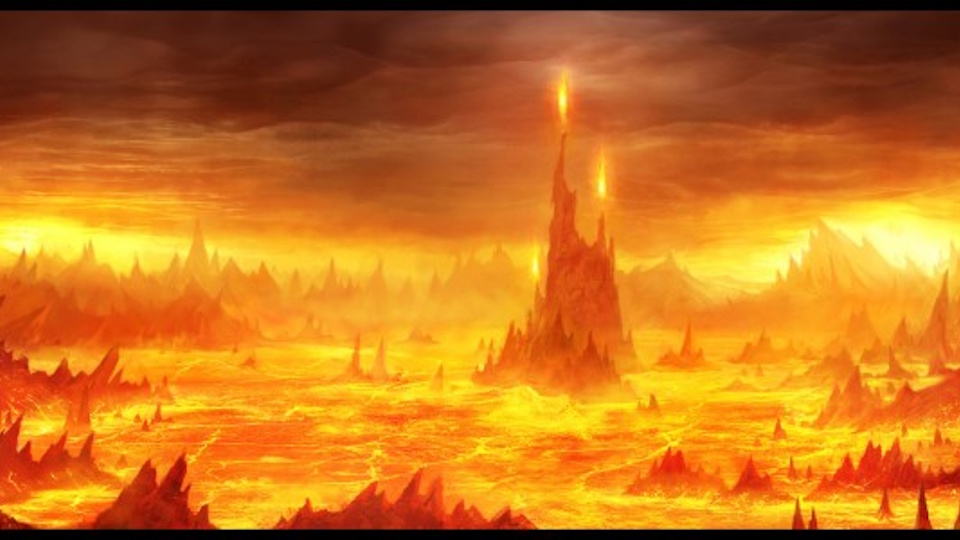
The Elemental Plane of Fire is one of the four Inner Planes and the elemental source most closely associated with flame, heat, and combustion.
Fire exists throughout the plane without requiring ordinary fuel. Its more accessible regions contain enough stable ground to support travel and settlement, while deeper reaches become increasingly dominated by elemental fire and offer fewer conventional surfaces on which to stand.
The City of Brass, domain of Kyrion, Primarch of Fire, is located within this plane.
Structure and Environment
Much of the accessible Plane of Fire possesses solid ground and conventional gravity. Volcanic rock and cooled formations create broad regions that can be crossed on foot, though stable terrain becomes scarcer as the concentration of elemental fire increases.
The landscape changes continually under intense heat and the movement of molten material. Mountains can fracture or collapse, old routes may disappear beneath lava, and regions where Fire mingles strongly with Earth can become vast expanses of magma broken by temporary islands of stone.
Elemental fire appears in many colors and forms according to local conditions, sometimes gathering into immense columns, walls, or sheets of flame. In the most concentrated regions, fire can become dense enough to behave almost like terrain.
Smoke, ash, and heat distortion frequently reduce visibility, especially where the plane approaches its confluence with Air.
Heat and Atmosphere
Much of the Plane of Fire is immediately lethal to creatures adapted to the Material Plane. Ambient heat can kill an unprotected traveler quickly, and flammable clothing or equipment may ignite even when its bearer possesses some resistance to fire.
Breathing can present a separate danger. Smoke, ash, and superheated gases make the atmosphere hazardous in many regions, requiring protection beyond simple resistance to heat.
Settlements and maintained travel routes can provide more tolerable conditions, but their safety depends on local protections and should not be assumed beyond their boundaries.
Movement and Travel
Travel usually follows stable terrain or maintained routes between settlements, but neither can be relied upon indefinitely. Lava may change course, eruptions can bury roads, and seemingly solid ground may fracture or melt between journeys.
Native creatures often cross regions that outsiders cannot safely enter, moving directly through flame or molten material without depending on roads.
Flight and magical transportation can avoid many ground hazards, though open air exposes travelers to smoke, violent eruptions, and powerful heated currents.
Connections to the Material Plane
Natural vortices sometimes connect the Plane of Fire to the Material Plane, most often where intense heat and flame are heavily concentrated.
Active volcanoes, magma chambers, large lava pools, and sites of sustained magical fire are common locations for such crossings. Some remain stable for long periods, while others appear only during eruptions or unusual surges of magical activity.
The conditions surrounding natural vortices can be dangerous even before a traveler crosses into the plane, making established portals preferable when they are available.
Elemental Confluences
The boundaries of the Plane of Fire gradually blend with neighboring Elemental Planes, forming transitional regions within what planar scholars collectively call the Elemental Chaos.
Toward Earth, stable stone becomes hotter and increasingly dominated by molten material. Solid ground may survive only as temporary shelves, islands, or ridges surrounded by vast regions of magma that continually reshape themselves.
Toward Air, conventional ground becomes scarce as smoke, heated currents, suspended flame, and drifting soot fill broad expanses of open space. Visibility can become extremely poor, and breathable air may disappear entirely from some regions.
These confluences remain transitional parts of the elemental planes, with their extent and balance shifting over time. Mixed elemental beings, including magma and smoke elementals, are especially common there.
Inhabitants
Fire elementals are among the most common native creatures of the plane and move freely through conditions that would be fatal to most Material Plane life.
Efreeti are also deeply associated with the Plane of Fire. They establish settlements, travel extensively across its more stable regions, and rank among its most powerful intelligent inhabitants.
Kyrion, the Primarch of Fire, was the first Efreet and remains the most important divine figure associated with them in Eldareth's traditions.
Other forms of life adapted to extreme heat are most diverse in regions where stable terrain or mixed elemental conditions allow more complex ecosystems to develop. The deeper reaches of pure elemental fire remain poorly explored, and knowledge of what inhabits them is limited.
Language
Ignan is the language traditionally associated with the Plane of Fire.
It is a form of Primordial widely used by efreeti, intelligent fire elementals, and other beings closely connected to elemental fire. Travelers who regularly visit established settlements often learn it for trade and communication.
The City of Brass
The City of Brass is one of the largest known settlements on the Elemental Plane of Fire and the domain of Kyrion, Primarch of Fire.
Its architecture and infrastructure are designed to endure the surrounding heat, with brass, volcanic stone, and other resilient materials used extensively throughout the city. These protections allow permanent habitation and regular commerce in conditions that would otherwise be dangerous to outsiders.
Stable planar connections and a population accustomed to dealing with travelers have made the City of Brass one of the most accessible destinations within the plane. It serves as Kyrion's principal seat of power and one of the four major elemental domains associated with the Primarchs.
Natural Hazards
Extreme heat remains the plane's most constant danger, compounded by unstable terrain and sudden changes in volcanic activity. Lava flows can alter direction, eruptions can bury surrounding regions, and apparently solid ground may conceal molten material beneath only a thin cooled crust.
Firestorms and airborne ash can make travel dangerous long before open flame reaches a region, while smoke and heated gases may render otherwise passable terrain impossible to cross safely.
Because local conditions change frequently, older maps are most dependable for locating major settlements and long-standing landmarks. Routes and smaller terrain features often require more recent information.
Survival
Travel beyond protected settlements requires reliable resistance to extreme heat and fire, along with protection against smoke, ash, and hazardous gases where those conditions are present. Ordinary equipment must also be chosen carefully, since combustible materials can ignite and metal objects may become dangerously hot.
Food and drinkable water are difficult to obtain outside inhabited regions and usually need to be carried or provided by magic.
Most outsiders base their journeys from established settlements such as the City of Brass, where supplies, local knowledge, and maintained routes make exploration of the surrounding plane considerably safer.