
The Elemental Plane of Earth
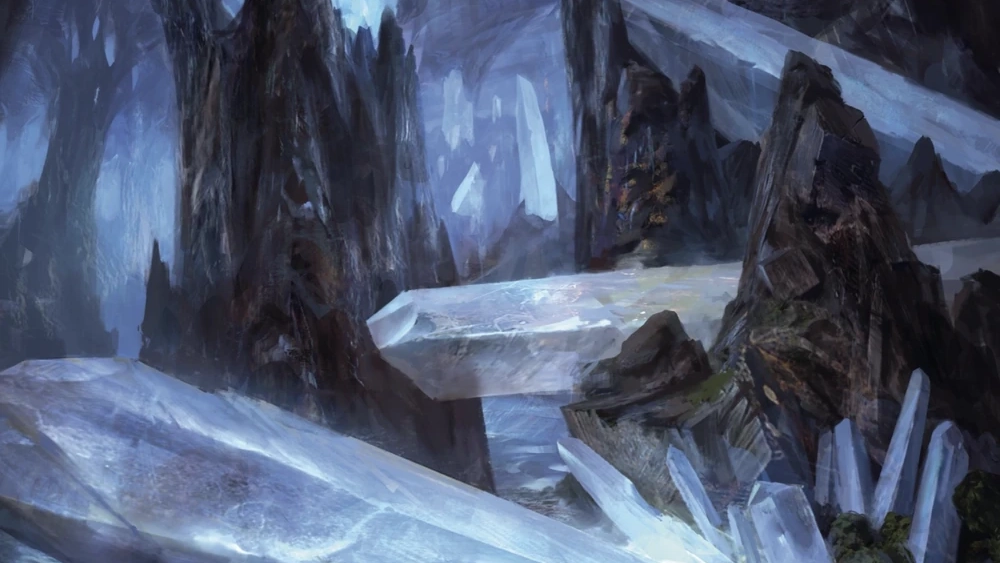
The Elemental Plane of Earth is one of the four Inner Planes and the elemental source most closely associated with stone, soil, metal, crystal, and mineral matter.
Much of the plane consists of solid earth, with travelers relying on caverns, fissures, and other open spaces to move through its more accessible regions. Farther inward, these openings become increasingly rare as uninterrupted elemental earth comes to dominate the surrounding environment.
The Diamond Bastion, domain of Durnathar, Primarch of Earth, lies deep within the plane.
Structure and Environment
The more accessible regions of the Plane of Earth contain vast cavern systems linked by natural and constructed passages. Some resemble subterranean environments found on the Material Plane, though individual systems can extend across far greater distances.
Open space becomes less common deeper within the plane, where stone, soil, crystal, ore, and other forms of elemental earth merge into increasingly continuous expanses. These regions can be almost entirely solid, leaving few natural routes for creatures that cannot move directly through earth.
The plane changes slowly but continually. Tremors and larger geological shifts can fracture stone, collapse passages, or alter entire cavern systems as the surrounding material settles and moves.
Rich deposits of metal, crystal, and gemstones occur throughout the plane, sometimes in concentrations rarely encountered on the Material Plane. Their value draws travelers into regions where reaching the deposit can be more dangerous than extracting it.
Caverns and Settlements
Caverns range from narrow passages to immense chambers capable of supporting permanent communities and complex local environments. Some connect through natural tunnel systems, while others have been expanded or joined through centuries of excavation.
Settlements generally develop within caverns whose surrounding stone is comparatively stable. Even long-established communities must account for geological change, since earthquakes can close familiar routes, expose new passages, or alter the shape of inhabited spaces over time.
Native beings capable of moving through solid earth are far less dependent on these openings and may travel between settlements along routes inaccessible to most visitors.
Movement and Travel
Movement is one of the greatest difficulties faced by outsiders. Earth elementals and other native creatures can pass directly through unworked earth and stone without leaving a tunnel behind, while most travelers depend on existing passages, excavation, magic, or local guidance.
This makes physical distance a poor measure of travel time. Two destinations may lie close together through solid rock yet require a long journey through connected caverns, and a route shown on an older map may have vanished after a collapse or geological shift.
Teleportation and planar travel also require precise arrival points. Appearing inside occupied stone can leave an unprotected traveler trapped immediately, so established portals and known destinations are strongly preferred.
Connections to the Material Plane
Natural vortices can form between the Plane of Earth and the Material Plane where elemental earth is particularly concentrated.
Mountain ranges are common sites for these crossings, especially in regions undergoing active geological change. Deep caverns, unusual mineral formations, and areas affected by powerful earthquakes can also develop temporary connections.
Some vortices remain stable for long periods, while others appear only during particular geological or magical events. Permanent portals are sometimes established around reliable crossings where regular travel or trade has developed.
Elemental Confluences
The Plane of Earth gradually blends with neighboring Elemental Planes along transitional regions of the Elemental Chaos.
Toward Water, the surrounding earth becomes increasingly saturated and unstable. Stone gives way to waterlogged soil, mud, silt, and flooded passages, while weakened ground can collapse or shift with little warning.
Toward Fire, temperatures rise until stone begins to soften and melt. Caverns become increasingly volcanic, and deeper regions may consist largely of molten rock interrupted by temporary shelves, pillars, or islands of solid earth.
These confluences remain part of the surrounding elemental planes, with their extent and conditions changing as the balance between elements shifts. Elemental creatures adapted to magma, mud, and other mixed forms are especially common along these boundaries.
Inhabitants
Earth elementals are among the most common native beings of the plane. Their bodies are formed from elemental earth, and they can move through unworked stone without disturbing it, allowing them to cross regions inaccessible to most outsiders.
Xorn possess a similar ability to pass through solid rock and are particularly sensitive to concentrations of valuable metals and gemstones.
Dao are also strongly associated with the Plane of Earth and establish settlements within its larger caverns and mineral-rich regions. Many traditions concerning earth genasi trace their ancestry to them.
Other life is concentrated in accessible caverns and elemental confluences, while the deepest solid regions remain poorly understood because few Material Plane travelers can reach or observe them.
Language
Terran is the language traditionally associated with the Plane of Earth.
It is a form of Primordial spoken by dao, intelligent earth elementals, and many other beings connected to elemental earth. Its sounds are commonly described as low and resonant, carrying especially well through stone and enclosed spaces.
Natural Hazards
The greatest danger on the Plane of Earth is entrapment. Earthquakes, shifting stone, and collapsing passages can close routes with little warning, while travelers caught away from an open space may suffocate if they lack a way to move through the surrounding earth.
Larger geological events can reshape inhabited caverns or seal entire tunnel systems, and recently disturbed regions often contain unstable ceilings, loose stone, and ground prone to further collapse.
Mineral-rich areas can also attract powerful native creatures, making some of the plane's most valuable regions especially dangerous to explore.
The Diamond Bastion
The Diamond Bastion is the domain of Durnathar, Primarch of Earth.
It lies deep within the Elemental Plane of Earth, surrounded by dense mineral formations and some of the oldest stone known within the plane. The Bastion serves as Durnathar's principal seat of power and one of the four major elemental domains associated with the Primarchs.
Portions of the realm extend directly through solid earth, allowing native elementals and others capable of moving through stone to travel between them without conventional corridors.
Survival
Many inhabited caverns can support ordinary mortal life, but travelers should not assume that air, food, or water will remain available once they leave established communities.
Journeys through less settled regions require sufficient supplies and reliable knowledge of the passages ahead. Known portals, maintained tunnels, and stable settlements provide the safest points from which to explore, especially for creatures unable to move through solid earth.
Travel becomes increasingly restrictive deeper within the plane as natural openings disappear, while journeys toward the boundaries with Water or Fire require preparation for the unstable environments of the Elemental Chaos.