
Vorandor, the Defiler
Greater Deity
Domains: Death
Vorandor is the god of pestilence, blight, contamination, and disease used against the living. He was the second member of the Triad to fully emerge from the divine remnants left after Lyrael's death.
His influence is most often suspected when disease or decay spreads beyond its expected course, persists without a clear cause, or resists treatments that would normally be effective.
Symbol
Vorandor's symbol is a broken circular maw lined with teeth and overtaken by rot and fungal growth.
The broken ring represents corruption taking hold within something once whole, while the maw represents its continued consumption.
Depictions
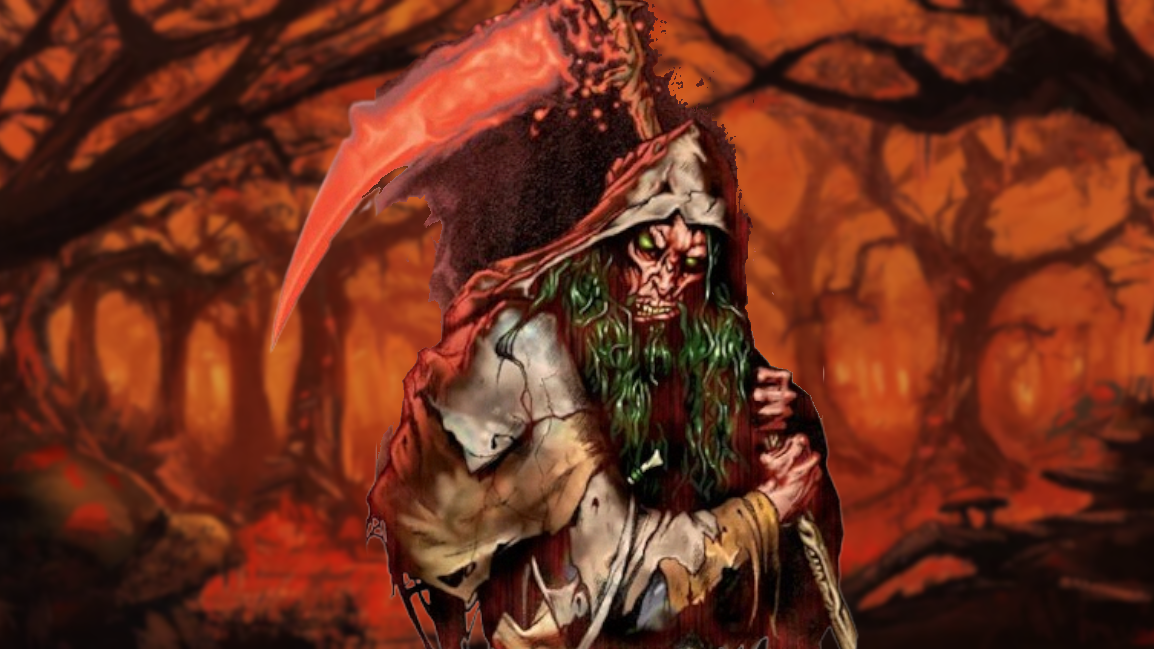
Vorandor is usually depicted as a hunched figure wrapped in worn robes or a hooded cloak. His body commonly bears visible signs of disease or fungal growth.
Some traditions also depict him as a healer. Stories from the Age of Divinity describe Vorandor entering afflicted communities under that guise while worsening or spreading the illnesses he claimed to treat.
Divine Realm
Vorandor resides in the Withered Spire, a remote tower in Othrys within the Gray Wastes.
The Spire remains largely intact, though disease has altered both the structure and the surrounding land. Cracks spread through its stone like lesions, fungal growth gathers along its walls, and nearby vegetation and water show increasing signs of contamination.
Its interior contains laboratories, sealed chambers, cisterns, and vaults used in Vorandor's study of disease and blight. Despite its size, much of the Spire remains sparsely inhabited.
Vorandor maintains little resembling a permanent court. Cultists, captives, infected creatures, and occasional visitors may be found there, but the Gloomfiends of the Gray Wastes are neither his creations nor his subjects.
Some Gloomfiend scholars have nevertheless spent centuries studying outbreaks associated with his presence, using what they learn for their own medical, commercial, or military purposes.
Origins and Divine Role
Vorandor took shape in the generations following Lyrael's death.
Warfare had left many communities vulnerable to disease. Crowded settlements, contaminated supplies, and untreated injuries allowed sickness to spread widely, while part of the divine power left after Lyrael's death began to gather around those conditions.
Existing outbreaks became harder to contain, blights spread farther than expected, and familiar remedies became less reliable.
Some mortals appealed to the presence behind these events in hopes of protection. Others sought its aid in using disease against their enemies. Cults had already formed by the time Vorandor fully emerged.
Traditions from this period frequently describe him posing as a healer while spreading or worsening the illnesses he claimed to treat.
Worship and Practice
Vorandor's worship is hidden across most of Eldareth.
His cults often take advantage of outbreaks to enter frightened or weakened communities. Some pose as healers or caretakers, gaining influence by controlling access to treatment or relief.
Other followers deliberately spread disease, blight, or contamination against those they wish to weaken. Resources that communities depend upon are common targets because the effects can continue long after the initial act.
Vorandor and Yssarel
Vorandor has long stood among Yssarel's greatest enemies.
His blights spread through living places and interfere with their ability to recover. The Creeping Rot became one of the largest examples of this conflict, affecting both inhabited and wild regions until some areas could no longer safely support the life that depended upon them.
Yssarel and her followers opposed its spread wherever they could.
The Scab-Rot Plague
Vorandor later unleashed the Scab-Rot Plague during the conflicts of the Age of Divinity.
The disease spread quickly through vulnerable populations and caused severe physical decay. Ordinary treatment proved largely ineffective, and even powerful healing often struggled to halt its progression.
Banishment
Vorandor fought alongside Malgathar and Lessarith when the Triad came into open conflict with the Celestial Accord.
After their defeat, he was driven into the Gray Wastes and confined beyond the Material Plane.
Vorandor cannot freely return to Eldareth in his full divine form, but his cults remain active and outbreaks associated with his influence still occur.
Teachings
-
Spread disease into places where others believe themselves safe.
-
Corrupt what others depend upon.
-
Use treatment and relief to gain power over those in need.
-
Favor blights and diseases that continue to spread without your intervention.