
Malgathar, the Destroyer
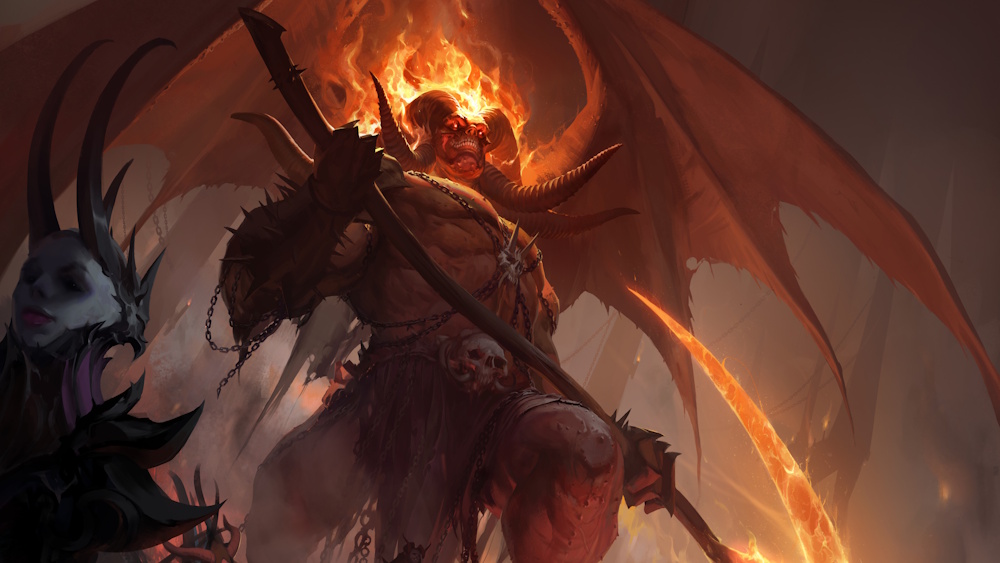
Greater Deity
Domains: War
Malgathar is the god of war, conquest, tyranny, and rule through force. He was the first of the Triad to fully emerge from the divine remnants left after Lyrael's death.
His influence encourages rulers and commanders to rely on force, expand their authority through conquest, and treat obedience as necessary to maintaining power.
Symbol
Malgathar's symbol is a three-pronged crown bound by a heavy chain.
The crown represents authority gained through conquest, while the chain represents obedience and subjugation. A dark red gem is commonly set at its center.
Depictions
Malgathar is usually depicted as an immense horned figure with red skin and blackened armor. Chains are common in his imagery, particularly around his weapons and armor.
Depictions associated with the period after his exile often give him great wings and show fire or ember-like light across his body. Earlier images are less consistent, suggesting that his familiar infernal appearance became established after his conquest of Baator.
Divine Realm
Malgathar rules from Hellfire Keep, a vast fortress built across and into a volcanic plateau in Avernus.
The oldest sections date to the early period following his exile. The fortress expanded as Malgathar established his authority over Baator and became the principal seat of his power within the Nine Hells.
Hellfire Keep contains extensive military infrastructure and foundries that supply weapons, armor, and siege equipment to infernal armies. Its inner halls remain under Malgathar's direct authority.
Zariel governs Avernus as its High Marshal and commands much of Baator's military strength, but Hellfire Keep answers to Malgathar himself.
Origins and Divine Role
Malgathar was not created as part of the Celestial Accord.
After Lyrael's death, some of the divine power left behind remained without a fixed identity. As warfare spread across Eldareth, part of that power gathered around conquest, vengeance, and the desire to rule through strength.
His emergence intensified existing conflicts and encouraged rulers to answer opposition with force. Followers and cults gathered around him before his nature was fully understood, and his influence continued to grow as the Triad moved toward open conflict with the Celestial Accord.
Malgathar's Forge domain is closely tied to war. His worship places particular importance on the making of weapons, armor, fortifications, and other tools used to impose or defend authority.
When the Triad was defeated, Malgathar was cast into Baator. He later conquered much of the plane and reorganized it into the Nine Hells.
Worship and Practice
Across most of Eldareth, worship of Malgathar is forbidden or practiced in secret. His followers commonly gather in concealed shrines or private spaces where their allegiance can remain hidden.
His rites are often associated with preparation for war, oaths of obedience, the forging of weapons, and the formal submission of defeated enemies.
His priests teach that authority weakens when challenges are allowed to spread. Rulers are encouraged to respond quickly to defiance and to maintain enough military strength to hold what they control.
The Nine Hells
After taking control of Baator, Malgathar divided the plane into nine descending circles and established the hierarchy that governs devil society.
He created the Archdevils to rule beneath him, with Asmodeus as the first and highest-ranking among them.
Infernal society is organized around rank and service. Devils may rise through the hierarchy when their usefulness is recognized, while failure or disobedience can result in loss of rank and power.
Mortal souls can also become part of this system, but infernal law requires a recognized claim before a soul can be taken into Baator's service.
Teachings
-
Prepare for conflict before your enemies are ready.
-
Suppress challenges to your authority before they spread.
-
Demand obedience from those under your rule.
-
Hold what you claim only if you have the strength to keep it.