
The Shadowfell
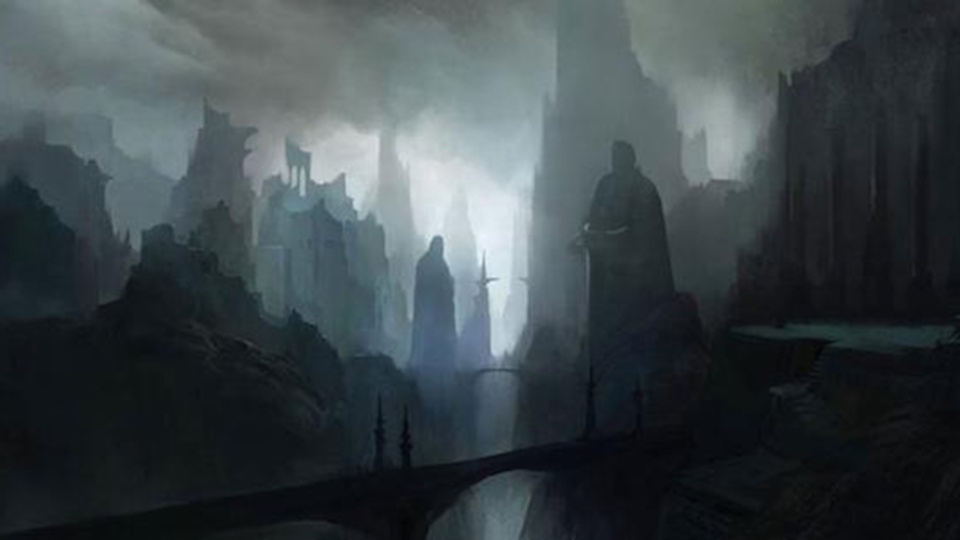
The Shadowfell, also known as the Plane of Shadow, is a planar echo of the Material Plane associated with shadow, absence, concealment, death, and the passage of souls.
It exists alongside Eldareth and preserves the quieter impressions left by places as they change. Old roads, ruined strongholds, abandoned settlements, and other locations that once held lasting significance can remain prominent within the plane long after their Material counterparts have faded or been transformed.
Shadow is a natural part of creation, and the Shadowfell supports living ecosystems, permanent settlements, native creatures, and travelers from other planes.
Athael, goddess of death and fate, resides within the plane. Mortal souls pass briefly into her care after death before continuing to their final destinations among the Outer Planes.
A Shadowed Echo
The Shadowfell reflects the broad geography of Eldareth without reproducing it exactly. Mountains, rivers, forests, coastlines, roads, and settlements often have recognizable counterparts, though individual structures and local details may differ considerably.
Places that leave deep or lasting impressions can persist after Eldareth has changed. A fortress destroyed centuries ago may still stand in partial form, an abandoned road can remain more distinct than a newer route, and an ancient battlefield may continue to dominate the landscape beneath farms and villages that later occupied the same ground.
Older and newer reflections sometimes overlap. A building may contain a room belonging to an earlier structure, while a staircase or road can continue beyond the point where its Material counterpart ends.
These inconsistencies are known collectively as misalignments.
Light and Shadow
Color throughout much of the Shadowfell is subdued, tending toward muted silver, blue, violet, charcoal, and other dark natural tones.
Light functions normally enough for travelers to see, though shadows often appear deeper and broader than expected. They may linger briefly after a source has moved, stretch beneath diffuse light, or allow native creatures to blend almost completely into their surroundings.
In regions where shadow is especially strong, darkness can obscure depth and distance or cling to surfaces despite nearby illumination.
Shadow magic and Negative Energy are separate forces, though necromantic power and shadow can interact under particular circumstances.
The Past in Shadow
The Shadowfell sometimes preserves impressions of events that occurred at corresponding locations in Eldareth.
These afterimages belong to the place itself rather than to the memories or souls of those involved. A traveler might hear fragments of an old conversation, glimpse figures where people died long ago, or watch a room briefly assume an earlier appearance before returning to normal.
Events that profoundly altered a location are more likely to leave such traces, particularly those involving death, sacrifice, betrayal, or disaster.
Afterimages cannot be relied upon as accurate records of history. Important events may leave nothing behind, while seemingly minor moments can persist for reasons no scholar fully understands.
Concealment and Sanctuary
The Shadowfell has long been used for refuge, secrecy, and concealment because reflected structures sometimes contain spaces with no accessible counterpart in Eldareth.
Hidden chambers, archives, sanctuaries, and other protected sites can be established within these reflections and reached only through the plane itself. Entire communities have also settled there to escape dangers or authorities elsewhere.
This property has been used for criminal secrecy, religious protection, political refuge, scholarship, and many other purposes throughout history.
Time
Time within the Shadowfell generally remains close to the passage of time in Eldareth.
Minor discrepancies occur, particularly around unstable crossings or severe misalignments, but large temporal differences are uncommon. Travelers can usually estimate the duration of their absence from Eldareth with reasonable accuracy.
Shadow Crossings
Natural passages between Eldareth and the Shadowfell are known as Shadow Crossings.
They most commonly form where the correspondence between the planes has become particularly strong, often around graveyards, old ruins, abandoned places, or regions associated with prolonged darkness. Death alone does not create a crossing.
A passage may open permanently or only under particular conditions. Many appear without any visible portal, revealing themselves when a traveler moves through a doorway, follows a road beyond its usual end, or crosses a darkened space and emerges into its Shadowfell reflection.
Crossings are not always reversible. A passage may close after entry, leaving travelers dependent on another route home.
The Upheaval disrupted the relationship between Eldareth and the Shadowfell. Many established crossings disappeared, changed destination, or became unreliable, while new weak points emerged in previously stable regions.
Shadow Magic
The Shadowfell is closely associated with arcane magic involving darkness, concealment, movement, and altered space.
These workings continue to use the same Weave present throughout Eldareth, though some practitioners possess an unusual affinity for the properties of shadow and the relationship between the Material Plane and its echo.
Shadow Sorcerers are among the clearest examples, using this affinity to manipulate darkness, conceal themselves, and exploit the boundary between the two planes. Such abilities are treated as a natural expression of shadow magic.
Death and the Passage of Souls
The Shadowfell plays a central role in the journey that follows mortal death.
When a soul leaves its body and is free to continue onward, it passes into Athael's care. Her ravens carry the departed to the Quiet Court, where the soul is brought before her within the Hall of Nine Roads.
For most souls, this process is nearly immediate. Athael perceives what mortal life has made of the soul and determines the Outer Plane with which it has become aligned, after which the same raven usually carries it onward.
Ghosts and stranded spirits arise when this passage is interrupted. Necromantic bindings, curses, magical imprisonment, and other supernatural interference can prevent a soul from reaching Athael or continuing beyond her realm.
Her faith regards deliberate interference with this passage as a serious violation.
The Quiet Court
Athael's divine realm, the Quiet Court, stands beside the River Mnemosyne within one of the most stable regions of the Shadowfell.
The realm is a broad funerary complex of dark stone, quiet courtyards, gardens, covered walks, and still water. Its restrained architecture is shaped around mourning, remembrance, and passage.
Ravens gather throughout the grounds and remain almost constantly in flight above Mnemosyne. Each arriving bird carries a faint point of light in its talons, the soul of the dead, whose reflection moves across the river below like a distant star.
At the heart of the Court stands the Hall of Nine Roads, named for the nine Outer Planes that receive mortal souls. Athael perceives the life that shaped each soul without testimony or formal trial, and most of the dead remain there only briefly before continuing onward.
Living visitors occasionally reach the Quiet Court. Priests, supernatural envoys, petitioners, and those seeking the return of a soul may be permitted to approach Athael, though access to the realm offers no assurance that their request will be granted.
River Mnemosyne
Mnemosyne flows through the lands surrounding the Quiet Court, its dark and highly reflective waters often mirroring the ravens and soul-lights passing overhead.
No living explorer has reliably traced its full course. Funerary traditions commonly associate the river with the passage of the dead, while Athael's ravens carry those souls into her keeping.
The river also holds strong associations with remembrance. Death ends mortal life without erasing the identity of the soul.
Gloomwrought
Gloomwrought is the largest known city within the Shadowfell and one of its most important permanent settlements.
The city has developed a history and identity independent of its Material reflection, drawing long-established residents alongside travelers, scholars, merchants, priests, and others who have chosen to remain.
People whose communities have lived within Gloomwrought and nearby settlements for generations are commonly known as Shadovar. The term describes a culture rather than a species, encompassing many peoples who have made permanent lives within the plane.
Generations of experience have given Shadovar communities extensive knowledge of misalignments, crossings, reflected history, and the practical demands of Shadowfell travel.
Gloomwrought is also an important center for planar commerce, funerary scholarship, shadow magic, and the preservation of hidden knowledge. Its streets and buildings are unusually stable, though old doorways can reappear and structures sometimes develop passages corresponding to earlier reflections.
The Keepers
The Keepers are mysterious inhabitants associated with Gloomwrought since before its reliable recorded history.
They maintain parts of the city without holding formal political authority, appearing when dangerous misalignments or structural changes require intervention. Their work may involve sealing unstable routes, restoring older passages, or altering buildings for purposes they rarely explain.
No widely accepted account explains their origin or continued presence. The people of Gloomwrought generally regard them as an enduring part of the city.
The House of Black Lanterns
The House of Black Lanterns is one of the best-known refuges for travelers in the Shadowfell.
It serves as an inn, sanctuary, and meeting place while appearing along several established routes without occupying a single reliably mapped location. Travelers who encounter it in distant regions consistently describe the same interior.
The House is particularly valued by those stranded after a crossing closes or a familiar route becomes misaligned. Old customs govern its hospitality, including a prohibition against violence within its walls that even hostile travelers generally respect.
Its origin, movement, and the means by which its doors reach distant locations remain unknown.
The Labyrinth
The Labyrinth is a broad region where older and newer reflections overlap so frequently that ordinary terrain becomes difficult to interpret.
A road from a vanished settlement may intersect the reflection of a modern one, while the ruined portion of an older building can stand beside the structure that replaced it. Afterimages of past events are also more common there than in most other regions.
Historians and explorers travel into the Labyrinth seeking structures or evidence long lost from Eldareth, though expeditions often return with incomplete or contradictory findings.
Some of the Shadowfell's most carefully hidden vaults and sanctuaries have been constructed within these overlapping reflections.
The Darklands
Darklands are regions where the Shadowfell's own nature predominates and its correspondence with Eldareth becomes weaker.
Shadow grows deeper and more substantial, native flora and fauna become increasingly common, and familiar Material landmarks lose much of their usefulness. Light continues to function, though distance and depth can become difficult to judge.
Several major Darklands are known, but their borders are often gradual or difficult to define.
Skotos
Skotos is one of the best-known Darklands, dominated by an immense living forest.
Tall pale trunks rise beneath canopies of charcoal, silver, blue, and nearly black foliage, while luminous fungi grow around ancient roots. Enormous beacon moths occasionally pass between the trees and illuminate large stretches of woodland.
Ecalypse herds move through open glades and broad valleys, while shadow mastiffs and other native predators hunt beneath the canopy.
Deeper regions correspond less clearly to any single forest in Eldareth, and some appear to preserve relationships with several different Material woodlands at once.
Skotos is a healthy native Shadowfell ecosystem shaped by deep shadow and its own long-established life.
Cimmeria
Cimmeria is a vast Darkland of dim heaths, low mountains, sparse woodland, dark lakes, and broad open horizons.
Natural light remains weak even by Shadowfell standards, yet the region supports abundant plant and animal life adapted to its subdued conditions. Settlements are often separated by considerable distances.
Travelers commonly use mountain silhouettes and waterways for orientation because roads can become difficult to distinguish from the surrounding terrain.
Cimmeria has become a favored region for isolated monasteries, hidden communities, observatories, and others seeking distance from both Gloomwrought and Eldareth.
Inhabitants
The Shadowfell supports native ecosystems alongside communities descended from visitors who settled there.
Shadow mastiffs are among its better-known predators, hunting in packs and disappearing almost completely within deep shade. Ecalypses move through open regions in herds and are sometimes trained as mounts, while enormous beacon moths produce a soft natural illumination as they travel through forests and Darklands.
Many other creatures and plants have adapted to dim light, deep shadow, and the unusual conditions of the plane. Ordinary animals may also develop pale coloration, remarkable camouflage, or minor shadow-related traits over generations.
These ecosystems arise from the native properties of the Shadowfell rather than from Negative Energy.
The Dead
Incorporeal undead occur throughout parts of the Shadowfell when the normal passage of souls has been disrupted.
Ghosts often arise when a soul cannot reach Athael, while more severely damaged or magically altered souls may become specters, wraiths, or similar entities. Shadows can also form in regions affected by unusual shadow magic.
Corporeal undead may enter or be created within the plane through necromancy and other supernatural processes. Many forms of undeath are sustained by powers associated with Negative Energy, which remains distinct from the native shadow ecology of the Shadowfell.
Sorrowsworn
Sorrowsworn appear where extreme suffering has left a lasting distortion within the Shadowfell.
Powerful emotional residue can remain within a place after the people involved have died or moved on. When grief, rage, despair, or similar suffering accumulates strongly enough, it can eventually develop into something independent.
Sorrowsworn are among the most dangerous results and are most commonly encountered around places marked by prolonged misery or mass suffering.
The phenomenon is related to the Shadowfell's ability to preserve impressions of the past, though most afterimages never develop into living entities.
Natural Hazards
The Shadowfell supports mortal life, but misalignment can make travel difficult even in otherwise familiar regions. Roads may no longer connect the same places, buildings can develop unexpected passages, and older maps become increasingly unreliable where the plane's own geography is stronger.
Darklands present the greatest navigational challenges because Material landmarks gradually disappear from use. Limited light and deep shadow can further complicate travel, especially across unfamiliar wilderness.
Cold is common throughout the plane, usually as a persistent discomfort rather than an immediate threat. Long periods of isolation can also leave visitors quieter or more withdrawn, an effect that generally fades after leaving the Shadowfell.
Travel and Survival
Air, water, edible plants, and living animals are available throughout much of the Shadowfell, and permanent settlements maintain the resources required for long-term habitation.
Travelers entering the wilderness commonly carry their own supplies and rely heavily on local guides when dealing with misalignments, unstable crossings, or Darklands. Material maps remain useful for broad orientation where the reflection is strong, but local knowledge becomes increasingly important elsewhere.
Experienced travelers also pay attention to the age of places. An older road or abandoned structure may possess a stronger and more reliable reflection than something built recently in Eldareth.
Treating the Shadowfell as an environment with its own geography, ecology, and history is essential for reliable travel through it.