
The Feywild
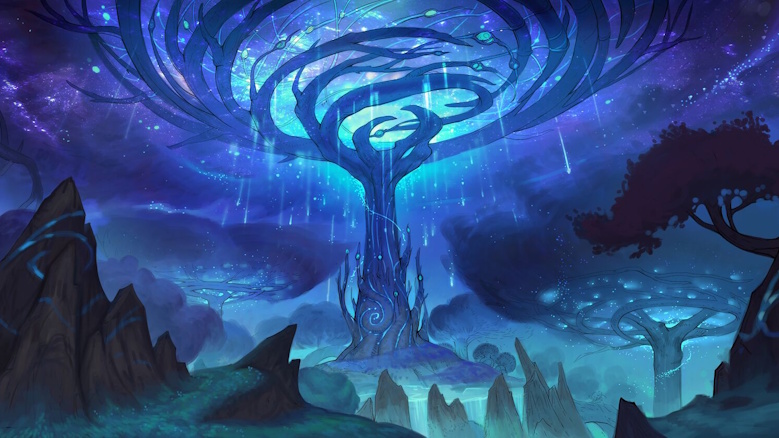
The Feywild, also known as the Plane of Faerie, is a planar echo of the Material Plane shaped by abundant life, fey magic, strong emotion, and constant change.
It exists alongside Eldareth and reflects much of the same underlying world, though the resemblance is rarely exact. Natural features often become more pronounced or significant, while places defined primarily by mortal construction may leave only a faint impression. A modest grove or spring in Eldareth can correspond to a region of great importance within the Feywild.
The Feywild is the ancestral homeland of Elves, Goblins, Changelings, and Faun, along with many peoples and creatures that remain within the plane. Its communities and wildernesses preserve histories stretching back to the earliest ages of creation.
A Living Echo
The Feywild reflects Eldareth through broad relationships between places. Major mountain ranges, rivers, forests, lakes, and coastlines often have recognizable counterparts, though their scale and character can differ dramatically.
Distance within that geography is less dependable. A path that required two days on one journey may take only an afternoon when followed again, while a nearby hill can remain distant for hours despite appearing close. Roads and borders remain meaningful, but their practical measurements can change with local conditions.
Centuries of fey influence complicate the resemblance further. Powerful Archfey can leave lasting marks upon their territories, and some regions have changed so extensively that their Material counterparts are difficult to recognize.
Life, Anima, and Magic
Life grows readily throughout the Feywild. Forests can reach extraordinary scale, ancient animals may grow far beyond their Material counterparts, and plants or creatures sometimes develop magical traits rarely seen in Eldareth. Particularly old beasts may become unusually intelligent or maintain relationships with nearby communities across generations.
This abundance is closely connected to anima, the living essence that first arose from Aether at the beginning of creation. As anima returns to the greater cycle of life, much of it passes through the Feywild's living systems before continuing into the wider flow of creation. It carries vitality without preserving the memories or identity of those who once held it.
Ancient trees and other great living structures play an important role in this circulation. Their roots can extend across immense areas, gathering and redistributing anima while helping regulate concentrations of magic throughout the surrounding land.
In rare circumstances, certain ancient trees condense excess anima into seed-like vessels that can remain dormant for long periods. These reserves may later restore damaged groves, strengthen weakened land, or aid the recovery of powerful fey.
The plane's abundance of anima also contributes to its magical character. Arcane effects occur naturally within the environment, and areas of exceptional concentration can strengthen, prolong, or alter magic in ways that are difficult to predict. Living environments, transformation, illusion, and enchantment are especially common expressions of this ambient magic.
Emotion and the Environment
The Feywild is unusually responsive to emotion, though the effect is generally subtle around ordinary individuals. Strong happiness may bring warmer light or greater animal activity, while fear can draw fog into a clearing or leave nearby woodland unnaturally quiet.
The influence becomes more pronounced when many people share the same emotional state over long periods. A settlement shaped by years of grief, celebration, fear, or resentment may gradually alter the character of the surrounding land.
Archfey can affect entire territories in this way, reinforcing local seasons, weather, vegetation, and magical conditions across generations. These influences work through the existing ecology of the plane, shaping its character without wholly overriding its natural processes.
Time
Time feels ordinary to those within the Feywild, but the plane does not remain perfectly synchronized with Eldareth.
Many journeys produce little noticeable difference. During others, a traveler may spend several days in the Feywild and return to discover that weeks, months, or years have passed on the Material Plane. When a significant discrepancy develops, Eldareth usually advances farther.
No reliable ratio exists between the two. Long stays, powerful Archfey domains, unstable passages, and areas of strong planar influence appear more likely to produce larger differences, but none allow the outcome to be predicted with confidence.
These discrepancies have affected Feywild history as well as individual travelers. During the earliest ages, conflicts that began during the Dawn War continued to unfold within the Feywild while Eldareth had already begun to recover.
Those without strong ties to the plane may also find parts of a long visit difficult to remember after returning home. Written records and objects carried between the planes can help preserve details that might otherwise grow unclear.
Fey Crossings
Fey Crossings are places where the boundary between Eldareth and the Feywild becomes thin enough to pass through.
They often form around old natural features or places where the relationship between corresponding locations is unusually strong. A crossing may appear as an obvious portal, but many are encountered simply by following a path, passing beneath an ancient arch, or moving through water until the surrounding landscape begins to change.
Many crossings function only under particular conditions tied to season, weather, moonlight, ritual, or local custom. Some are also watched by nearby fey communities or other guardians, making permission as important as knowing the location itself.
The Upheaval disrupted the relationship between the two planes. Many established crossings collapsed, began opening irregularly, or changed where they emerged, while new weak points appeared in previously stable regions.
Old maps of Fey Crossings are therefore no longer fully reliable.
Oaths, Gifts, and Agreements
Promises carry considerable weight in many fey cultures. Casual speech does not automatically become binding, but an oath deliberately sworn, a bargain knowingly accepted, or an exchange made under recognized custom can acquire real force.
Certain ancient places are traditionally used as witnesses to important agreements, and oaths made there may remain remembered long after those who spoke them are gone. Gifts and hospitality can carry similar obligations when offered or accepted under formal circumstances.
These customs vary between communities, and outsiders often create problems by assuming that all fey follow the same rules.
Names also hold significance within many traditions. Formal titles, chosen names, and true names can matter in particular forms of magic or agreement, though introducing oneself does not by itself surrender supernatural authority.
Many customs preserved among the elves of Alven'Nathiss descend from these older practices. On Ael'delar, important oaths and public agreements are still witnessed and preserved with unusual care, with Syl'dareth holding particular significance in these traditions.
The Fey Courts
The Feywild has never belonged to a single ruler.
Two great political traditions hold influence across much of the plane: the Seelie Court and the Unseelie Court. Beyond them are the Courtless, encompassing independent Archfey, communities, and territories that recognize neither hierarchy.
Court allegiance is political rather than moral. Seelie powers generally maintain more stable relationships with mortal peoples and neighboring communities, while Unseelie territories have a stronger reputation for danger and predation. Individuals and lesser courts vary considerably within both traditions.
Many smaller courts exist within these broader relationships, while large stretches of wilderness recognize no court at all.
Áine and the Seelie Court
Áine is the recognized Queen of the Seelie Court and one of the most influential Archfey in the plane.
Her authority is strongest among fey associated with summer, flourishing life, established communities, and formal court traditions. Numerous Archfey and lesser rulers acknowledge her position while retaining considerable authority over their own territories.
The Seelie Court is not politically uniform. Its nobles compete for influence, dispute borders and obligations, and have fought among themselves during periods of instability.
Beira, the Winter Queen
Beira is one of the greatest powers associated with the Seelie Court.
Her domain expresses winter through dormancy, preservation, and recovery. Great forests stand beneath deep blue and violet light, with luminous growth beneath immense canopies and still pools among ancient roots. Frost and snow occur throughout the region, though much of the land remains green and intensely alive.
Growth slows within Beira's territory as plants and animals conserve their strength, and damaged groves are sometimes brought there to recover.
Lerathae has long been treated with particular respect within parts of Beira's domain. Traditions surrounding moonlight, guidance, prophecy, and the changing night were already established among some of the ancient elven communities that once lived there.
Mab and the Unseelie Court
Mab, the Queen of Air and Darkness, rules the Unseelie Court.
Her influence is associated with night, secrecy, violent weather, dangerous magic, and predatory fey traditions. Many hostile powers have served or bargained with her, though the Unseelie Court contains peoples and motives far more varied than its reputation alone suggests.
Mab and Áine have opposed one another repeatedly across Feywild history, drawing lesser Archfey into conflicts that displaced communities and altered borders across wide regions.
Other Archfey
Several other Archfey hold influence comparable to rulers of mortal kingdoms.
Herne, the Green Lord, is associated with untamed wilderness, beasts, hunting, and migration, and is closely tied to the Wild Hunt. Midir is associated with ancient groves, great trees, stewardship, and forms of living magic rooted in long relationships between communities and the land. His history is especially important to the Sera'drin and Ilyr'dor.
Olwen is associated with spring and new beginnings, while Edern, Lord of Autumn, presides over harvest, migration, preparation, and seasonal decline.
Among the Courtless, Hyrsam is associated with revelry, music, satire, and personal freedom. Niamh is closely connected to crossings and the strange routes linking distant places, while Nicnevin is an ancient hag whose knowledge commands caution from both great courts. Melusine holds considerable influence over rivers, lakes, springs, and the fey communities surrounding them.
These are only the most widely known powers. Numerous other Archfey rule smaller territories or remain outside the politics of the great courts.
Feonar and the Feywild
Feonar holds no place within the hierarchy of the Fey Courts, but he is encountered in the Feywild more often than most gods.
Stories place him among Archfey and travelers, particularly around unusual crossings or journeys whose course changes unexpectedly. He is often associated with opportunities that appear after an original plan has failed.
Some Archfey regard him as an old friend, while others find his presence far less welcome.
Isyl'norin
Isyl'norin, the Lake of Sorrows, is one of the most important known sites in the Feywild.
Magic gathers strongly beneath its waters and throughout the surrounding land. At the lake's center stands Ilyr'dor, the Heartwood Tree, one of the great living structures through which anima and magic move across the plane.
Ilyr'dor regulates the extraordinary concentration beneath Isyl'norin through its roots and surrounding ecosystem, distributing accumulated power through the land and deeper rootways. This made the region valuable enough to be contested repeatedly throughout Feywild history.
In the centuries following the earliest conflicts, Seelie forces reclaimed Isyl'norin from Mab's influence. Áine entrusted its defense to a community of elves who settled around Ilyr'dor and gradually became its principal guardians.
Generations of study followed as these elves observed the magical currents surrounding the tree and lake, compared techniques, and learned how arcane workings could be reproduced deliberately and taught. From this work developed the earliest elven traditions of wizardry.
Their growing reputation and independence eventually created tension with parts of the Seelie nobility. When renewed conflict among the Archfey threatened Isyl'norin, Midir helped those who chose to leave open a passage into Eldareth. Their descendants became the Sera'drin, the Sun Elves.
The passage brought them to Ael'delar beneath Syl'dareth, a great tree whose unusual connection to Ilyr'dor remains the subject of elven study. Some scholars believe Syl'dareth may share the same living magical lineage, though no explanation has been universally accepted.
Vael'dareth and Falha'neir
Long before the Sera'drin left the Feywild, two other elven communities lived within the wider lands associated with Beira.
Vael'dareth, the Moonlit Grove, was home to the ancestors of the Vaela'drin, the Moon Elves. It lay among silvered forests, clear pools, and open glades where moonlight passed easily through the canopy.
Falha'neir, the Midnight Glade, was home to the ancestors of the Falha'drin, the Shadow Elves. It stood farther into the contested reaches, where denser woodland left much of the land beneath prolonged twilight.
Both communities were caught in conflicts spreading through the young Feywild during the Dawn War. As borders shifted and routes became difficult to hold, Lerathae guided their inhabitants toward a passage into Eldareth.
Vael'dareth survived the departure, and Beira's followers preserved much of the settlement until later fey communities returned to the surrounding woodland. Many elven structures and sacred sites remain there.
Falha'neir suffered greater destruction during the fighting. The territory was eventually reclaimed, but the old settlement was only partially preserved, leaving foundations, paths, and other remnants throughout a forest that has long since developed a different character.
Fómhar
Fómhar is a broad region associated with Edern and the autumnal cycle of the Feywild.
Its forests carry red, gold, brown, and deep green through orchards, wetlands, open fields, and fungal woodland. Animal migrations pass through the region in great numbers as communities gather and preserve food ahead of the colder season.
Decay is a visible part of the same cycle. Fallen fruit, dead leaves, wood, and other organic matter are broken down and returned to the soil, providing the conditions from which later growth emerges.
Fómhar reflects the Feywild's broader cycle of renewal, where endings within a healthy ecosystem continue to sustain what follows.
The Feydark
Beneath the forests and hills of the Feywild lies the Feydark, an immense subterranean region of caverns, buried waterways, ancient roots, fungal forests, and settled communities. It is an integral part of the same living plane as the lands above.
Roots from ancient trees descend for great distances through the stone, sometimes forming bridges, walls, or entire habitats around themselves. Luminous fungi, underground lakes, insects, mosses, and other adapted life support ecosystems that never experience the open sky.
Anima continues to circulate through these depths as roots and enormous fungal networks break down dead matter and redistribute its vitality through the subterranean environment.
Myconid communities occupy many fungal regions and have developed societies around the immense living networks they tend, independent of the Fey Courts.
Fomorians are another major power of the Feydark. Their kingdoms extend through natural caverns connected by fortified routes and cultivated subterranean regions, and they have fought Seelie, Unseelie, and Courtless powers over important rootways and magically rich territory.
Bres, one of the most prominent fomorian rulers, holds authority within the Deep Court, though no single kingdom controls the entire Feydark.
Inhabitants
The Feywild contains an enormous range of peoples, spirits, magical animals, and other creatures.
The Ela'drin, the Faeborne Elves, descend from communities that remained in the Feywild when the Vaela'drin, Falha'drin, and later Sera'drin departed. Their seasonal physiology, customs, and magic reflect their long association with the plane and its courts. Significant numbers have only begun settling permanently in Eldareth within the last several generations, while large populations remain across Seelie, Unseelie, and Courtless territories.
Goblins also originated within the Feywild. The ancestors of Eldareth's Goblins departed long ago and eventually developed the Murrkin and Giznat traditions, while communities that remained became the people commonly known as Brownies.
Faun, also called satyrs, likewise trace their ancestry to the Feywild and remain widespread there. Hybsils are especially common in older wilderness associated with Herne. Changelings descend from Courtless communities where altering one's physical appearance was accepted as an ordinary part of life.
Dryads and other spirits inhabit living places throughout the plane, while hags maintain covens or solitary territories according to their own alliances. Luminous wisps are also common, many of them the continuing spirits of Fey who once lived in embodied form.
Pixies, sprites, redcaps, boggles, quicklings, meenlocks, blink dogs, displacer beasts, faerie dragons, wood woads, yeth hounds, and many other creatures inhabit particular regions of the plane. Their behavior varies significantly between territories and communities.
Fey Death and Renewal
Fey possess a particularly close relationship with the Feywild.
When an embodied Fey dies, its anima returns to the wider cycle of life while its soul returns directly to the plane. These souls persist as individual Fey spirits, commonly appearing as luminous wisps or as spectral reflections of the forms they once possessed.
Fey spirits can remain distinct for immense spans of time, and some gradually form stronger associations with particular places, traditions, seasons, or other aspects of the plane. Others eventually choose to merge with the Feywild itself.
Archfey possess a deeper connection to their domains and can recover from bodily destruction by eventually forming a new living embodiment. Their identity remains with the returning soul, while anima-rich places and the rare seeds formed by ancient trees can provide the living essence needed for recovery.
Permanently destroying an Archfey therefore usually requires more than destroying its current physical form.
Natural Hazards
The Feywild readily supports mortal life, but travel remains unpredictable. Shifting distance can make familiar routes unreliable, while irregular time can leave travelers returning to Eldareth far later than expected.
Many plants, foods, waters, and other apparently ordinary parts of the environment possess magical properties unfamiliar to outsiders. Fey agreements create a different kind of risk, since bargains, gifts, or formal hospitality may carry obligations a visitor does not recognize.
The plane also contains powerful predators and extensive wilderness, including regions where intelligent or magical creatures have little interest in peaceful interaction.
Travel and Survival
Food, water, breathable air, and natural shelter are widely available, leaving navigation and local knowledge as the greater concerns for most travelers.
Fey guides are particularly valuable because they often know routes that cannot be reconstructed from ordinary maps or that function only under specific conditions. Travelers also benefit from keeping careful records, learning local customs before entering agreements, and understanding whose territory they are crossing.
Healthy Feywild environments can still be dangerous. A thriving forest, court, winter grove, or fungal cavern may be functioning exactly as it should while remaining hazardous or indifferent to unfamiliar visitors.