
The Nine Hells
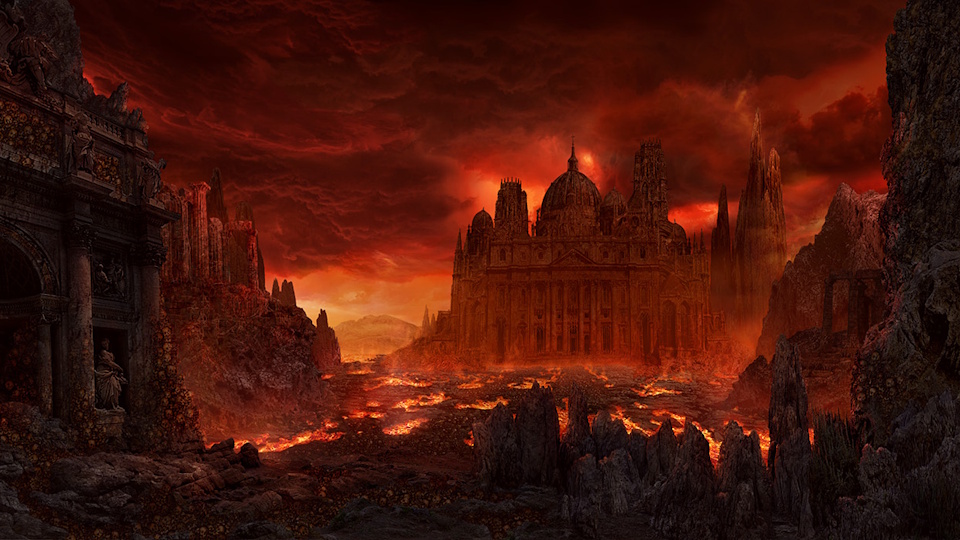
The Nine Hells of Baator form the Lawful Evil plane among the Outer Planes and are the principal home of devils. Ruled by Malgathar the Destroyer, Baator is divided into nine descending circles: Avernus, Dis, Minauros, Phlegethos, Stygia, Malbolge, Maladomini, Cania, and Nessus. Each has its own character and government while remaining part of the infernal hierarchy beneath him.
Infernal society is highly ordered. Every devil holds a recognized rank, and advancement depends on usefulness, influence, and success within the system. Rivalry is constant, but infernal law determines how authority can be gained, challenged, and exercised.
Before the Nine Hells
Baator existed long before Malgathar was confined there. Ao created the plane as part of the original structure of the Outer Planes, and native peoples had already established settlements and other works before the Destroyer's arrival. Among these earlier inhabitants were beings now called the Ancient Baatorians, though few are known to survive.
Different powers controlled parts of the plane without any authority ruling Baator as a whole. After the Last War of the Gods, Malgathar was driven from Eldareth and confined there. He began conquering the territories around him, gradually bringing them under a common system of roads, controlled passages, settlements, and fortified strongholds. These territories eventually became the nine circles known today.
Older structures still survive beneath or beyond later infernal construction, preserving remnants of Baator before Malgathar's conquest.
The Infernal Order
Malgathar created several of the earliest Archdevils while his control over Baator was still being established. They served as commanders and officials during his expansion, later receiving authority over territories suited to their abilities.
Other Archdevils reached the rank through different paths. Some descend from older infernal lineages, while others rose through the hierarchy by accumulating power and influence. Archdevilhood is therefore an office that can be granted, inherited, or earned. Baalzebul, ruler of Maladomini, is one of the best-known examples of a devil who rose to the position.
Control of a circle is never completely secure. Catastrophic failure can result in the loss of authority, imprisonment, demotion, or replacement.
Asmodeus stands at the highest point of this system beneath Malgathar. From Nessus, he coordinates much of Baator's government and exercises authority over the other circle rulers on Malgathar's behalf.
Devils and Fallen Celestials
Devils are infernal beings native to Baator. Fallen celestials retain their celestial origin even after long service to the Hells, though prolonged exposure to Baator may alter them considerably.
Such beings can hold infernal offices and serve Baator's rulers. Zariel, High Marshal of Avernus, is the most prominent example, holding authority comparable to the Archdevils who govern the deeper circles.
Rank and Advancement
Every devil occupies a recognized position within the infernal hierarchy. Advancement comes through service, influence, and success, with higher rank bringing greater authority and access to more important roles.
Major promotions may also reshape a devil physically. Infernal rites and powerful magic can transform a promoted devil into a stronger form suited to its new position, while severe demotion can strip away power and reduce it to a lesser state. These transformations are part of infernal advancement and have no bearing on the original nature of devilkind.
Infernal Law and Contracts
Infernal law defines the rights, obligations, and claims recognized throughout Baator. Contracts allow those rules to extend beyond the Hells, letting devils exchange assistance or resources for service, property, information, or a recognized claim upon a mortal soul.
The wording of an agreement matters. Devils routinely interpret contracts in their own favor, but a properly formed agreement can bind the infernal party as firmly as the mortal one.
A soul may reach Baator through judgment without any infernal power holding a legal claim over it. Such claims are governed separately under infernal law.
Travel Between the Circles
Most travelers entering Baator through established planar routes arrive in Avernus. Reaching the deeper circles usually requires following controlled routes from one layer to the next, with infernal authorities regulating passage and often demanding approval or payment.
The River Styx crosses Avernus and Stygia and provides another important route through the plane. Its course also connects Baator to parts of the other Lower Planes.
Avernus
Avernus is the first circle of Baator and its principal military region. Rocky badlands and volcanic terrain stretch beneath a dark, smoke-filled sky, with old battlefields scattered across regions still dangerous from unstable ground and lingering fires.
The circle has been heavily fortified. Military roads connect its major garrisons and strongholds, and the principal approaches to the deeper Hells remain closely guarded. Even during long periods of relative peace, Avernus maintains trained armies and large reserves for future campaigns.
Older ruins survive beyond the main military routes, including structures from before Malgathar's conquest and remains from the wars that followed his exile.
Zariel, High Marshal of Avernus
Avernus is governed on Malgathar's behalf by Zariel, a fallen celestial and ancient military commander. She fought against Malgathar during the Last War of the Gods and pursued him into Baator after his exile, believing that confinement would not end the threat he posed. The campaign continued after the war on Eldareth had ended and eventually led to her fall.
Malgathar later granted her command over Avernus and its armies. Her authority within the circle is comparable to that of the Archdevils governing the deeper Hells, and she remains directly involved in the readiness and defense of Baator's military forces.
The High Redoubt
The High Redoubt is Zariel's mobile command fortress. It can relocate across Avernus and is usually positioned near regions of military importance, allowing Zariel to oversee deployments and respond quickly to threats.
The fortress carries the staff, defenses, and support needed to function as a mobile military headquarters. It is sometimes referred to informally as Zariel's Redoubt.
Avernian Reavers
Avernian Reavers are enormous siege walkers built for the infernal armies. Rare and expensive, they are reserved for major assaults against heavily defended positions and large military exercises.
Their construction combines Avernian engineering with advanced magical systems developed elsewhere in Baator, particularly Cania.
Hellfire Keep
Hellfire Keep is the divine realm of Malgathar and one of the oldest major infernal strongholds in Baator. The fortress occupies a vast volcanic plateau and has expanded repeatedly since he first established his power within the plane.
Its defenses and foundries support the infernal armies, producing weapons, armor, and specialized war equipment. The deeper halls remain reserved for Malgathar and those summoned before him.
Malgathar may leave Hellfire Keep and travel freely throughout Baator.
Dis
Dis is the second circle and the domain of Dispater. Dark mountains and steep canyons dominate much of the landscape, crossed by heavily controlled roads that become increasingly secure toward the circle's center.
There stands the Iron City of Dis, the largest urban center in Baator. Blackened iron and dark stone dominate its construction, and parts of the city remain hot enough to injure unprotected visitors.
Dis is also one of the main places where approved outsiders can conduct business within the Hells, though all such activity takes place under close scrutiny.
Dispater and Internal Security
Dispater is one of Malgathar's oldest Archdevils and oversees much of Baator's internal security and counterintelligence. His agents investigate threats to infernal institutions and monitor suspicious activity throughout the hierarchy, including the movements of important visitors.
Dispater rarely relies on a single source. His surveillance networks overlap, and sensitive districts regularly alter their security procedures, making Dis one of the most closely controlled circles in Baator.
The Iron Tower
The Iron Tower rises above the central districts of the Iron City and serves as Dispater's principal seat. Much of the circle's most sensitive intelligence passes through it, while secure prisons beneath the surrounding districts hold prisoners whose information or future usefulness makes execution undesirable.
Minauros
Minauros is the third circle and the domain of Mammon. Polluted marshland covers much of the region, with unstable ground and deep mud making travel difficult outside the rocky routes that cross the mire.
The circle is the financial center of the Nine Hells. Its major settlements manage much of Baator's wealth, debt, and ownership, giving Mammon considerable influence over the resources on which other powers depend.
The Sinking City
The city of Minauros stands upon ground increasingly unable to support its size. Streets and foundations sink steadily into the marsh, requiring constant reinforcement while districts that can no longer be saved are stripped for usable material.
Older levels remain buried beneath the modern streets, leaving forgotten vaults and abandoned structures below the inhabited city. Mammon continues to maintain Minauros because so much of Baator's financial power is concentrated there.
Jangling Hiter
Jangling Hiter, the City of Chains, hangs above one of the deepest regions of the marsh, suspended from enormous chains anchored into the surrounding rock and fortifications.
Infernal authorities use the city to hold people or property while claims remain unresolved. Chain devils are especially common within its administration and security forces.
Phlegethos
Phlegethos is the fourth circle and the shared domain of Belial and his daughter Fierna. Volcanic activity dominates the landscape, making much of the region dangerous through intense heat, unstable ground, and frequent eruptions.
The circle also contains some of Baator's most important courts, particularly for disputes involving powerful infernal interests. Its cities support a substantial culture of regulated entertainment and indulgence operating under infernal law.
Belial and Fierna
Belial is one of Malgathar's older Archdevils and has extensive experience in infernal politics, law, punishment, and negotiation. Fierna is particularly skilled at understanding desire and using it to influence others.
They govern Phlegethos together despite differences between their interests and supporters, maintaining an arrangement that continues to serve them both.
Abriymoch
Abriymoch is the principal city of Phlegethos, built within an immense volcanic caldera. Its districts climb the surrounding walls while bridges and passages connect them across the interior.
Government buildings and residences occupy the more stable upper levels, while lower districts descend toward hotter industrial and military areas. Some of Baator's most serious legal sentences are issued in Abriymoch before being carried out elsewhere.
Stygia
Stygia is the fifth circle and the domain of Levistus. Much of the region consists of a black ocean sealed beneath vast sheets of ice, broken by frozen coastlines and unstable ice fields beneath a storm-heavy sky.
The River Styx remains open along much of its course and provides one of the few dependable waterways through the modern circle.
Older records describe a much more navigable sea with active ports along its shores. The present freeze dates to Malgathar's punishment of Levistus following a major betrayal, leaving many earlier settlements and routes preserved beneath the ice.
Levistus
Levistus is one of Malgathar's oldest Archdevils and is closely associated with intelligence, infiltration, manipulation, and betrayal.
Malgathar imprisoned him within the ice while allowing him to retain authority over Stygia. Levistus therefore governs through servants and intelligence networks, many of which remain active beyond Baator where secrecy is especially useful.
He is also closely associated with bargains offered to those who are desperate or trapped.
Tantlin
Tantlin is the principal city of modern Stygia. The settlement predates the freezing and once served as an important port on the open sea. Its former waterfront now faces the frozen expanse, while access to the nearby Styx keeps the city connected to wider trade and travel.
Merchants, agents, brokers, and travelers from beyond Stygia regularly pass through Tantlin, where surveillance is common.
Cold Fire
Lightning strikes in Stygia occasionally produce pale flames known as cold fire. These flames draw heat from their surroundings, causing frost and ice to spread around whatever they touch.
Cold fire usually burns only briefly but can be exceptionally dangerous in enclosed spaces.
Malbolge
Malbolge is the sixth circle and the domain of Glasya. Steep black mountains and unstable slopes dominate the region, with rockfalls and avalanches frequently damaging roads and settlements.
Permanent communities survive where the terrain offers protection or where extensive reinforcement has made habitation possible. The circle also serves as Baator's principal penal region, with numerous fortresses used to hold serious offenders and other valuable prisoners.
Glasya
Glasya is the daughter of Asmodeus and an Archdevil in her own right. She is known for her political ambition and her ability to identify weaknesses in infernal law and procedure, skills that also shape her administration of Malbolge.
The circle was previously governed by Moloch, one of Malgathar's early Archdevils, before control passed to Glasya.
Osseia
Osseia is Glasya's principal fortress and seat of power, built directly into one of Malbolge's great mountain formations.
Its lower sections contain extensive prisons designed for inmates of different kinds and threat levels, while Glasya's court and political chambers occupy the upper portions of the fortress.
Maladomini
Maladomini is the seventh circle and the domain of Baalzebul. Abandoned construction covers much of the landscape, where ruined settlements and unfinished public works mark centuries of repeated redevelopment.
Baalzebul frequently orders successful projects replaced when he believes they can be improved. Earlier versions are abandoned beside or beneath their replacements, and the constant rebuilding has placed increasing pressure on the circle's resources.
Baalzebul
Baalzebul is a true devil who rose through the infernal hierarchy and eventually gained control of Maladomini. His ability as an administrator and planner earned him Archdevil status.
He is highly competent but rarely satisfied, and even functional systems may be replaced when he believes they can be improved. His rise has also made him one of Asmodeus's most significant political rivals, with Baalzebul seeking the highest authority beneath Malgathar.
Flies are strongly associated with him and are common throughout the polluted districts of his circle.
Malagard
Malagard is the largest functioning city of Maladomini and the center of Baalzebul's administration. Its carefully planned government districts stand amid a landscape filled with abandoned earlier projects.
The city is continually altered as new plans replace existing ones. Roads shift, buildings are replaced, and entire districts may be redesigned while Malagard continues to function as one of Baator's major administrative centers.
The Infernal Archives
Maladomini contains extensive repositories of official records gathered from across the Nine Hells. Centuries of legal and administrative material are preserved there under systems of classification that can be difficult for outsiders to navigate without assistance.
Grenpoli
Grenpoli is one of Baator's principal centers of formal diplomacy. Foreign powers and recognized outside interests may maintain representatives there when permitted to negotiate openly with the Hells.
Weapons and open violence are tightly restricted within the principal diplomatic districts, and agreements reached there remain subject to infernal law.
Cania
Cania is the eighth circle and the domain of Mephistopheles. Frozen mountains and immense glaciers dominate the landscape, with moving ice capable of altering established routes and threatening structures over comparatively short periods.
Substantial settlements survive behind powerful magical protections, supporting Baator's principal center for advanced arcane research and magical development.
Mephistopheles
Mephistopheles is one of Malgathar's older children and among the most powerful Archdevils in Baator.
His interest in arcane advancement made him increasingly valuable as the Nine Hells expanded, and Malgathar eventually granted him Cania as a place where difficult and dangerous research could be pursued on a much greater scale.
Mephistopheles supports advanced magical work with particular emphasis on military and planar applications. He also serves as one of Malgathar's most important advisers and remains a longstanding rival of Asmodeus.
Hutijin
Hutijin is one of the most powerful devils in Cania and the principal military lieutenant of Mephistopheles. He commands elite infernal forces and oversees much of the circle's military readiness when his master is occupied elsewhere.
Despite his own considerable power, Hutijin has remained unusually loyal to Mephistopheles.
Hellfire
Hellfire is a destructive form of infernal energy closely associated with the magical traditions of Cania.
Mephistopheles developed methods for drawing it deliberately from Baator and controlling it through infernal magic. Canian artificers and arcanists use those closely guarded techniques in specialized military technologies, many of which are later tested or deployed in Avernus.
Mephistar
Mephistar is the principal city and stronghold of Mephistopheles. It stands upon Nargus, an enormous glacier whose movement he can influence, allowing the city to shift slowly across Cania.
The city supports much of Cania's arcane work and remains heated and carefully maintained despite the deadly cold outside. Research considered too hazardous for Mephistar is carried out in remote facilities elsewhere in the circle.
Buried Ruins
The glaciers of Cania preserve numerous structures that predate Malgathar's conquest of Baator. Some can be identified as remnants of earlier settlements and fortifications, while others remain poorly understood.
Canian scholars and artificers excavate newly exposed ruins for information about the plane's earlier history and magic.
Pyreshi, the Knower of Names
Pyreshi is an Ancient Baatorian kept under close protection in Cania and is one of the few known survivors of peoples who inhabited the circle before Malgathar's conquest.
She is known as a Knower of Names. Her gift allows her to identify the true name of a being beneath titles, disguises, assumed identities, and temporary forms. Such knowledge can make magic directed at that individual considerably more precise.
Every use of Pyreshi's gift demands a price that she cannot choose or waive. Once that price is satisfied, she must answer truthfully.
Access to her is tightly controlled by the authorities of Cania.
Nessus
Nessus is the ninth and deepest circle of Baator and the domain of Asmodeus. Enormous chasms dominate the landscape, with infernal construction spread across their walls, floors, and upper reaches.
Conditions vary greatly with elevation. The exposed heights are bitterly cold, while geothermal activity warms some of the deepest regions. Access from Cania is heavily controlled, and anyone following the normal infernal routes must descend through every preceding circle before reaching Nessus.
Asmodeus
Asmodeus is Malgathar's first and greatest Archdevil and the highest authority in Baator beneath the Destroyer himself.
Malgathar relies upon him to coordinate the rulers of the Nine Hells whenever direct divine involvement is unnecessary. Asmodeus is controlled and courteous in his dealings with others, with much of his influence resting on his ability to manage competing interests and maintain useful arrangements.
Malsheem
Malsheem is the greatest fortress in Nessus and the working capital of the Nine Hells. Built through several levels of one of the circle's largest chasms, it houses the institutions through which Asmodeus coordinates Baator as a whole.
Representatives of the other circles maintain a permanent presence there. Malsheem also holds elite forces assigned directly to Asmodeus, kept deep within the Hells until needed.
The Senior Counselors
Asmodeus, Baalzebul, and Mephistopheles are particularly influential in Malgathar's councils. Asmodeus holds the broadest authority, while Baalzebul's administrative ability and Mephistopheles's arcane expertise give both considerable influence.
Their ambitions frequently place them in competition, particularly over the authority Asmodeus holds beneath Malgathar.
Inhabitants
Devils form the dominant civilization of Baator, with infernal society extending through every part of life in the plane. Lesser devils fill much of its laboring and military population, while greater forms generally occupy positions carrying more authority or specialized responsibility.
Imps are among the devils most frequently encountered outside Baator and commonly serve as minor agents or messengers. Other infernal creatures live throughout the plane under varying degrees of devil control.
Visitors from elsewhere in the Lower Planes and mortal travelers can also be found in the Hells, where they remain subject to local authority.
Natural Hazards
Baator has no single climate. Conditions range from volcanic regions to frozen seas and glaciers, with each circle presenting its own environmental dangers.
Preparation that is useful in one layer may offer little protection in another, making travel through several circles considerably more difficult than surviving within only one.
Travel
Travel within Baator is possible but heavily regulated. Infernal authorities control many of the routes between major settlements and between the circles themselves, and travelers may need approval or payment before proceeding.
Major cities provide services for approved outsiders, usually at a cost. Those descending beyond Avernus generally prepare separately for each circle because conditions can change dramatically from one layer to the next.
Survival
Survival in Baator depends on understanding the region being crossed and the authority controlling it. Environmental dangers vary between circles, and local restrictions can affect movement as much as the terrain itself.
Property, debt, contracts, and access to restricted areas are actively enforced under infernal law. Visitors who prepare for the landscape while ignoring those rules may still find their journey brought to an end.