
The Abyss
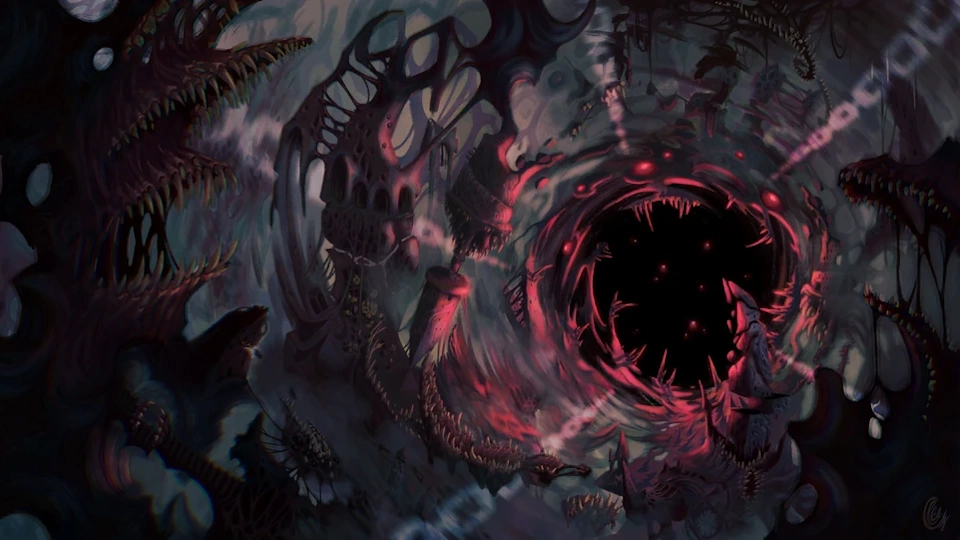
The Abyss is the plane of Chaotic Evil among the Outer Planes and the birthplace of demons.
It consists of an unknown number of layers connected by unstable passages of many kinds. No final depth has ever been established, and even well-known routes can change as layers shift, divide, collapse, or merge.
Lessarith the Deceiver has been confined to the Abyss since the defeat of the Triad. Her presence, the rise of demonkind, and the long conflicts between Demon Lords have all contributed to the shape of the plane known today.
Structure and Environment
The Abyss has no common landscape. Known layers range from deserts and forests to oceans, frozen regions, cavern systems, and stranger environments with little resemblance to the Material Plane. Conditions may differ completely between one layer and the next.
Some layers support large wildernesses, settlements, or kingdoms, while others are difficult to inhabit even for demons.
The layers themselves are unstable. Territory can be reshaped by conflict, absorbed into neighboring regions, or broken away entirely, leaving fragments elsewhere in the Abyss.
Depth provides little indication of what a layer will be like. Regions far from established routes are usually less explored, but they are not necessarily harsher than those nearer the surface.
The Layers
No reliable count of the Abyssal layers exists.
Planar scholars number layers that have been firmly identified, usually according to when they entered established records. These numbers provide a common reference rather than describing a fixed order of descent.
Older records can become obsolete as the Abyss changes. Layers may divide, shrink, disappear, or become joined to other regions, while fragments of lost layers sometimes survive elsewhere in the plane.
Any record of the Abyss therefore describes only what was known at the time it was made.
Formation and Change
The Abyss existed long before Lessarith's exile, though much of its present character developed over the ages that followed.
Its Chaotic Evil nature allows powerful inhabitants to influence the territories they control. A Demon Lord who holds a domain for long enough may gradually alter its landscape, climate, and internal structure.
Conflict can produce equally lasting changes. Territory may be lost or absorbed, while routes and settlements can disappear as control shifts between rival powers.
The Abyss also produces life independently. Demons can arise directly from the plane, and powerful beings have reached Demon Lord status through several different paths.
Movement and Travel
The Abyss has no fixed sequence of descent. A single layer may connect to several others, while regions that appear close together may have no reliable passage between them.
Crossings are found throughout the plane, but their stability varies widely. Some remain dependable for centuries, while others collapse, move, or begin leading somewhere else.
The River Styx passes through portions of the Abyss and provides one of the more reliable connections to the other Lower Planes.
Travel beyond established routes carries considerable risk, particularly where no known passage leads back from the destination.
Connections to Other Planes
The Abyss can be reached through the Astral Plane and through established planar portals. The River Styx also links parts of the plane to the other Lower Planes.
Permanent gates exist within some well-known layers, especially near major settlements and territories controlled by Demon Lords. Their ownership often changes when control of the surrounding region changes.
Demonic incursions can also create temporary breaches elsewhere. Small disturbances may allow individual demons through, while larger breaches can remain active long enough to support sustained movement between planes.
These breaches remain local to the areas in which they form.
Demons
Demons are native to the Abyss and exist in more forms than planar scholars have catalogued. Some arise directly from the plane, while others develop through transformations or processes that remain poorly understood.
Many remain closely tied to the layer in which they formed, though others travel widely through the Abyss and beyond it.
Demonic society has no universal hierarchy. Authority depends on the ability to gain and hold power, whether through personal strength, influence, allies, or control of territory. A ruler who can no longer defend a claim may quickly lose it.
The Abyss also contains many inhabitants who are not demons, including outsiders who enter willingly and those brought there against their will.
Demon Lords
Demon Lord is an Abyssal title held by exceptionally powerful beings capable of ruling major territories or entire layers. The title grants no divine status.
Their origins vary considerably. Some were created by Lessarith, while others arose from demonkind, developed from the Abyss itself, or reached their present state through other means.
Graz'zt was the first Demon Lord created by Lessarith and remains the one most closely associated with her. He rules Azzagrat, a domain spanning three Abyssal layers.
Demogorgon was her second creation and later became one of the most powerful beings in the Abyss. His domain is the Gaping Maw.
Pazuzu was the third. His influence is closely associated with desperate bargains, temptation, and corrupted guidance. Pazunia, the first widely recorded layer of the Abyss, bears his name.
Other prominent Demon Lords emerged independently of Lessarith. Juiblex rules within the Slime Pits, while Orcus governs Thanatos and commands vast hosts of undead. Traditions concerning Orcus describe him as having once been mortal before his rise through demonkind.
Baphomet rules the Endless Maze, and Yeenoghu claims the Death Dells.
Control among Demon Lords is rarely secure. Alliances shift, territories change hands, and even long-established rulers must continue defending what they claim.
Pazunia
Pazunia is the first widely recorded layer of the Abyss and one of its most common points of entry.
It is a barren land beneath a red sun, scattered with great iron fortresses and enormous pits that descend into other regions of the plane. Many of those pits contain routes to additional layers, and branches of the River Styx pass through some before returning to the wider river.
These connections have made Pazunia one of the principal crossroads of the Abyss.
The layer takes its name from Pazuzu.
The Deep Abyss
The deepest explored reaches contain some of the least understood regions of the plane.
Fragments of collapsed layers survive there in varying states, from recognizable pieces of former domains to unstable masses fused together over time. Expeditions have also encountered creatures that do not resemble familiar forms of demonic or planar life.
Some regions appear to contain layers still in the process of forming, though direct study has been limited by the instability and danger of those areas.
No expedition has established whether the Abyss possesses a final layer or any true bottom.
The Endless Spiral
The Endless Spiral is Lessarith's divine realm, extending through many parts of the Abyss rather than occupying a single layer.
Its entrances have been found in widely separated regions, including territory controlled by other Demon Lords. Once inside, travelers can be carried enormous distances through passages whose relationship to the surrounding Abyss is difficult to determine.
Routes within the Spiral may bend, divide, return to earlier chambers, or eventually emerge into a distant layer. Lessarith can alter these internal paths, conceal existing entrances, and open new ones.
The Spiral gives her access throughout the plane while remaining entirely within the Abyss, where she is confined. Its presence grants her no general authority over the layers surrounding its entrances.
Natural Hazards
The dangers of the Abyss depend heavily on the layer being entered. Some regions are hostile because of climate or terrain, while others interfere with perception, memory, emotion, or thought.
The changing geography creates an additional risk. A route that was safe during one journey may later disappear, shift destination, or lead into territory that has changed hands.
Information about the Abyss is therefore most reliable when recent and tied to a specific route or layer.
Survival
Preparation for travel in the Abyss must be based on the intended destination and the regions expected along the way. Conditions vary too widely for ordinary assumptions about food, water, breathable air, gravity, or temperature to remain dependable across the plane.
Navigation is equally important. Most expeditions rely on known portals, established crossings, the River Styx, or guides familiar with particular layers. Maps are most useful as records of previous journeys, since the routes they describe may not remain unchanged.