
The Far Realm
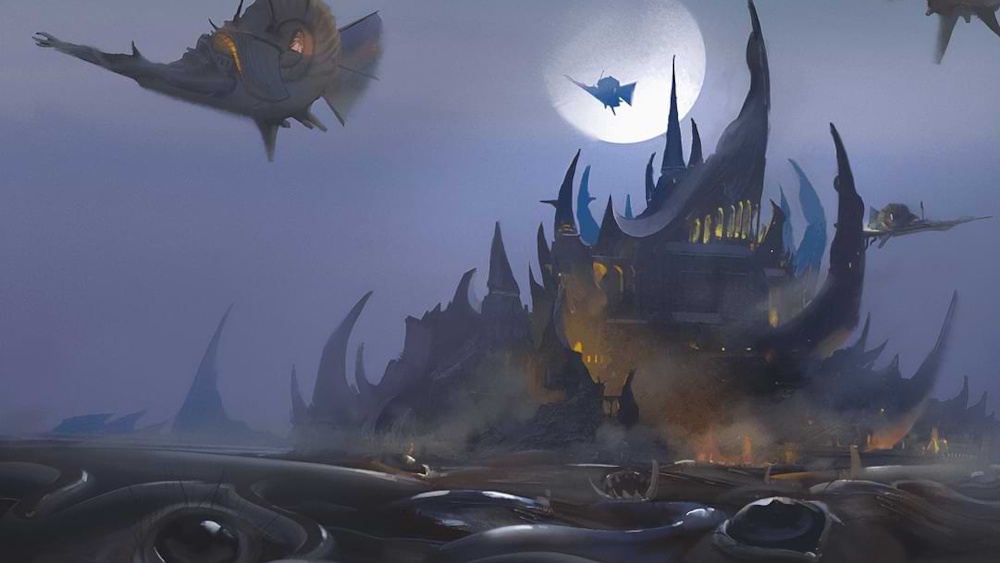
The Far Realm exists outside the conventional arrangement of the Material, Elemental, Energy, Transitive, and Outer Planes while remaining part of Eldareth's Reality Sphere.
Its structure differs sharply from that of the better understood planes. Matter, distance, gravity, time, and perception can operate according to unfamiliar rules, with neighboring regions sometimes following entirely different physical principles.
The Far Realm contains stable landscapes, ecosystems, settlements, civilizations, and forms of life that developed under these unusual conditions. It is cosmologically separate from Driftspace and does not form part of the ordinary Astral or Ethereal transit networks.
Structure
The Far Realm has no single geography that can be mapped consistently.
Many known regions consist of overlapping layers or strata occupying the same apparent space. Creatures, structures, and landscapes may extend through several layers at once, while an observer perceives only the portions accessible from their current position.
Movement between layers follows local rules. Native creatures may cross between them with little apparent effort, while outsiders sometimes depend on particular locations, shifts in perception, or deliberate mental focus to reach another stratum.
The relationships between layers can also change. They may divide, converge, or develop new connections over time, though some regions remain stable enough to support permanent ecosystems and civilizations.
Within such regions, unfamiliar conditions can remain entirely consistent. Travelers who understand the local structure may therefore navigate it reliably even when its rules appear impossible by Eldarethian standards.
Physical Conditions
Gravity, distance, and time vary considerably throughout the Far Realm.
Some regions possess recognizable ground and a consistent downward direction, while others contain several competing gravitational orientations or none at all. Apparent distance can be equally unreliable, with nearby locations requiring long journeys and distant ones becoming accessible through particular layers or boundaries.
Time can also fall out of alignment with the rest of the Reality Sphere. Certain regions appear to follow ordinary progression, while others produce substantial differences between a traveler's experience and the time that passes elsewhere.
Movement depends on local conditions. Some environments resemble open air or fluid, while others are weightless or partly responsive to thought.
These rules are often stable within a particular region. Knowledge gained in one area can make travel there predictable, though the same methods may become useless after crossing into another.
Landscapes
The Far Realm contains recognizable environments, though their scale and structure can be difficult for outsiders to interpret.
Accounts describe alien seas, immense organic plains, living growths that form entire forests, and regions where flesh-like and mineral structures develop together as part of the landscape. Other reports describe enormous blue globes descending through open regions before rupturing and releasing parasitic life into the surrounding environment.
Forms comparable in scale to cities have also been observed at great distances. Their appearance can change depending on the layer from which they are viewed, resembling organisms, moving terrain, or vast constructed structures.
Permanent settlements exist throughout the realm, though they rarely conform to Material ideas of streets, walls, or orientation. Portions of a single settlement may occupy several layers simultaneously, allowing two accurate descriptions of the same place to appear contradictory.
Inhabitants
The Far Realm is home to numerous sentient peoples and established civilizations.
Illithids, beholders, grell, neogi, and tsochars are among the inhabitants best known to Eldarethian scholars and travelers, while countless other species remain poorly documented.
These peoples possess their own histories, rivalries, ambitions, and beliefs. Some seek conquest, resources, knowledge, trade, or living hosts, while others have little interest in Eldareth unless their own goals bring them into contact with it.
Eldarethian scholars commonly classify many Far Realm species as aberrations, a term describing their profound biological difference from more familiar forms of life rather than any shared society or allegiance.
Their civilizations are often shaped by conditions that outsiders find difficult to survive, including layered space, altered gravity, unusual atmospheres, and forms of perception extending beyond ordinary sight or hearing. An illithid settlement, neogi enclave, beholder domain, or another Far Realm society may therefore differ radically from neighboring cultures.
Altered Life
The conditions of the Far Realm can produce lasting changes in creatures exposed to them.
Visitors who remain for long periods sometimes develop physical alterations, particularly within regions governed by laws significantly different from those of the Material Plane. The form and severity of these changes vary widely.
Some beings encountered in the Far Realm resemble familiar animals or humanoids only superficially, possessing unusual anatomy or structures that become fully apparent only when viewed across several layers.
Whether such creatures evolved in those forms, adapted over generations, or were transformed after arriving cannot always be determined. Exposure itself produces no single predictable result, and the nature of the region, duration of contact, and individual creature all influence what changes occur.
Effects on Visitors
Travel through the Far Realm can disrupt both perception and thought.
Visitors may experience missing or unreliable memories, difficulty judging distance, or sensory impressions that continue after leaving the region where they originated. Layered space can also make it difficult to determine whether an event was experienced directly or perceived indirectly through another stratum.
Some travelers continue to interpret ordinary surroundings incorrectly after returning. Familiar rooms may appear distorted, or objects may briefly seem to occupy positions that conventional space cannot support.
Longer exposure can produce deeper cognitive effects, including disordered memories, intrusive perceptions, changes in identity, or lasting physical alteration.
Responses vary considerably between individuals, even among travelers exposed to the same region.
Great Old Ones
Among the most powerful beings associated with the Far Realm are entities commonly called Great Old Ones or Elder Evils.
Some scholars collectively refer to several of these powers as the Unshaped Court, though little is known about their relationships with one another.
Their abilities rival those attributed to powerful divine beings, but their nature remains disputed. They do not necessarily possess worship, domains, or divine structures resembling those of Eldareth's gods.
Far Realm civilizations maintain widely different relationships with them. Some Great Old Ones possess willing cults or servants, while others dominate creatures psychically, manipulate them unknowingly, face active opposition, or remain irrelevant to nearby societies.
Their influence can sometimes reach beyond the Far Realm even when the entities themselves cannot cross into Eldareth.
Nyxarath, the Eye Beyond the Stars, is one of the Great Old Ones best known to Eldarethian scholars.
Breaches
The Far Realm is normally reached through specialized planar magic, rare crossings, or breaches that extend beyond Eldareth's conventional planar structure.
A breach can carry more than creatures. Foreign matter, environmental conditions, psychic effects, and portions of a Far Realm landscape may intrude into the surrounding plane while the opening remains active.
Areas around larger breaches can begin following unfamiliar physical rules. Gravity and distance may shift, alien organisms can establish themselves, and creatures adapted to Far Realm conditions may survive where they ordinarily could not.
The severity of these effects depends on the size and stability of the opening. Most breaches eventually collapse, while powerful forces can hold them open or enlarge them enough to permit vessels, armies, or extensive portions of a foreign environment to cross.
Anything that has already passed through remains after the breach closes.
The Incursion
The Incursion of 572 U.R. remains Eldareth's most significant recorded encounter with the Far Realm.
Evidence preserved by the Naerids indicates that Far Realm activity had already begun spreading across distant regions of the cosmos before the invasion reached Eldareth. Routes their people had used safely for generations became increasingly dangerous, and attacks were reported across multiple worlds. The Incursion formed part of this broader period of expansion.
Breaches opened across the Material Plane, allowing illithids, beholders, grell, neogi, tsochars, and other aberrant forces to enter Eldareth. They did not operate under a single command structure, and different groups pursued their own forms of domination, expansion, exploitation, and survival.
The larger breaches also began imposing Far Realm conditions on the surrounding land. Distances became unreliable, gravity shifted, unfamiliar organisms appeared, and psychic disturbances spread through nearby settlements. Some openings remained small, while others expanded enough to admit vessels and major invading forces.
The Venthari proved particularly effective against the widespread use of psychic domination, drawing upon disciplines developed from their inherited psionic abilities and warnings preserved by the Naerids who had reached Eldareth two years earlier.
The war reached a major turning point in Vel'Nathar when Nyxarath, the Eye Beyond the Stars, attempted to manifest through an exceptionally large breach.
During the crossing, the Athrakan Obelisk at Rimecliff was activated and received responses from distant Obelisks elsewhere in the ancient network. Their combined dimensional resonance destabilized the breach and disrupted many of the psychic effects sustaining the invasion.
Nyxarath was caught while only partially manifested. The breach collapsed before the entity could complete its crossing, severing and destroying the portion that had entered the Material Plane. Whether Nyxarath itself was destroyed, wounded, or merely cut off remains unknown.
The collapse broke the momentum of the invasion, though fighting continued. Surviving aberrant forces remained across Eldareth, occupied settlements still required liberation, and other breaches had to be contained or closed.
The Incursion permanently changed Eldarethian understanding of the Far Realm by revealing the scale of its civilizations, the reach of its conflicts, and the danger posed by breaches capable of imposing foreign conditions directly upon the Material Plane.