
Pandemonium
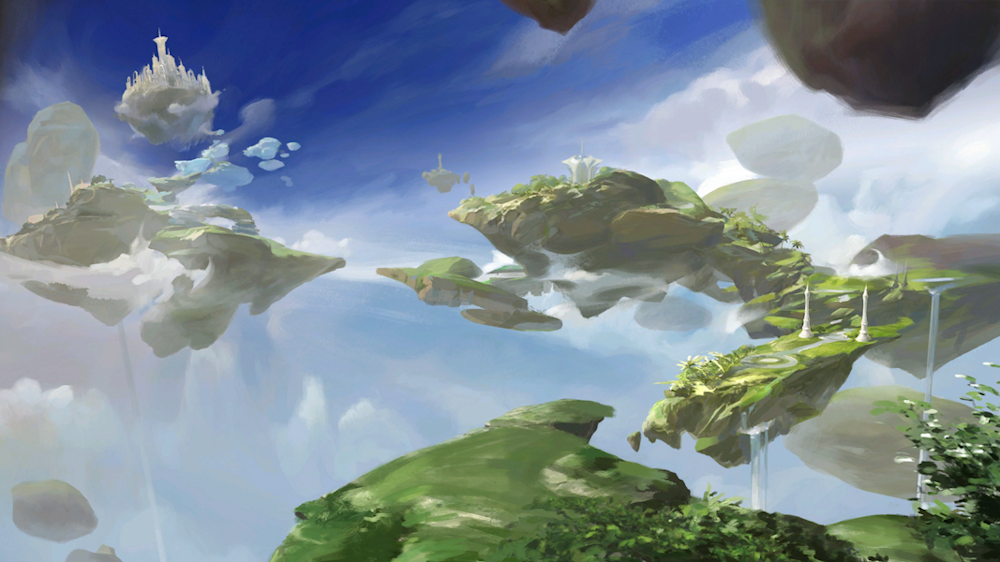
Pandemonium, formally known as the Ever-Changing Chaos of Pandemonium, is the plane of Chaotic Neutrality among the Outer Planes.
It is a realm of mutable matter, drifting landscapes, powerful currents, and formations whose permanence can rarely be assumed. Vast bodies of rock, water, elemental substance, vegetation, and stranger materials move independently through open space or gather into larger structures that may persist for centuries.
Pandemonium has no formal layers. Its known regions extend in every direction around a single fixed feature called the Stillpoint, giving the plane a broadly spherical arrangement despite the absence of any known outer boundary.
The outer reaches are generally more stable, while regions nearer the Stillpoint experience greater mutability and more frequent disruption. Chaos tides and wandering formations can disturb even long-settled areas, so this distinction remains gradual rather than absolute.
Structure and Environment
Pandemonium has no consistent division between land, sea, and sky. Some regions consist largely of open space filled with isolated terrain, suspended water, elemental matter, or fragments of environments that once formed part of something larger.
Elsewhere, enormous formations known as Great Masses remain coherent for centuries or longer. Some stretch for hundreds or thousands of miles and support complete landscapes, ecosystems, settlements, and vast cavern systems.
Even these formations continue to move through the plane and may slowly change course, fracture, or collide with others. Many follow broad curved trajectories around the Stillpoint, leading planar charts to depict Pandemonium as an immense three-dimensional sphere centered upon it.
No enclosing edge has ever been found.
The Stillpoint
The Stillpoint is the most stable known feature of Pandemonium, appearing as an immense, perfectly dark sphere suspended within the plane. Its surface reflects no visible light, and attempts to determine its exact size or composition have produced inconsistent results.
The surrounding regions are among the most unstable in the plane. Debris, elemental matter, and even Great Masses can become caught in long curved paths around the Stillpoint, sometimes remaining there for centuries before breaking away.
The Stillpoint itself has never been observed to move or react to anything around it, and planar scholars commonly describe it as a singularity within the structure of Pandemonium without claiming to understand its nature.
Among petitioners, it is also associated with final union with the plane. Those who willingly seek such an end allow themselves to enter its depths and do not return.
Slaadi are particularly common in the turbulent regions surrounding the Stillpoint, and some are believed to emerge directly from the mutable matter found there.
Mutable Matter
Matter throughout Pandemonium exists at different degrees of stability. Some formations remain recognizable for generations, while others change rapidly as solid terrain softens, elemental substances separate or combine, or existing structures settle into new configurations.
Particularly unstable matter can be shaped through concentration and force of will. Small amounts may be formed into temporary ground, shelter, barriers, or simple structures, while larger changes demand greater effort, cooperation, or specialized techniques. Reinforced forms can persist for considerable periods.
Petitioners who spend long periods in Pandemonium often become increasingly skilled at shaping both mutable matter and their own planar bodies. These changes remain consciously directed, and settlements throughout the plane often depend on the same techniques to maintain terrain that would otherwise become unreliable.
Chaos Tides
Periods of heightened planar instability are commonly known as chaos tides.
During a tide, drifting formations can accelerate, mutable matter becomes more active, gravity may fluctuate, and structures that have remained stable for years can begin to shift or fracture. Some tides affect only a small region for a few hours, while others cross enormous distances and disrupt routes used for generations.
Their arrival can sometimes be anticipated. Experienced inhabitants watch for changes in currents, gravity, wind, and unstable matter, while Kezharin navigators maintain especially detailed records of these patterns.
Gravity
Pandemonium has no universal direction of gravity. Large solid bodies generate their own local pull, drawing creatures toward their surfaces much as ordinary ground would.
Inside large caverns, gravity often pulls outward toward the surrounding stone, allowing floors, walls, and ceilings to function as ground depending on a traveler's position. Water follows the same local conditions and may run across walls or ceilings before reaching another surface.
Gravity weakens considerably between solid formations. Objects moving through open space tend to retain their momentum until acted upon, making some form of propulsion or anchoring essential for travel through many regions.
The Great Masses
The largest stable formations in Pandemonium are known collectively as the Great Masses. Some are enormous bodies of stone, while others support forests, grasslands, mountains, lakes, settlements, or combinations of terrain gathered over long periods.
Their movement is usually slow enough for generations to live upon the same mass without experiencing a major change in its immediate environment. Over longer periods, however, their paths may carry them into entirely different regions of the plane.
This movement shapes relationships between communities. Settlements on neighboring masses may trade regularly while their paths remain close, then lose contact for decades when those routes diverge.
Many petitioners first arrive in these more stable regions, where persistent terrain and established settlements provide a manageable beginning to their afterlife. The largest Great Masses also contain the immense cavern systems for which Pandemonium is widely known.
The Howling Caverns
Caverns within the Great Masses can reach extraordinary dimensions, with chambers and branching tunnel systems extending across hundreds of miles.
Powerful winds move constantly through many of these passages. In quieter regions they form a persistent roar, while stronger currents can extinguish flames, disrupt footing, or carry unsecured travelers through the tunnels.
Sound travels remarkable distances along these winds, allowing voices, impacts, and animal calls to carry far beyond their source before disappearing into the greater noise of the caverns. The loudest passages can damage unprotected hearing and make ordinary conversation difficult.
Settlements survive within more stable regions where wind patterns are dependable or can be redirected through barriers, channels, and other construction.
Movement and Travel
Travel through Pandemonium depends heavily on local conditions. Great Masses can often be crossed by ordinary overland travel, though their size alone can make journeys far longer than expected.
Open regions require much greater care, since travelers must manage momentum, changing gravity, moving destinations, and the possibility that a planned route has shifted before they arrive. Journeys toward the Stillpoint lead through increasingly mutable territory, though experienced inhabitants sometimes travel there deliberately to work with matter that responds more readily to will.
Long-distance navigation relies on persistent landmarks, recorded currents, the movement of major Great Masses, and the position of the Stillpoint. Maps commonly include dates and projected changes alongside routes, allowing older charts to remain useful when adjusted for movement over time.
Connections to Other Planes
Pandemonium can be reached through the Astral Plane and through established planar portals.
Some permanent crossings lie near settlements or stable Great Masses, while others are anchored to formations that continue moving through the plane. A portal may therefore remain fully functional even as its position relative to surrounding landmarks changes.
Connections to the Outlands are among the best documented, while other passages lead to neighboring Outer Planes or more distant destinations. Some become accessible only when particular formations or planar conditions align.
Because these crossings move with the plane around them, experienced local navigators are highly valued by travelers unfamiliar with Pandemonium.
Inhabitants
Pandemonium supports native peoples, petitioners, planar creatures, and communities founded by outsiders.
Slaadi are especially common near the Stillpoint, while Kezharin communities are concentrated on Great Masses, within stable caverns, and around persistent routes. Petitioners are most often found in the more stable outer reaches, though experienced individuals may travel much farther inward.
Over time, petitioner bodies become increasingly responsive to conscious choice. Some eventually undergo a voluntary transformation into crystalline planar beings known as Shardminds.
Outsider communities can be found wherever sufficient stability exists, ranging from isolated enclaves to long-established trade settlements. No single authority governs the plane as a whole.
Shardminds
Shardminds are crystalline planar beings associated with Pandemonium, some of whom arise when mortal petitioners voluntarily enter a fully planar state.
Each possesses a stable central core surrounded by independent crystalline fragments whose size, color, and arrangement vary considerably. Most adopt broadly humanoid configurations when interacting with mortal peoples, though their bodies can take many other forms.
Their structure is maintained through will, allowing the surrounding shards to separate, rotate, and rearrange without losing the being's underlying identity. A chosen configuration can remain stable indefinitely, and no particular form represents a final or perfected state.
Shardminds are also especially capable of shaping Pandemonium's mutable matter. Older or more experienced individuals may maintain substantial structures or environments through concentration, though their abilities vary greatly.
They possess no prescribed stages of advancement and can grow in power or experience without changing into a fixed higher form.
Slaadi
Slaadi are closely associated with Pandemonium's mutable nature, and transformation remains a common feature throughout their lives. Most belong to recognizable forms, though age, unusual environments, and repeated changes can produce increasingly individual bodies.
Their societies are usually temporary and decentralized. Slaadi may gather around a location, powerful individual, shared interest, or immediate goal before dispersing as circumstances change. Some remain near the Stillpoint for generations, while others wander throughout Pandemonium or beyond it.
Exceptionally ancient and powerful individuals are sometimes called Slaad Lords. The title carries no formal rank or divine authority and is used for beings whose age, power, and accumulated transformations have made them singular among their kind.
Some attract followers or control territories, while others remain solitary.
The Kezharin
The Kezharin are a small people native to Pandemonium, recognizable by their large ears and eyes, compact builds, and patches of short fur along the face and limbs.
They are skilled at reading moving terrain, unstable portals, changing gravity, and the broad currents that carry matter through the plane. Their communities place strong value on careful observation and practical adaptation, and their charts record movement and timing as carefully as location.
A Kezharin navigator may track where a Great Mass will pass weeks in advance or calculate when changing routes are likely to intersect. Their settlements follow the same approach, using repositionable platforms, reinforced anchors, and structures designed to remain functional as gravity or surrounding terrain changes.
Kezharin communities are built to adapt continuously to Pandemonium rather than hold the plane in a permanent state.
Native Creatures
Pandemonium supports creatures adapted to conditions that would make survival difficult elsewhere.
Howlers are common throughout the cavern systems, where they use powerful calls to communicate and hunt in regions where sight can be unreliable. Much rarer howling dragons occupy some of the largest tunnels and remote Great Masses, establishing territories shaped by the winds and acoustics of their surroundings.
Other predators take advantage of the plane's mutability itself. Some can shape unstable material around their bodies while approaching prey, while chaos beasts possess morphic forms that adjust as they move between different environments.
Settlements and Freeholds
Permanent settlement is possible wherever inhabitants can rely on natural stability or maintain it through construction, magic, communal shaping, and regular upkeep.
Some communities occupy the inner surfaces of enormous caverns, while others spread across connected fragments or travel with a Great Mass as it moves through the plane. Independent freeholds are especially common and develop political structures suited to their own circumstances.
Authority is usually local, with few institutions recognized beyond the communities or territories that choose to accept them.
Natural Hazards
Pandemonium can be extremely dangerous to unprepared travelers. Terrain may fracture or move without warning, chaos tides can disrupt familiar routes, and open regions leave travelers vulnerable to uncontrolled momentum when no stable surface is nearby.
The Howling Caverns add powerful winds, intense noise, difficult gravity, darkness, and native predators to those risks.
Navigation remains one of the plane's most persistent challenges, particularly across regions where both destinations and routes continue to move.
Survival
Great Masses and established settlements can support ordinary mortal life for long periods, including agriculture, stored water, and permanent habitation.
Travel away from these regions requires preparation suited to movement through unstable space. Reliable propulsion, anchoring equipment, sufficient supplies, and protection appropriate to the Howling Caverns may all become necessary depending on the route.
Experienced travelers plan alternate paths and expect to revise them as conditions change. In Pandemonium, a successful journey often depends on responding to the plane as it moves.