
Concordium
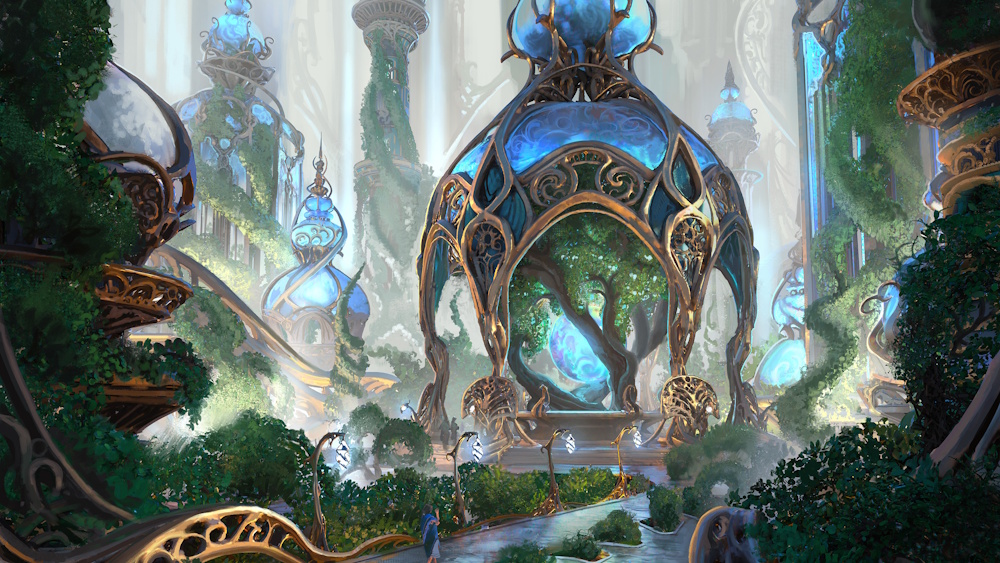
The Clockwork Nirvana of Concordium, sometimes shortened to Nirvana, is the plane of Lawful Neutrality among the Outer Planes.
Concordium is shaped by the idea that individual parts exist within larger systems whose stability depends on how those parts relate to one another. Natural cycles follow reliable patterns, cause and effect are unusually consistent, and many of its societies place strong value on responsibility and continuity.
The plane takes the form of a vast disk with two distinct faces. Arcadia occupies one as a fertile and highly ordered landscape, while Mechanus covers the other with an immense system of interlocking gears and machinery. The two are closely connected: water and other natural systems from Arcadia feed into mechanisms below, while the movement and structure of Mechanus appear to contribute to the stability of Arcadia above. The full nature of this relationship remains poorly understood.
Structure of Concordium
Arcadia and Mechanus occupy opposite faces of the same planar disk. References to one as the upper face and the other as the lower are matters of convention, since each has its own gravity and feels upright to those standing upon it.
The only ordinary physical route through the body of Concordium lies along its central axis, connecting Ordin Vell in Arcadia with the Grand Array in Mechanus. Portals provide additional direct travel between the two faces without passing through the disk itself.
No reachable outer edge has been identified, and attempts to determine the full dimensions of Concordium have produced no reliable measurement. Across both faces, change usually follows recognizable causes and established cycles, making the plane unusually predictable by the standards of the Outer Planes.
Order and Society
Cultures throughout Concordium tend to understand individuals in relation to the larger systems around them. Responsibilities may be personal, civic, communal, or institutional, but they are generally treated as meaningful because the actions of one part can affect the stability of the whole.
This principle produces many different societies. Communities may organize themselves through civic institutions, strict hierarchies, collective agreements, or other structures suited to their needs, and individuality is common throughout both faces. Deliberately disrupting a system upon which others depend is usually taken seriously.
Petitioners live throughout Arcadia and Mechanus and often move between them. Over long periods, many develop metallic or crystalline hues, geometric patterns in the eyes, or shifting markings across the body. These markings vary with the individual and are often said to become more distinct as a petitioner comes to understand their relationships and place within the systems around them.
When petitioners draw close, their patterns can sometimes align into larger designs. Some eventually undergo a deeper transformation into crystalline planar beings known to scholars as axiomites. A solitary transformation produces a Navan, while several compatible individuals may voluntarily join through a process known as Convergence and become a more complex Aveneva. Axiomites are uncommon and share no single hierarchy or vocation.
Arcadia
Arcadia forms one face of Concordium, an expansive and fertile landscape shaped by reliable weather, carefully maintained settlements, and natural systems that follow remarkably stable patterns.
Rivers remain within established courses, crops grow with unusual consistency, and even wild regions often display forms of regularity uncommon on the Material Plane. Forests, farms, gardens, cities, and open countryside all support abundant life within this ordered environment.
Forests and Orchards
Arcadian forests grow in broad, orderly stands, with many trees displaying metallic sheens in their bark and vivid leaves throughout the year. Some species bear fruit continuously instead of following ordinary seasonal cycles.
Certain fruits possess mild magical properties, most commonly restorative or strengthening effects. Many settlements cultivate these trees in orchards, though wild groves remain widespread.
Wildlife
Arcadian wildlife resembles many creatures found on the Material Plane but often carries unusual coloration, such as metallic fur or wool and pale eyes. Some animals also display an unusual resistance to illusions and deceptive magic.
Most remain peaceful unless threatened. Creatures that naturally form highly organized colonies are especially abundant throughout the layer.
The Orb of Day and Night
Arcadia's cycle of light and darkness is governed by the Orb of Day and Night, an immense sphere positioned high above the greatest known mountain range near the center of the layer. One half radiates brilliant light while the other remains completely dark, and the Orb turns at a constant rate.
Its rotation carries daylight and darkness across Arcadia in exact succession, with only a brief transition between them. The cycle corresponds precisely with rhythms observed within the Grand Array on the opposite face of Concordium, though it remains uncertain whether one drives the other or both belong to a larger mechanism.
No measurable variation in the Orb's cycle has been recorded.
Ordin Vell
Ordin Vell surrounds the central mountain beneath the Orb of Day and Night, extending across its slopes, valleys, and surrounding countryside.
The city follows long-established plans that integrate terraces, waterways, transport routes, and cultivated green spaces into its architecture. Pale stone and warm metals are common throughout its districts, while rivers descending from the mountain are directed through channels crossing the city.
Some of this water continues outward into Arcadia, while other channels enter vast waterworks beneath Ordin Vell and contribute to mechanisms extending into Concordium and Mechanus. At the base of the mountain lies the entrance to the only ordinary physical route between the plane's two faces, making Ordin Vell one of Arcadia's principal centers of travel and exchange.
Settlements of Arcadia
Arcadian settlements range from small agricultural communities to large cities, but intentional planning and long-term maintenance are common across them. Roads, districts, waterworks, and other public systems are generally designed to remain useful for generations.
Arcadian order is often expressed through civic responsibility, stewardship, and dependable communal institutions. Different cultures interpret those values in their own ways, producing considerable variety within a broadly stable social environment.
Inhabitants of Arcadia
Arcadia is home to petitioners, planar settlers, formians, and other creatures adapted to ordered societies.
Formian colonies are particularly well established. Their hives follow strict social structures in which members perform clearly defined roles, and successful colonies can become highly expansionist as they seek additional territory and resources. This sometimes brings them into conflict with Arcadian communities whose own forms of order allow greater individual autonomy.
Celestials from Celestia also travel through Arcadia regularly and may maintain enclaves along established planar routes.
Portals of Arcadia
Arcadia possesses a limited number of permanent portals beyond Concordium, including important routes to the Outlands, Celestia, and the Astral Plane. Stable portals also connect directly to Mechanus.
These passages are usually fixed, clearly marked, and surrounded by settlements whose importance has grown through trade and regular planar traffic.
Mechanus
Mechanus forms the opposite face of Concordium as an immense system of interlocking gears turning through an open expanse. Some cogs stretch for hundreds or thousands of miles, while others function as smaller platforms or components within larger mechanisms.
The gears intersect at different angles and move according to precise relationships with the machinery around them. No complete purpose for the system has ever been established, and scholars continue to debate whether it expresses the fundamental order of Concordium or performs functions beyond the perception of planar travelers.
Gravity and Movement
Each major gear possesses its own gravity, drawing creatures and structures toward either of its broad faces. Settlements can therefore exist on both sides of the same cog.
Gravity weakens between gears, though the surrounding expanse contains breathable air. Travel between mechanisms often depends on careful timing, since their changing positions and angles can open or close routes as they rotate. Residents commonly plan journeys according to mechanical cycles as well as distance.
Light and Time
Mechanus follows an exact cycle of twelve hours of light followed by twelve hours of darkness. No visible sun or moon produces the illumination; the surrounding expanse itself brightens and darkens with complete regularity.
This cycle corresponds precisely with the rotation of Arcadia's Orb of Day and Night and shows no known seasonal variation. Settlements use its reliability to coordinate activity across enormous distances.
Modrons
Modrons are among the principal native inhabitants of Mechanus. Their society is organized into a strict hierarchy in which increasingly complex forms assume increasingly complex responsibilities.
Information moves upward through this hierarchy while instructions move downward, allowing work and coordination to continue across vast regions of the plane. No known sovereign stands at its summit.
Modrons describe their directives as the result of established process and the needs of the larger system. Outsiders continue to debate whether that system ultimately answers to the machinery of Mechanus, some hidden intelligence, or processes too large for an individual observer to perceive. The modrons themselves show little interest in resolving the question.
The Grand Array
The Grand Array is the largest known center of modron administration within Mechanus and occupies the central region directly opposite Ordin Vell.
It extends across numerous interconnected gears filled with administrative complexes, workshops, transport systems, inhabited districts, and machinery whose full purpose remains unclear to outsiders. Modrons continually arrive carrying information from distant parts of Mechanus and depart with new directives intended for regions far beyond the Array.
Among its most recognizable structures is a vast circular complex built around rotating rings and instruments used to coordinate gear movements, transport, schedules, and other systems across the surrounding region. The full extent of its function remains uncertain.
Despite its scale and constant activity, the Grand Array is carefully maintained, with inhabited districts planned to the same degree as the machinery around them. No throne or singular seat of authority has ever been identified. Deeper regions instead reveal further layers of administration connected to increasingly wider systems, leaving even the existence of a true center uncertain.
Inevitables
Inevitables are powerful constructs created or activated in response to violations of fundamental laws, bindings, or conditions.
Certain mechanisms within Mechanus appear capable of recognizing events significant enough to require intervention and assigning an Inevitable a directive appropriate to the violation. Once committed, the construct may pursue that task across great distances and over long periods.
An Inevitable enforces the principle attached to its directive regardless of the laws of individual nations or settlements. The process by which Mechanus determines that such intervention is necessary remains unknown.
Many other clockwork beings inhabit the plane, ranging from simple maintenance constructs to highly specialized entities whose purposes are difficult for outsiders to understand.
Settlements of Mechanus
Large portions of Mechanus consist primarily of machinery, but many gears have been transformed into fully inhabited environments. Settlers have established planned cities, cultivated regions, enclosed green spaces, and extensive infrastructure directly upon the turning mechanisms.
These environments depend on continued maintenance and careful adaptation to the movement and gravity of the gear supporting them. Even heavily industrialized settlements are generally orderly and well maintained.
Portals of Mechanus
Mechanus contains a large and carefully studied network of planar portals, many appearing as pale or luminous circles bordered by slowly turning mechanical forms.
Their operation commonly depends on scheduled alignments. A passage may open only at a particular point in a gear's rotation or when several distant mechanisms reach the correct relationship, making accurate timing essential to travel.
Known routes lead to the Outlands, the Astral Plane, Arcadia, distant regions of Mechanus, and other Outer Planes. Travelers who depend on these portals keep detailed records of mechanical cycles, since missing an alignment can delay a journey for hours or days.
Travel Between Arcadia and Mechanus
The central route between Arcadia and Mechanus connects Ordin Vell with the Grand Array through the interior of Concordium.
A rail line carries long carriages along an energized guideway into an enclosed passage beneath either city. As the route crosses the plane's central region, gravity changes gradually until passengers and carriages emerge properly oriented on the opposite face.
The line forms a continuous connection between Ordin Vell and the Grand Array and joins wider transport networks on both sides. Portals elsewhere in Concordium also connect Arcadia and Mechanus directly, while inhabitants generally treat movement between the two faces as ordinary travel within the same plane.
Connections to the Outer Planes
Concordium maintains routes to the Outlands, the Astral Plane, and neighboring Outer realms.
Established Arcadian routes provide some of the easiest access to Celestia, while passages toward Baator are more commonly encountered through Mechanus and other heavily regulated crossings. These patterns arise from geography, historical travel, and the development of planar routes across the two faces.
The Astral Plane remains the principal transitive route between Concordium and the Material Plane.
Natural Hazards
Concordium is generally hospitable to mortal life, especially within Arcadia, where most dangers arise from local conflicts, territorial disputes, or interference with systems maintained by established communities.
Mechanus presents more immediate physical risks. Moving gears can separate travelers or close routes, transitions between different gravitational fields can be dangerous, and portal cycles can leave poorly prepared travelers stranded far from their intended destination.
Many of these dangers can be anticipated by those who understand the systems involved.
Survival
Arcadia readily supports mortal life, with abundant food, water, and generally moderate conditions. Mechanus also provides breathable air and stable temperatures, though supplies may be difficult to obtain away from inhabited gears.
Travel through Mechanus benefits greatly from accurate knowledge of gear rotations, portal schedules, and established routes, as well as sufficient mundane supplies for unexpected delays.
Visitors throughout Concordium are also expected to respect the systems upon which local communities depend. Deliberate disruption can quickly turn an otherwise orderly and predictable journey into a hostile one.