
Myranthus, the Dawnsinger
Greater Deity
Domains: Light, Life, Order, War
Myranthus is the god of dawn, healing, protection, and renewed hope. Creation traditions place his arrival at the first sunrise over Eldareth, after Ao and Io had established space and time.
His faith has historically been strongest among humans, though worship of Myranthus has never been limited to them. He is commonly invoked during periods of injury, danger, hardship, and recovery.
Symbol
Myranthus is represented by a golden rising sun enclosed within a circle. The rising sun represents dawn and the possibility of recovery after hardship.
Depictions
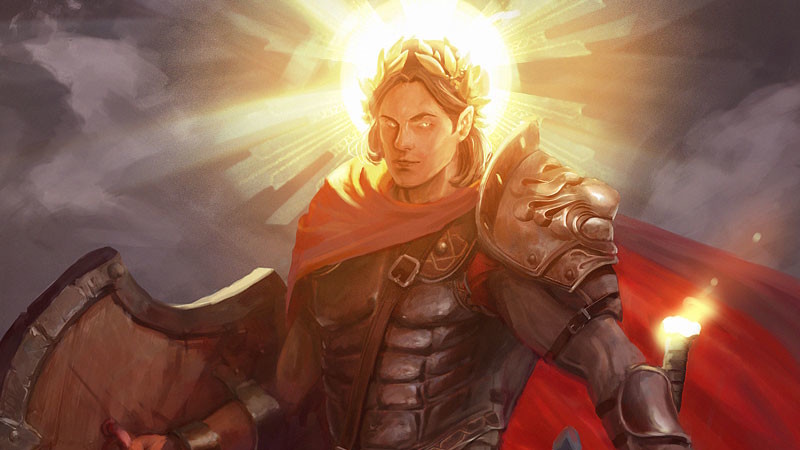
Myranthus is usually depicted as a youthful humanoid figure in armor and a red mantle, with the light of dawn forming a halo behind his head.
Martial depictions often give him a warhammer and shield. He is also frequently shown carrying a lyre in his aspect as the Dawnsinger, reflecting the importance of song in his worship.
Divine Realm
Myranthus resides in the Dawnbreak Bastion within Mertion, the Platinum Heaven of Mount Celestia.
A perpetual sunrise rests over the Bastion, filling its halls with morning light. The wounded are cared for there, while others train or prepare for dangers they may have to face.
Training within the Bastion emphasizes the disciplined use of force in defense of others. Those who have fought are also expected to help with the recovery that follows.
Origins and Divine Role
Myranthus's association with dawn came to include recovery from injury, war, disaster, and other hardship.
Protection and healing are closely connected in his faith. Defending someone from immediate danger is only part of that responsibility. The wounded still require care, damaged communities may need help rebuilding, and fear can remain after the danger itself has passed.
War falls within Myranthus's authority when force is used in defense of others. Conquest and needless bloodshed have no place in his teachings, and those who fight in his name are expected to stop when force is no longer necessary.
Worship and Practice
Sunrise is the principal time of worship for Myranthus. Daily observances commonly begin with the first light, and important vows are often spoken at dawn.
Song holds a prominent place in his faith. Hymns are used during religious observances and in times when a community is preparing for danger or recovering from hardship.
Myranthus remains especially prominent among human communities, though his worship has spread far beyond them.
The Thessaric Empire
Myranthus held a central place within the Thessaric Empire, where the Dawnsinger's Concord became one of its major religious institutions.
Thessaric traditions remember him as one of the powers that recognized the danger posed by the Triad and helped bring others together against their growing influence.
His faith also influenced Thessaric ideas of rulership. Those who held authority were expected to protect the people who depended upon them, and military power was expected to serve the realm rather than personal ambition.
The Dawnsinger's Concord survived the fall of the Empire. Myranthus remains widely worshipped in lands once governed by Thessar, where several religious traditions still descend from the imperial faith.
Teachings
-
Protect those who are in danger.
-
Use force only for as long as it is needed.
-
Help the wounded and those recovering from hardship.
-
Support those who are losing heart and help them try again.