
Lerathae, the Moonmaiden
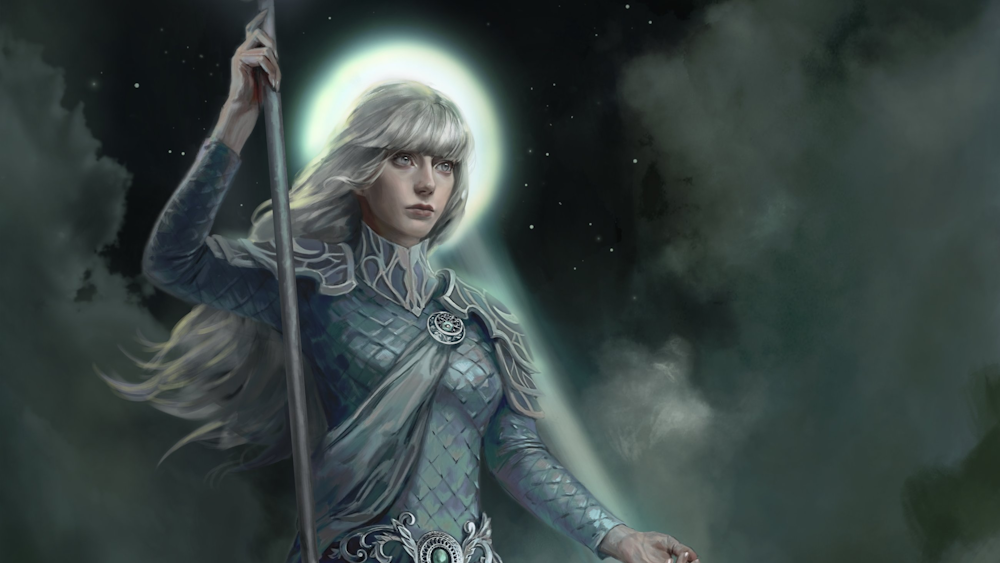
Greater Deity
Domains: Peace, Twilight
Lerathae is the goddess of the moon, dreams, night, and remembrance. Her worship is associated with rest, guidance in uncertain circumstances, and the preservation of memories that might otherwise be lost.
She holds particular importance among the Vaela'drin and Falha'drin, whose histories remember her guidance during the First Elven Exodus.
Symbol
Lerathae is represented by a silver crescent surrounding three stars. The largest star represents Lerathae. Among the Vaela'drin and Falha'drin, the two smaller stars have come to represent their peoples and the journey that brought their ancestors from the Feywild.
Depictions
Lerathae is usually depicted as a woman with long silver or white hair, though her features vary between cultures. A crescent moon commonly frames her head, accompanied by a pale lunar glow.
She is sometimes shown carrying a staff crowned with a crescent or keeping watch beneath the night sky while mortals sleep.
Divine Realm
Lerathae resides in the Moonfall Sanctuary within Thalasia, the fourth layer of Elysium. Her realm lies on a large island near one of the channels where the River Oceanus emerges from the Thalasian Sea.
Perpetual twilight rests over the Sanctuary. Its halls offer quiet places for rest, while its records preserve memories and the names of those who might otherwise be forgotten.
Some followers believe mortal dreams occasionally pass near the Sanctuary during sleep. The belief has influenced her worship, though its literal truth remains uncertain.
Lerathae is also believed to have a connection to Val'Syra, the Dreaming. Her priests and planar scholars have never reached an accepted explanation for the nature or extent of that relationship.
Origins and Divine Role
Creation traditions place Lerathae's arrival at the first moonrise over Eldareth, when mortal sleep first began to carry dreams.
Her faith does not assume that dreams contain messages. Most are understood to arise from the dreamer's own mind, and even unusual dreams are approached cautiously.
Priests give greater attention to dreams that recur, correspond with later events, or develop meaning over time. A vivid experience on its own is rarely considered enough to support a firm interpretation.
Remembrance is equally important to her worship. Temples preserve names and testimony so that people and events are not lost to time. Families may entrust the memory of someone they have lost to a shrine, particularly when grief remains unresolved.
Lerathae is also invoked by those seeking peaceful sleep or comfort during illness, grief, and fear.
Worship and Practice
Many observances begin at twilight, when lamps are lit and temples prepare to remain open through the night. Shrines dedicated to Lerathae often provide refuge for those who need a safe place to rest.
Dreamkeeping is one of the best-known practices of her faith. Unusual dreams are recorded soon after waking, before memory has time to alter them. Interpretation usually comes later, after there has been time to compare the account with other dreams or events.
Vigils are held for the missing and the dead. Their names may be spoken, recorded, or kept in prayer even when nothing more is yet known of their fate.
The First Elven Exodus
Lerathae holds a central place in the histories of the Vaela'drin and Falha'drin.
During the conflicts that preceded the First Elven Exodus, both peoples remember her guiding the clans of Vael'dareth, the Moonlit Grove, and Falha'neir, the Midnight Glade, toward a passage out of the Feywild.
Their traditions differ on how that guidance appeared, but agree that Lerathae helped their ancestors find a route when familiar paths had failed.
Her worship remained strong among their descendants after they settled in Eldareth. Moonlit observances, Dreamkeeping, and rites of remembrance remain especially important in many of their communities.
Teachings
-
Offer rest and shelter when you are able.
-
Preserve what should not be forgotten.
-
Treat dreams and signs with patience before deciding what they mean.
-
Help others when they are uncertain of the way forward.
-
Accept that some answers take time.