
Io, the Timekeeper
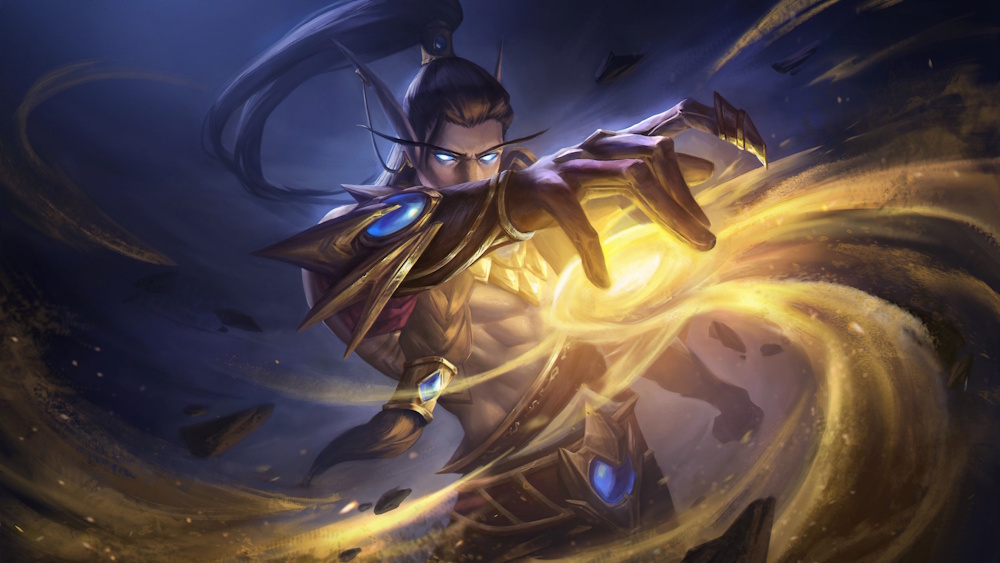
Greater Deity
Domains: Fate, Knowledge, Order
Io is the god of time, history, and foresight. He emerged from the right eye of Elgalar alongside his twin Ao, who arose from the left.
Creation traditions credit Io with setting time into motion. Together with Ao, he also helped create the Weave through which much of Eldareth's magic flows.
Symbol
Io's symbol is an hourglass encircled by a bronze dragon curling clockwise around it.
The hourglass represents the passage of time and events that cannot simply be undone once they have occurred. The dragon's direction recalls Io's emergence from Elgalar's right eye and mirrors the counterclockwise dragon associated with Ao.
Depictions
Io is usually depicted in humanoid form as a tall man with long dark hair and bright blue eyes. He wears layered robes in deep blue and bronze, sometimes accompanied by armor and hourglass imagery.
His draconic form is an immense bronze dragon with branching horns that form a crown-like silhouette. Golden markings cross his scales, and some traditions claim that their arrangement changes over time.
Divine Realm
Io shares the Eternal Archive with Ao within the Astral Plane.
Its halls contain records reaching back to the earliest ages of creation, including histories and preserved prophecies. Some traditions claim that portions of the Archive record events as they occur.
Io's work there centers on history, prophecy, and changes that unfold across time. Ao's concerns lie with the planes, the Veil, and the spaces between them.
Origins and Divine Role
During the ordering of creation, Ao established distance and separation between places. Io established the passage of time, allowing events to occur in sequence and the world to change from one age to the next.
His followers preserve history because earlier events help explain present circumstances. Accurate records allow later generations to examine what happened, what decisions were made, and what followed from them.
Io is also closely associated with prophecy. His visions may reveal possible futures or warn of events that could occur, but his faith does not regard such outcomes as inevitable. A warning may change what happens if people act upon it.
Prophecies are therefore preserved even when the events they describe never occur. They may still record a danger that was avoided, a possibility that changed, or a warning that influenced later decisions.
Temporal magic is treated with caution. Manipulating the flow of time can have consequences beyond the immediate effect, and attempts to change events that have already occurred are considered especially dangerous.
Worship and Practice
Io and Ao are frequently worshipped together. Temples dedicated to the twins may maintain separate shrines while sharing clergy, libraries, and places of study.
Io is also honored independently by those concerned with history, prophecy, and unusual temporal phenomena.
His temples maintain historical records and preserve significant visions. Priests compare new prophecies with earlier accounts and known events before deciding how much confidence to place in them.
Temporal Disturbances
The Upheaval disrupted the normal passage of time in some parts of Eldareth. Most of these disturbances eventually faded, though a small number of affected sites remain.
Io is believed to have helped contain the worst of the instability. His followers continue to investigate temporal disturbances when they appear, especially where they threaten nearby communities or make it difficult to determine what happened within an affected area.
The Triad
Traditions surrounding the rise of the Triad connect Io with some of the earliest warnings of the threat they posed.
His visions revealed only part of what was happening. Other members of the Celestial Accord still had to uncover the identities and actions of the three, but Io's warnings gave them time to prepare before the conflict fully emerged.
Teachings
-
Keep an honest record of what happened.
-
Learn from the past when making choices in the present.
-
Consider the consequences your choices may create.
-
Treat prophecy as guidance, never certainty.
-
Do not alter the past for convenience, regret, or personal gain.