
Apothecary
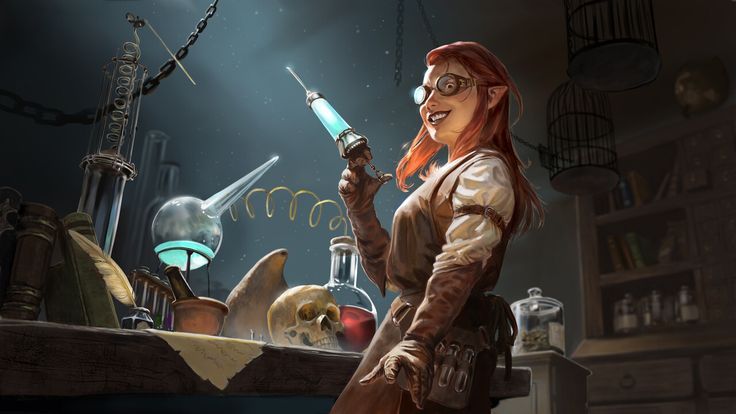
Apothecaries study the workings of living creatures, the properties of magical substances, and the forces that govern life and death. Through medicine, alchemical experimentation, and occult research, they develop techniques capable of healing injuries, altering the body, manipulating the mind, and producing effects that conventional science cannot explain.
Where a Cleric might call upon divine power to restore the wounded, an Apothecary approaches the same problem through anatomy, magical formulae, and practical experimentation. Their methods vary considerably. Some become accomplished physicians, while others investigate dangerous diseases, artificial life, psychic phenomena, or the transformation of living tissue.
Apothecaries record their discoveries in Formula Books, developing spells and specialized techniques known as Esoteric Theories. Their magic relies on a relatively small number of powerful spell slots that recover through rest, allowing them to perform demanding experiments and magical procedures throughout an adventuring day.
This version of the Apothecary follows the April 2026 Dungeon Dudes revision, adapted for Eldareth's class progression and balance. Apothecary Magic retains its Short Rest recovery and prepared-spell system, with a revised spell-slot progression reaching five slots at level 17. Experimental Research provides limited access to spells from other disciplines, while Esoteric Theories offer extensive customization.
An Apothecary chooses an Occult Practice at level 3, with further subclass features at levels 6, 10, 14, and 18. Greater Formula grants access to powerful magic beyond fifth level, and Miraculous Recovery allows the Apothecary to restore the resources of several companions at level 20.
Core Apothecary Traits
| Trait | Details |
|---|---|
| Primary Ability | Intelligence |
| Hit Point Die | D8 per Apothecary level |
| Saving Throw Proficiencies | Intelligence and Wisdom |
| Skill Proficiencies | Medicine; choose two: Arcana, History, Investigation, Nature, or Religion |
| Weapon Proficiencies | Simple weapons, Shortswords, and Hand Crossbows |
| Armor Training | Light and Medium armor |
| Starting Equipment | Choose A or B: (A) Hide Armor, Light Crossbow, 20 Bolts, Shortsword, Formula Book (Arcane Focus), Scholar's Pack, Healer's Kit, and 15 GP; or (B) 75 GP |
Becoming an Apothecary
As a Level 1 Character
Gain all the traits in the Core Apothecary Traits table.
Gain the Apothecary's level 1 features, which are listed in the Apothecary Features table.
As a Multiclass Character
Prerequisite. You must have an Intelligence score of at least 13 to multiclass into or out of this class. You must also meet the multiclassing prerequisites of your other class.
Traits Gained. Gain the following traits from the Core Apothecary Traits table: Hit Point Die, proficiency in the Medicine skill, and training with Light and Medium armor.
Gain the Apothecary's level 1 features, which are listed in the Apothecary Features table.
Multiclass Spellcasting. Your Apothecary spell slots are tracked separately from spell slots granted by other classes. Apothecary levels don't contribute to the Multiclass Spellcaster table.
You can use Apothecary spell slots to cast eligible spells you know or have prepared through another class. You can also use spell slots granted by another class to cast your prepared Apothecary spells, provided the slots are of a sufficient level.
If an Apothecary feature specifically requires you to expend an Apothecary spell slot, you must expend a slot granted by Apothecary Magic.
Features that limit how frequently you can cast a particular spell remain subject to those limits regardless of which class supplied the spell slot.
You determine your Apothecary spell preparation, Spell Slot Level, Experimental Research eligibility, Greater Formula progression, and Esoteric Theory prerequisites using only your Apothecary levels.
Apothecary Features
| Level | Proficiency Bonus | Features | Cantrips Known | Spell Slots | Slot Level | Theories Known |
|---|---|---|---|---|---|---|
| 1st | +2 | Apothecary Magic, Esoteric Theories | 3 | 1 | 1st | 1 |
| 2nd | +2 | Experimental Research | 3 | 2 | 1st | 3 |
| 3rd | +2 | Apothecary Subclass | 3 | 2 | 2nd | 3 |
| 4th | +2 | Ability Score Improvement | 4 | 2 | 2nd | 3 |
| 5th | +3 | — | 4 | 3 | 3rd | 5 |
| 6th | +3 | Subclass Feature | 4 | 3 | 3rd | 5 |
| 7th | +3 | — | 4 | 3 | 4th | 6 |
| 8th | +3 | Ability Score Improvement | 4 | 3 | 4th | 6 |
| 9th | +4 | — | 4 | 3 | 5th | 7 |
| 10th | +4 | Subclass Feature | 5 | 3 | 5th | 7 |
| 11th | +4 | Greater Formula (Level 6) | 5 | 4 | 5th | 7 |
| 12th | +4 | Ability Score Improvement | 5 | 4 | 5th | 8 |
| 13th | +5 | Greater Formula (Level 7) | 5 | 4 | 5th | 8 |
| 14th | +5 | Subclass Feature | 5 | 4 | 5th | 8 |
| 15th | +5 | Greater Formula (Level 8) | 5 | 4 | 5th | 9 |
| 16th | +5 | Ability Score Improvement | 5 | 4 | 5th | 9 |
| 17th | +6 | Greater Formula (Level 9) | 5 | 5 | 5th | 9 |
| 18th | +6 | Subclass Feature | 5 | 5 | 5th | 10 |
| 19th | +6 | Epic Boon, Additional Greater Formula (Level 6) | 5 | 5 | 5th | 10 |
| 20th | +6 | Miraculous Recovery, Additional Greater Formula (Level 7) | 5 | 5 | 5th | 11 |
Level 1: Apothecary Magic
Your study of medicine, alchemical principles, and occult phenomena allows you to manipulate magical forces through specialized formulae.
See the Player's Handbook for the general rules of spellcasting. The following rules explain how you cast Apothecary spells.
Formula Book
You maintain a Formula Book containing your research, spell formulae, medical observations, and experimental procedures.
You determine its appearance. It might be a bound research journal, a collection of annotated diagrams, a medical case containing handwritten formulae, or another suitable record of your discoveries.
You can use your Formula Book as a Spellcasting Focus for your Apothecary spells.
If your Formula Book is lost or destroyed, you can recreate it using suitable writing materials during a Long Rest.
Your Formula Book doesn't limit your spell preparation to spells physically recorded within it. You prepare spells from the Apothecary spell list according to the rules below.
Cantrips
You know three Apothecary cantrips of your choice.
You learn additional Apothecary cantrips at higher levels, as shown in the Cantrips Known column of the Apothecary Features table.
Elementary Reformulation. Whenever you finish a Long Rest and consult your Formula Book, you can replace one Apothecary cantrip you know through this feature with another cantrip from the Apothecary spell list.
Apothecary Spell Slots
The Apothecary Features table shows how many spell slots you have and the level of those slots.
All your Apothecary spell slots are the same level.
To cast a prepared Apothecary spell of level 1 through 5, you expend one spell slot. The spell is cast at the level of the expended slot, provided the slot is of a sufficient level.
You regain all expended Apothecary spell slots when you finish a Short or Long Rest.
Preparing Spells
You prepare a number of level 1 or higher Apothecary spells equal to your Apothecary level plus your Intelligence modifier, with a minimum of one spell.
Choose these spells from the Apothecary spell list.
Each spell must be of a level no higher than the Slot Level shown for your Apothecary level in the Apothecary Features table.
For example, a level 5 Apothecary with Intelligence 16 can prepare eight Apothecary spells of levels 1 through 3 in any combination. The Apothecary has three third-level spell slots and casts a prepared level 1 spell using one of those third-level slots.
Casting a spell doesn't remove it from your prepared spells.
Whenever you finish a Long Rest, you can replace any or all the Apothecary spells you have prepared through this feature with other eligible Apothecary spells.
Preparing a new list requires studying your Formula Book and conducting the necessary research or preparation, taking at least 1 minute per spell level for each spell on the new list.
Additional Prepared Spells
Some Apothecary features, Esoteric Theories, and Occult Practices grant additional spells.
Unless a feature specifies otherwise, these spells:
-
Are always prepared once you meet their requirements.
-
Don't count against the number of spells you prepare through Apothecary Magic.
-
Count as Apothecary spells for you.
-
Use Intelligence as their spellcasting ability.
-
Require a spell slot unless the granting feature provides another method of casting them.
Cantrips granted by these features don't count against the number of cantrips you know through Apothecary Magic.
An additional spell doesn't become part of the base Apothecary spell list merely because it counts as an Apothecary spell for you.
Spells from Other Class Lists
Certain Apothecary features allow you to choose spells from other classes' spell lists.
When such a feature grants a chosen spell of level 1 through 5 that isn't on the base Apothecary spell list, you can cast that spell using a spell slot once per Long Rest through the feature that granted it.
This restriction applies regardless of whether you expend an Apothecary spell slot or a spell slot granted by another class.
The restriction applies separately to each chosen spell. Any free casting expressly granted by the feature remains available and follows its own recovery rules.
This rule applies to Experimental Research, Stolen Secrets, and Esoteric Theories that allow you to select spells from another class's spell list.
Occult Practice Spells. Fixed spells automatically granted by an Occult Practice aren't subject to this restriction. You can cast them normally using your available spell slots.
However, if an Occult Practice allows you to choose a replacement spell from another class's list, that chosen spell follows this restriction when it isn't on the base Apothecary spell list.
Independent Spell Access. If another class independently grants you access to the same spell, you can cast it through that class's features according to their normal rules. Such castings don't count against the restriction imposed by an Apothecary feature.
A spell doesn't become part of the base Apothecary spell list merely because an Occult Practice, Esoteric Theory, or other feature grants access to it.
Spellcasting Ability
Intelligence is your spellcasting ability for Apothecary spells.
You use Intelligence when a spell refers to your spellcasting ability, when determining your spell save DC, and when making a spell attack.
Spell Save DC = 8 + your Proficiency Bonus + your Intelligence modifier
Spell Attack Modifier = your Proficiency Bonus + your Intelligence modifier
Ritual Casting
You can cast an Apothecary spell as a Ritual if that spell has the Ritual tag and you have it prepared.
Spellcasting Focus
You can use an Arcane Focus or your Formula Book as a Spellcasting Focus for your Apothecary spells.
Level 1: Esoteric Theories
Through your research, you develop specialized techniques that extend your understanding of medicine, magic, and the physical world.
You learn one Esoteric Theory of your choice.
You learn additional Esoteric Theories as you gain Apothecary levels, as shown in the Theories Known column of the Apothecary Features table.
Whenever you gain an Apothecary level, you can replace one Esoteric Theory you know with another Esoteric Theory for which you qualify.
If a Theory has a prerequisite, you must meet that prerequisite to learn it. A prerequisite specifying an Apothecary level refers to your level in this class rather than your total character level.
You can't replace a Theory if doing so would cause you to cease qualifying for another Theory you retain.
You can't select the same Theory more than once unless its description expressly allows it.
The available Esoteric Theories, including their prerequisites and Eldareth-specific adjustments, are presented in the separate Esoteric Theories article.
Level 2: Experimental Research
Your investigations have revealed magical principles outside the traditional boundaries of Apothecary practice.
Choose one spell from the Apothecary, Cleric, Druid, or Wizard spell list. The spell must be of a level no higher than your Apothecary Spell Slot Level.
You always have the chosen spell prepared. It doesn't count against the number of Apothecary spells you prepare, and it counts as an Apothecary spell for you.
You can cast the chosen spell once without expending a spell slot. You regain the ability to cast it in this way when you finish a Long Rest.
When cast without expending a spell slot, the spell is cast at its normal level. You must still provide its required components unless another feature says otherwise.
Additional Casting. If the chosen spell appears on the base Apothecary spell list, you can also cast it normally using your available spell slots.
If the chosen spell isn't on the base Apothecary spell list, you can cast it using a spell slot once per Long Rest through this feature, in addition to its free casting. This casting follows the rules for Spells from Other Class Lists.
Changing Your Research. Whenever you gain an Apothecary level, you can replace the chosen spell with another eligible spell from one of the four permitted spell lists.
The maximum level of the chosen spell is determined by your Apothecary Spell Slot Level, regardless of higher-level spell slots you might possess from another class.
Level 3: Apothecary Subclass
You specialize in a particular field of occult medicine and experimental magic, represented by an Apothecary subclass of your choice.
Your Occult Practice reflects the direction of your research, whether you pursue psychic phenomena, chemical experimentation, supernatural protection, bodily transformation, disease, or artificial life.
Your chosen Occult Practice grants features at Apothecary levels 3, 6, 10, 14, and 18.
Occult Practice Spells
Each Occult Practice grants additional spells associated with its specialization.
These spells are always prepared once you reach the required Apothecary level, don't count against your normal number of prepared spells, and count as Apothecary spells for you.
You can cast these spells using your Apothecary spell slots, even when they don't appear on the base Apothecary spell list.
An Occult Practice may also grant cantrips, which don't count against the number of cantrips you know through Apothecary Magic.
Earlier Occult Practices. For an Occult Practice originally designed to grant subclass features at level 1 or 2, those features are instead gained at Apothecary level 3.
When you choose such an Occult Practice, you also gain the spells assigned to its former level-1 and level-3 subclass spell entries, where applicable.
Further subclass spells become available at their specified Apothecary levels.
Chosen Replacement Spells. If your Occult Practice allows you to replace one of its spells with a spell chosen from another class's spell list, that replacement follows the rules for Spells from Other Class Lists when it isn't on the base Apothecary spell list.
Level 4: Ability Score Improvement
You gain the Ability Score Improvement feat or another feat of your choice for which you qualify.
You gain this feature again at Apothecary levels 8, 12, and 16.
Level 11: Greater Formula
Your research has uncovered an exceptionally powerful magical formula, allowing you to reproduce an effect beyond the limits of ordinary Apothecary Magic.
Choose one level 6 spell from the base Apothecary spell list. This spell becomes one of your Greater Formulae.
You can cast the chosen spell once without expending a spell slot. You regain the ability to cast it in this way when you finish a Long Rest.
You gain additional Greater Formulae at the following Apothecary levels:
-
Level 13: One level 7 Apothecary spell.
-
Level 15: One level 8 Apothecary spell.
-
Level 17: One level 9 Apothecary spell.
-
Level 19: One additional level 6 Apothecary spell.
-
Level 20: One additional level 7 Apothecary spell.
Each Greater Formula has its own use, which you regain when you finish a Long Rest.
Greater Formulae don't use your ordinary Apothecary spell slots and aren't affected by features that restore those slots.
Master Reformulation
Whenever you finish a Long Rest and consult your Formula Book, you can replace one of your Greater Formula spells with another spell of the same level from the base Apothecary spell list.
You can't use Master Reformulation to choose a higher-level spell or a spell that isn't on the base Apothecary spell list.
Level 19: Epic Boon
You gain an Epic Boon feat or another feat of your choice for which you qualify.
Level 20: Miraculous Recovery
Your mastery of occult medicine allows you to restore the physical and magical vitality of several creatures through extraordinary treatment.
Over the course of 5 minutes, you can administer a restorative formula to a number of willing creatures up to your Intelligence modifier (minimum of one creature), including yourself.
You must use a Healer's Kit, expending one use for each creature treated.
Each affected creature gains the following benefits:
-
It regains all its lost Hit Points.
-
It regains all expended Hit Point Dice.
-
It regains all expended spell slots of level 5 or lower.
-
It regains expended uses of class features that normally recharge when it finishes a Short Rest.
This treatment doesn't restore spell slots of level 6 or higher, uses of Mystic Arcanum or Greater Formula, or abilities that recharge only when a creature finishes a Long Rest. It doesn't restore charges of magic items.
Miraculous Recovery doesn't count as completing a Short or Long Rest for any other purpose, and it can't restore its own use.
A creature can benefit from Miraculous Recovery only once within a 24-hour period.
Once you use this feature, you can't use it again until you finish a Long Rest.
Continue Reading
Apothecary Spell List
Apothecaries approach magic through scientific experimentation, medical research, and the study of occult phenomena. Their spells reflect this unusual combination of disciplines, encompassing restorative magic, alchemical reactions, biological manipulation, psychic interference, and the forces governing life and death. The following...
Apothecary Esoteric Theories
Through research, experimentation, and the study of occult phenomena, Apothecaries develop specialized techniques known as Esoteric Theories. These discoveries allow them to refine their spellcasting, improve their medical abilities, acquire additional magical knowledge, and develop unusual combat techniques. An Apothecary...
Apothecary Custom Spells
Apothecaries develop magical formulae through experimentation, medical research, and the study of supernatural phenomena. Their spells combine established magic with specialized techniques involving alchemical reactions, disease, biological manipulation, psychic interference, and the forces of life and death. This article presents...
Apothecary Conditions
The following conditions are used by Apothecary spells, Esoteric Theories, and certain Occult Practices. They supplement the conditions provided in the Player's Handbook. Unless an effect states otherwise, multiple applications of the same condition don't stack. The strongest applicable damage...
Apothecary Subclasses
The following subclasses, known as Occult Practices, are available for this class. The original publication or most recent applicable update is listed for each option. Note that some subclasses listed may replace others where concepts have been significantly redesigned, or may...