
Galarium
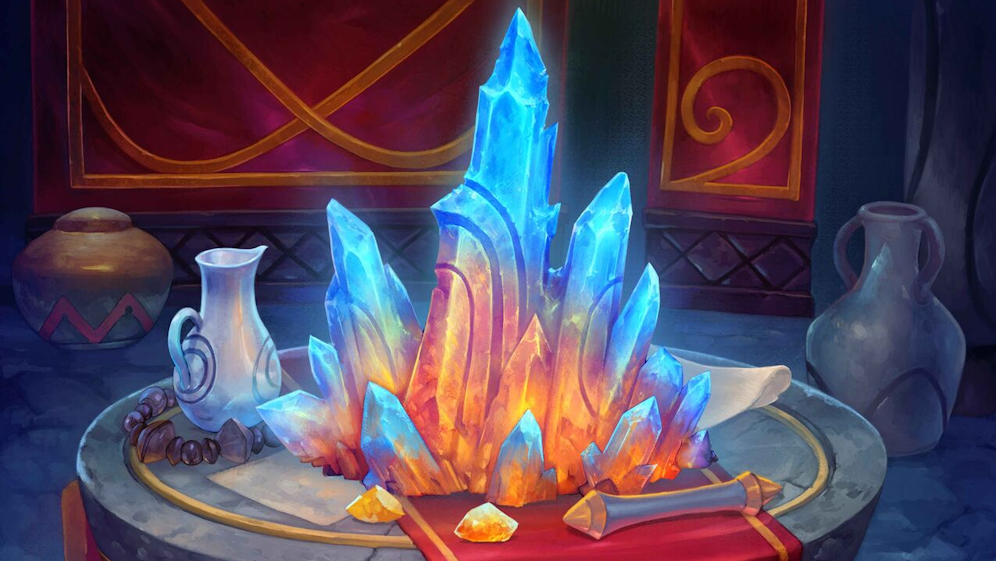
Galarium is a naturally occurring magical crystal found where ley energy remains strongly concentrated and stable over long periods. The richest deposits tend to develop around major ley nexuses, though smaller formations can appear elsewhere along powerful currents.
Its crystalline structure is exceptionally receptive to magic. Once properly prepared, Galarium can carry magical energy, hold it for later use, regulate its flow, or help an enchantment draw more effectively upon the power supplied to it. This versatility made Galarium one of the foundations of arcane engineering during the Age of Wonders and continues to make it one of Eldareth’s most valuable magical materials.
Physical Appearance
Natural Galarium is translucent or semi-translucent, with a glow that seems to come from within the crystal. Blue and cyan are common, often shading into gold, amber, or violet. Several colors can appear within the same formation, shifting gradually through the crystal rather than forming ordinary mineral bands.
Deposits usually grow as irregular clusters or veins. Worked pieces are often more compact and carefully shaped, particularly when intended for enchanted objects or arcane machinery.
The crystal can respond visibly when magic moves through it. Its inner glow may brighten, faint motes may gather around an active formation, and brief arcs can sometimes pass between nearby surfaces. Larger deposits or heavily charged crystals may also produce a low hum.
Formation and Regrowth
Galarium forms extremely slowly. Strong and stable concentrations of ley energy create favorable conditions for its growth, with major nexuses supporting some of the largest known deposits. A substantial formation usually indicates that the surrounding magical currents have remained powerful and relatively stable for centuries.
Deposits can gradually recover after mining if those conditions endure, though meaningful regrowth often takes generations. Heavy extraction can therefore leave a productive source depleted for centuries.
The Upheaval changed the course of ley currents throughout Eldareth, disrupting many old deposits while creating favorable conditions elsewhere. New formations have since appeared along parts of the altered network.
Eisyli are frequently observed around Galarium. These small luminous entities travel between deposits and areas of concentrated ley activity, and their presence appears to encourage growth and recovery where Galarium can already form naturally.
Magical Properties
Galarium responds unusually well to magical energy passing through its crystalline structure. A prepared crystal can serve very different purposes depending on how it has been worked and how it is incorporated into an enchantment or larger system.
Some Galarium is used to carry magical power through an object or machine. Other preparations allow energy to remain within the crystal until it is needed, or help keep an uneven magical flow under control. Galarium can also be prepared to strengthen the response of an enchantment, allowing it to make more effective use of the power already being supplied.
How much magic a piece can safely handle depends on the crystal itself and the construction around it. Size matters, but so do its quality, internal structure, preparation, and the way power is being moved through the finished system. The enormous installations of the Age of Wonders could manage magical loads far beyond those encountered in ordinary enchanted objects.
Refinement and Use
Natural Galarium usually undergoes specialist refinement before it is used in advanced magical work. The way the crystal is prepared determines how it will respond once magic is introduced.
This made Galarium unusually adaptable. The same mineral could be prepared for an enchanted object intended to preserve magic, incorporated into machinery that carried power between its parts, or used within larger systems designed to keep powerful magical currents under control.
Its usefulness extended well beyond machinery. Galarium became important to artificers and enchanters because it allowed complicated magical work to be made more reliable and repeatable, while still leaving room for older magical traditions that used other materials and methods.
The Galarium Revolution
Galarium had been known for far longer than it had been widely exploited. Around 1500 B.U., Giznat artificers developed reliable methods for refining the crystal and controlling its response to magic.
The breakthrough began what later became known as the Galarium Revolution. Over the centuries that followed, these techniques spread across Eldareth and were adapted by other artificers, scholars, and engineers.
Galarium helped make increasingly ambitious magical technology practical. Enchanted machinery became more dependable, new forms of magical transportation appeared, and large systems could maintain effects that had previously depended much more heavily upon the constant work of individual spellcasters.
The Great Leyline Conduits
By approximately 1350 B.U., Galarium had become central to the Great Leyline Conduits, vast networks built to draw power from major ley currents and distribute it across great distances.
Galarium was concentrated at important points throughout these networks, where carefully prepared crystal helped manage the immense magical loads entering and moving through the system. From there, the conduits carried power onward to settlements and infrastructure far removed from the nexus where it had been drawn.
These networks became one of the defining achievements of the Age of Wonders. Cities connected to them could support extensive magical transportation, defenses, workshops, public works, and other arcane infrastructure on a scale that would otherwise have required direct access to powerful ley nexuses.
Extraction and Trade
Healthy Galarium is stable enough to mine, but extracting valuable crystal requires care. A formation that survives intact can be far more useful than one shattered through careless work, particularly when its natural structure is unusually clear or coherent.
Greater caution is needed around deposits already carrying significant magical energy. Damage to an active formation can release some of that power, while mining around major nexuses also requires an understanding of the surrounding ley currents.
Careful extraction can leave those currents undisturbed. Greater risks emerge when a deposit is severely depleted or when nearby magic is deliberately drawn, redirected, or manipulated as part of the operation.
Productive Galarium mines are valuable assets, and large quantities attract considerable attention from governments, guilds, and other powerful interests. Smaller amounts also pass through specialist trade, with restrictions varying considerably between regions.
Scarcity and Political Importance
Demand for Galarium grew enormously during the later Age of Wonders. Older mines were driven deeper, new deposits were sought in increasingly distant regions, and control of productive sources became an important economic and political concern.
Its strategic value increased as more settlements came to depend on ley-powered infrastructure. During the Sundering Years, Galarium mines, major nexuses, and conduit routes could influence transportation, industry, and military power.
The pressures of this period reached beyond the extraction of the crystal itself. The greatest societies of the Age of Wonders were drawing immense quantities of energy from the ley network and redistributing it through infrastructure spanning entire regions.
Instability and Failure
Healthy Galarium is ordinarily stable. Its behavior becomes more dangerous when a crystal carries a heavy magical load, suffers serious structural damage, or remains connected to a system experiencing unstable flow.
A crystal under strain may begin to brighten sharply as fractures spread through it. Arcing can become more frequent, and the low resonance associated with active Galarium may grow noticeably stronger.
Many failures remain confined to the crystal and the machinery immediately around it. In larger installations, however, a single damaged part can expose connected systems to the same unstable flow. The amount of power moving through Age of Wonders infrastructure made these cascading failures particularly dangerous.
A catastrophic release can destroy nearby machinery and structures within moments. Under extreme conditions, uncontrolled arcane energy can manifest as Spellfire.
The Upheaval
The Upheaval caused Galarium infrastructure to fail on an unprecedented scale.
When the Mythal fractured in 0 U.R., ley currents throughout Eldareth shifted violently. Systems that had operated reliably for generations were suddenly exposed to surges and changes far beyond the conditions for which they had been built. Galarium cores overloaded or fractured, and failures spread through the infrastructure connected to them.
Ley stations, workshops, transportation systems, arcane vessels, and other magical works were destroyed across the world. Cities built around major nexuses or dense conduit networks suffered especially severe losses as failures passed from one system into another.
In the centuries that followed, many came to believe that the scale of magical exploitation during the Age of Wonders had contributed to the disaster. The enormous demands placed upon the ley network gave that belief lasting influence among scholars, governments, and the wider public. The cause of the initial worldwide failure remains unresolved in public history.
Galarium in the Modern Age
The Upheaval devastated Galarium production. Mines collapsed or became inaccessible, old formations were disrupted by shifting ley currents, and the networks that once moved large quantities of the crystal across Eldareth fell apart.
The knowledge surrounding Galarium survived through specialist traditions and preserved research, but the world no longer possessed the same supply or infrastructure needed to put that knowledge into practice on an Age of Wonders scale.
By around 630 U.R., this had begun to change. Scholars documented renewed growth in surviving deposits, while exploration of the altered ley network revealed formations that had developed since the Upheaval or had previously gone unnoticed. Galarium gradually became available in quantities capable of supporting more ambitious work once again.
Tessarion became one of the leading centers of this renewed arcane engineering. In 680 U.R., its artificers and engineers completed the first new functional skyships built since the Upheaval. Their success demonstrated that some of the great technologies of the previous age could once again be constructed with modern resources.
By 741 U.R., Galarium supports a substantial specialist industry across Eldareth. Refiners, artificers, enchanters, and arcane engineers work with it regularly, even though its availability and use remain far below the extraordinary scale reached during the Age of Wonders.
No true Great Leyline Conduit or full Regional Leyline Conduit has been restored. Their catastrophic failure during the Upheaval left a lasting distrust of attempts to manipulate the ley network on that scale. Even as skyships return to the skies and other advanced technologies reappear, rebuilding the great conduit networks remains one of the most controversial possibilities of the Age of Resurgence.