
Feonar, the Wanderer
Greater Deity
Domains: Fate, Trickery
Feonar is the god of fate and chance, particularly where judgment, wit, and unexpected opportunity can affect what comes next. He was the last member of the Celestial Accord brought into being by Elgalar, appearing after much of creation had already taken shape.
His followers understand fate as the course formed by choice, chance, and circumstance. Decisions change what follows, while accidents and unforeseen events can create possibilities that were never planned. Feonar is closely associated with moments when circumstances shift and someone must decide how to respond.
His ties to the Feywild are ancient, though his worship reaches far beyond it. He is especially popular among people whose lives regularly depend on uncertain outcomes or changing conditions.
Symbol
Feonar is most commonly represented by a golden coin marked with a spiral. The coin reflects chance, while the spiral represents the way one event or decision can affect those that follow.
Accounts of the symbol are not always consistent. Some worshippers claim the spiral has changed between viewings, while others describe markings absent from familiar versions. Most traditions accept these variations without insisting on a single fixed design.
Depictions
Feonar has no known fixed appearance and is said to take many mortal forms. Stories sometimes describe encounters in which his identity becomes apparent only afterward.
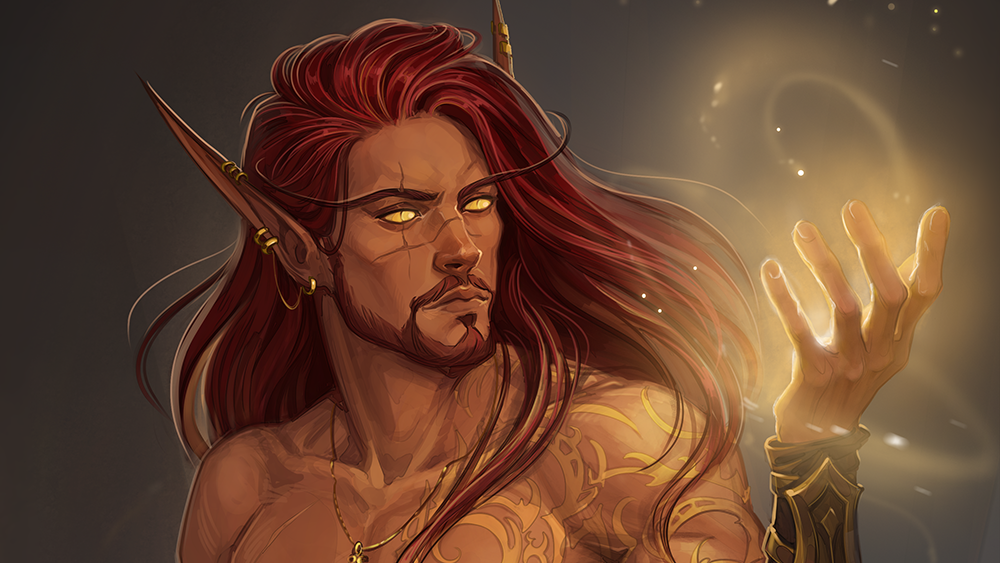
Religious art is more consistent. He is usually shown as a lean man with long reddish hair, pointed ears, golden eyes, and a hooded cloak of green or gold. This is understood as a conventional representation rather than his true form.
Disguise appears frequently in stories about Feonar. He often takes an unremarkable form while observing events or speaking with people who have no reason to suspect that they have met a god.
Divine Realm
Feonar has no permanent divine realm. Accounts most often place him in the Feywild or travelling through the Astral Plane, particularly near routes between realms.
His movements are aided by his unique relationship with the Mythal. Feonar was granted an exemption when the barrier was created and can cross it despite his divine nature. The reason for this exemption is not known with certainty.
Origins and Divine Role
Feonar was the final member of the Celestial Accord created by Elgalar, after much of creation had already been established.
Traditions surrounding his arrival associate him with the introduction of chance into the world. Preparation could influence an outcome without guaranteeing it, while unexpected circumstances could alter what choices were available.
Stories about Feonar often concern people who have become too certain that they understand what will happen next. An overlooked detail, an accident, or an unexpected decision can force them to reconsider their plans.
His trickery is rarely portrayed as cruelty for its own sake. It more often unsettles certainty or draws attention to options that might otherwise have been ignored.
Worship and Practice
Feonar has relatively few large temples. Small shrines are more common in places connected with travel, trade, games of chance, or other circumstances where outcomes are difficult to predict.
Coins are widely used in his worship. Some are left before a journey or uncertain undertaking, while others are carried until the matter is resolved and offered afterward. Local customs vary considerably.
His clergy has little central organization. Many priests travel, and local traditions often develop independently.
Feonar and the Peoples of Eldareth
Feonar appears throughout traditions connected to the Feywild. Stories place him among Archfey, near unstable crossings, and occasionally helping travellers who have become lost between realms. His relationships with the powers of the Feywild differ considerably between accounts.
Some Rakkari traditions connect their beginnings to an accident involving Feonar. Surviving versions disagree over what occurred and whether the event was accidental at all.
Giznat traditions also place Feonar near the period when their ancestors became widely known for their inventions. The surviving accounts differ enough that no single version is generally accepted.
After Lyrael's Death
Feonar played an important role in the events that followed Lyrael's death. Traditions credit him with gathering fragments of her remaining divine essence and joining them with four elemental spirits. From this came Durnathar, Kyrion, Nerissa, and Velora, the Primarchs.
He later helped uncover the identities of the Triad. Accounts describe him moving among mortals in different forms while tracing their influence and reporting what he learned to the rest of the Celestial Accord.
Teachings
-
Leave room for the unexpected.
-
Change course when circumstances change.
-
Notice an opportunity before dismissing the risk it carries.
-
Prefer wit when force would close off other options.
-
Never mistake good fortune for something you are owed.