
Awakening of the East
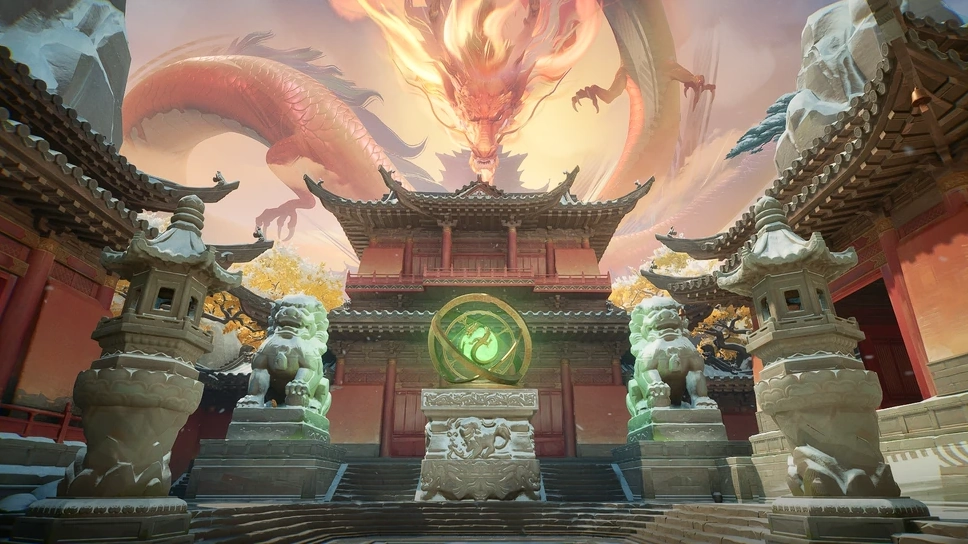
Long, long ago, when the sky held no stories and the rivers had yet to dream, the world waited. Still. Silent. Patient.
Ah... difficult to imagine, is it not? A world before all the tales we know. Before every mountain had a name and every old road had collected a ghost or two.
But even then, people were people.
Far below the clouds, there lived those whose sails touched every horizon. Their markets overflowed with silk and spice, their halls glittered with pearl and jade, and their voices carried into the courts of distant rulers. Fortune smiled upon them so often that, in time, they began to believe she did so because they deserved it.
That is the trouble with good fortune. Enjoy enough of it, and a person may begin to mistake luck for wisdom.
Their confidence grew. Then their pride. Soon they spoke not of living beside the sea, but of mastering it. They measured its depths, charted its currents, and drew lines across maps as though ink alone could make the waters obedient.
Ah... but knowing the road is not the same as owning it.
And the sea bows to no one.
The warnings came quietly at first. Fish abandoned familiar waters. Storms gathered far beyond the horizon and simply... waited. Sailors returned speaking of strange currents and spray that whispered against the hulls of their ships.
The old fishermen listened.
The rulers laughed.
In halls of marble, mock prayers were offered over cups of wine. Merchants joked that the sea itself must surely envy their wealth. Why should such a powerful people fear water?
A very foolish question.
The sea answered anyway.
A wall of jade rose against the horizon, vast as the sky itself. It reached the shore before the bells could finish their warning. Towers folded beneath it. Markets disappeared. Silken banners became scraps among the foam.
Gold sank beside common stone.
Royal decrees drifted beside broken timber.
The sea made no distinction between them.
When the waters finally withdrew, they left behind salt, silence, and the bitter memory of a lesson learned too late.
High among the stars, Zhàohuáng, the Eternal Dragon of Time, had watched it all. His golden coils wound through the heavens, and his gaze carried the weariness of one who had seen pride end badly many times before.
Beside him sat Wei’Shen, clever of claw and quick of heart. Her loom of mist and starlight had gone still, its silver threads trembling beneath her paws.
“Ambition without wisdom drifts toward ruin,” Zhàohuáng said.
Wei’Shen gave a small sigh. “And pride without restraint finds no safe harbor.”
They watched the ruined coast below.
At last Wei’Shen asked, “Shall we send them another ruler?”
Zhàohuáng was quiet for a moment.
“No. I think they have had quite enough rulers.”
Wei’Shen smiled.
“Teachers, then.”
And so the heavens chose seven.
Now... there is something the grand paintings tend to leave out.
The Seven were not always dragons.
No, little one.
Once, they were carp.
Strange, perhaps. But wisdom often begins in humble places.
In hidden streams and quiet mountain pools, silver-scaled carp leapt against rushing falls, climbing toward waters they could neither see nor understand. Most rose only a little before tumbling back into the river.
Then they tried again.
There is wisdom in that too.
Every so often, however, one would leap higher than the others. Higher than seemed possible. And when that happened, the heavens took notice.
Zhàohuáng saw those whose spirits endured. Wei’Shen saw those whose hearts might carry wisdom without becoming proud of it.
Those few were lifted beyond water and stone.
Fins became claws. Silver scales shone with celestial light. Their small bodies lengthened beneath the breath of heaven until humble river carp became dragons.
Not because they had conquered the river.
No.
Because they had learned from it.
Seven were chosen, each carrying a lesson the mortal world had forgotten.
And one by one, they descended.
First came Zhenyu.
He arrived beneath a sky bright with stars, his scales shining like moonlight upon polished gold. Yet Zhenyu did not raise a palace for himself, nor did he demand a crown.
He walked among mortals instead.
He spoke with rulers, farmers, soldiers, and scholars. He listened far more than he spoke, which, I am told, is a rare quality among both dragons and emperors.
In time, Zhenyu chose a line of rulers and placed within their blood a breath of his own celestial spirit. Not enough to make them dragons, no, but enough that his wisdom might awaken when the world had need of it.
Generations passed.
The breath remained.
When the stars shift and the balance of the world trembles, the dragon stirs once more within their blood. Thus stands Shen Xha, where its emperors are taught from childhood that a throne is not a prize.
It is a burden carried for others.
Then came Huanglong.
She emerged through curling mountain mist, emerald-eyed and endlessly patient. She found the warlords of Takorei doing what warlords so often do: sharpening their swords and arguing over who should swing first.
“Hold your strength,” Huanglong told them. “Coil it tightly. The storm that strikes too soon is little more than noise.”
The warlords did not care for this lesson.
No, no.
Young warriors are very fond of lessons that involve swinging swords. Patience is much harder to show off at a banquet.
But Huanglong waited.
That was, after all, the lesson.
She watched armies exhaust themselves. She watched victories become burdens and anger burn itself hollow. Slowly, the people of Takorei began to understand.
Strength was not found only in striking.
Sometimes it was found in choosing not to.
And so the Takorei Shogunate learned restraint, teaching that the sword left in its sheath may sometimes win the greater battle.
Meilan came more quietly.
Silver-scaled and soft-spoken, he wandered through gardens of stone and beneath silk lanterns glowing against the evening sky. He spoke so rarely that people learned to listen when he did.
One evening, he sat beside a perfectly still pond.
A student asked him how a person might know the truth of their own heart.
Meilan looked into the water.
“Still waters reflect clearly,” he said. “So too must the heart.”
That was all.
The student waited for more.
There was no more.
Sometimes the best lessons are short ones.
From his teachings grew the Jinshan Daeryun, where poets, sages, scholars, and warriors came to believe that strength begins with understanding oneself.
Then the sea welcomed Yuanzhu.
She rose laughing from beneath the waves, crowned in coral and bright shells, with the sound of the tide following wherever she went.
Yuanzhu loved a busy harbor.
Oh, she adored them.
Merchants shouting prices, gulls stealing breakfast, sailors arguing over knots, children running between crates while someone somewhere insisted that yes, of course this fish was worth twice what it had cost yesterday.
But when greed entered a bargain, Yuanzhu's laughter stopped.
“Give with kindness,” she taught. “Trade with honor. The waters remember what we carry across them.”
The Minhara Dynasties listened.
Their ships sailed farther. Their ports grew richer. Their palaces shone like morning light upon the sea.
But their prosperity did not come from taking everything they could.
They learned something far more useful.
A good trade leaves both hands fuller than before.
Baoxiang preferred quieter places.
He drifted along the rivers of Lian’Sa, moss growing between his scales, moving so slowly that children sometimes mistook him for an old log.
He did not seem bothered by this.
Children usually changed their minds when the log opened one eye.
Baoxiang watched farmers dig channels, fishermen cast their nets, and villages draw life from the river. He watched them carefully, as old creatures often do when young people believe no one is paying attention.
At last he said:
“Tend the river well, and it will tend you. Neglect it... and it will remind you who was here first.”
The people remembered.
Even now, lanterns are set upon the waters of Lian’Sa in thanks, and each harvest begins by honoring the rivers that made it possible.
Shidong came to the mountains.
Deep beneath roots older than kingdoms, she walked through halls of stone, iron-grey scales scraping softly against the earth.
The people of Namkar asked her how mountains survived storms, war, and the passing of ages.
Shidong placed one claw upon the stone.
“Stone endures,” she said.
Then she looked at them.
“So must you.”
Simple words.
Heavy ones.
Her lesson was not merely patience, but persistence. The patience to carve a road one strike at a time. The patience to build something knowing you may never live to see it finished.
After all, even mountains are shaped slowly.
And then...
Ah.
Then came Jinfeng.
Every family has one.
Jinfeng did not descend gently from the heavens.
He arrived inside a thunderstorm.
Lightning split the skies above the Shihar’i Isles. Waves battered the cliffs. Winds tore across the rooftops.
And there, among the black clouds, flew Jinfeng, laughing as though the entire storm had been arranged for his amusement.
“Survive me!” he roared.
The islanders thought this was a rather poor introduction.
Still, they survived.
Then Jinfeng returned.
And returned again.
Each storm taught them something. They built stronger ships. Learned how the winds changed before lightning came. Learned where waves broke and where currents hid beneath calm water.
Slowly, fear became understanding.
Understanding became confidence.
And one day, instead of sheltering from Jinfeng's storm, someone raised a sail.
Now that...
That made the dragon laugh.
The people of the Shihar’i Isles became storm-riders, guiding their ships between thunderheads as comfortably as other sailors crossed quiet bays.
And Jinfeng?
He could not have been prouder.
Seven dragons came.
Seven lessons were given.
And from those lessons, seven kingdoms grew.
But do not make the mistake of thinking that is where the tale ends.
No, no.
Stories like this rarely end. They simply grow old enough that people stop noticing they are still happening.
The dragons still watch.
Perhaps not from thrones or mountain peaks. Perhaps not where you expect.
Sometimes wisdom comes in the rustling of bamboo.
Sometimes in the pull of a river.
Sometimes in the silence before the storm.
And sometimes...
Well.
Sometimes it finds you while you are drinking tea.
So drink slowly, little one.
There is no wisdom in rushing a good cup.
Besides...
The dragons are patient.
They have always been patient.
They can wait until you are ready to listen.