
The Mythal
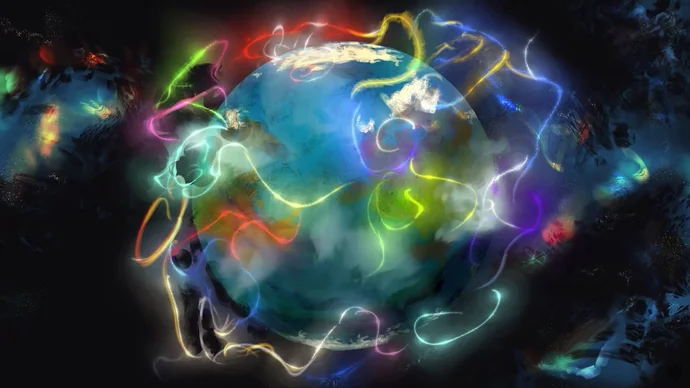
The Mythal is the planar barrier that prevents deities from entering Eldareth in their full divine form. It was established at the end of the Age of Divinity, following the final conflict with the Triad, when the Prime Deities agreed to withdraw their full presence from the Material Plane. Ao, the Realmweaver, gave that agreement permanent form through the barrier.
The gods remain connected to Eldareth despite that separation. Divine magic continues to function, prayers can still be answered, and deities may guide their followers or act through intermediaries. Feonar the Wanderer is the sole known exception to the restriction itself, having been granted freedom to cross the Mythal when it was created.
Origins of the Mythal
The Mythal arose from the destruction caused by earlier conflicts between gods. The Dawn War had already shown how severely Eldareth could suffer when divine powers fought directly within the Material Plane, and the later rise of Malgathar, Vorandor, and Lessarith threatened another conflict on a similar scale.
The Prime Deities eventually drove the Triad from Eldareth. Malgathar was cast into Baator, where he later reshaped the plane into the infernal empire of the Nine Hells. Lessarith was driven into the Abyss and established the Endless Spiral, while Vorandor was confined within the Gray Wastes.
Their exile ended the immediate conflict, but it left the underlying danger unresolved. Another struggle between deities could again turn Eldareth into a divine battlefield. The Prime Deities therefore accepted the same restriction placed upon their enemies and withdrew their full presence from the Material Plane.
Ao bound that agreement into the planar boundaries surrounding Eldareth, creating the Mythal.
Nature of the Barrier
The Mythal responds to divine presence rather than planar origin. Mortals and most beings from other planes can cross Eldareth's boundaries normally, and demigods remain beneath the level of power that triggers the barrier. The Dragon Ascendants can therefore reside within the Material Plane and travel beyond it despite their divine nature.
Deities are held beyond that boundary. A different body or manifested vessel cannot carry the same divine presence through the Mythal if the god itself would otherwise be barred.
Feonar's exemption was incorporated into the barrier from its creation and remains unique among known deities.
Divine Influence
The Mythal limits direct manifestation while leaving the relationship between gods and mortals intact. The gods remain capable of answering worshippers, granting divine power, and influencing events through those able to act within Eldareth.
This distinction has shaped the relationship between mortal faith and divine authority for most of recorded history. A god may make its wishes known, but carrying them out remains the responsibility of people living within the world.
The Mythal and Planar Travel
The Mythal permeates the planar boundary surrounding Eldareth rather than occupying a single gateway or location.
Travelers who have perceived it from the Astral Plane describe structures that do not correspond easily to ordinary space. Some accounts speak of vast lattices of divine energy, while others describe immense arches extending beyond sight without visible foundations. Such descriptions vary, and most planar travelers encounter no obvious sign of the barrier at all.
Its deeper relationship with Eldareth remains imperfectly understood. Scholars have long suspected a connection between the Mythal and the ley network, particularly because disturbances in both occurred during the Upheaval.
The Fracture During the Upheaval
The Mythal suffered its first known major fracture during the Upheaval. The cause has never been established with certainty.
Most scholars believe the catastrophe subjected the barrier to conditions it had never been designed to withstand. Others argue that the nature of the disturbance was more important than its sheer scale and may have interfered with one of the principles upon which Ao constructed the Mythal.
The fracture coincided with severe disruption throughout Eldareth's ley network. Long-stable currents changed course or failed, and magical systems dependent upon them became unstable. The resulting disasters contributed heavily to the collapse of the Age of Wonders.
Although damaged, the Mythal continued to prevent deities from entering Eldareth in their full divine form. Its wider planar structure was less fortunate. The relationships between the Material Plane and surrounding realms became increasingly unstable in the centuries that followed, giving rise to the phenomenon known as the Planar Drift.
The Planar Drift
Planar travel became less predictable after the Upheaval. Routes that had once been dependable changed, while some regions of Eldareth began experiencing stronger influence from neighboring planes.
These changes do not resemble movement through ordinary space. A plane may become easier to reach from Eldareth for a time and later seem more distant, while local conditions can make crossings possible in places where none were previously known.
The same instability has been suggested as a factor in the later Incursion from the Far Realm. Some scholars believe the weakened planar boundaries made a major breach easier to establish. Others suspect that the disturbances surrounding the Upheaval drew the attention of beings capable of perceiving events far beyond Eldareth's ordinary planar relationships. Neither explanation has been established.
The Mythal and Mortal Faith
The distance imposed by the Mythal places greater responsibility upon mortal followers of the gods. Divine guidance may still reach Eldareth, but people must interpret that guidance and decide how to act upon it.
This has shaped religious institutions throughout the ages since the Mythal's creation. Questions of doctrine or divine intent cannot always be resolved through direct intervention, and disagreement may persist even among sincere followers of the same deity.
The gods remain influential in mortal affairs, but much of what is done in their names depends upon the judgment of those who live within Eldareth.
The Mythal Today
The Mythal remains fractured in the Age of Resurgence, though its original restriction continues to function. Deities remain beyond Eldareth in their full divine forms, with Feonar retaining the exemption granted when the barrier was created.
Scholars disagree over the condition of the damage left by the Upheaval. Some believe the fracture stabilized centuries ago and that the Planar Drift is a lasting consequence of that event. Others interpret continuing changes in planar influence as evidence that the surrounding structure is still developing.
The Reverie Murmurs recorded in Alven'Nathiss have become part of that debate. Their resemblance to phenomena associated with Val'Syra has led some scholars to consider a planar connection, though their cause remains uncertain.
The Mythal has continued to serve its original purpose despite the damage it suffered. Whether that condition will remain stable in the centuries ahead is unknown.