
The Forge of Wills
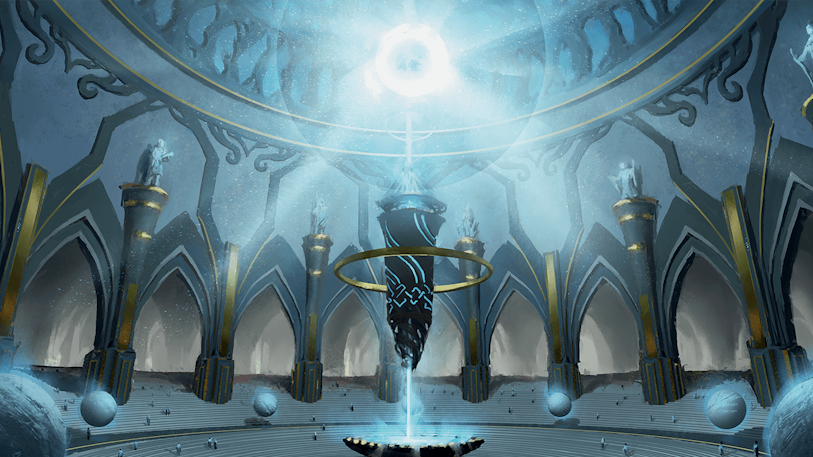
Deep beneath the Ironhowl Range of Skorrheim lies Thuradun, an ancient complex created after the Dawn War by the Jarl Triumvirate and their giant kin.
At its center stands the Forge of Wills. The first dwarves were created there after the Dawn War, and centuries later the Dragon Ascendants used the same Forge to create the first Dragonborn during the Incursion.
Thuradun spreads through the Ashen Depths and incorporates much of the natural cavern system around it. Despite its age, the complex has suffered little decay. Worked stone remains smooth, metal survives with little corrosion, and many of its mechanisms still function.
Only a small part of Thuradun is regularly occupied. Its custodians maintain posts near important chambers and entrances, but the complex has never developed into a conventional city.
Origins of Thuradun
Thuradun was created in the aftermath of the Dawn War, after portions of the defeated Primordial Titans' power were bestowed upon several of those who had fought against them. Five dragons became the Dragon Ascendants, while three giant Jarls received power of their own: Thalkor of the Stone Giants, Saaktar of the Fire Giants, and Thorden of the Storm Giants. Together they became known as the Jarl Triumvirate.
The three Jarls chose to surrender much of the power they had received toward the creation of Thuradun. They selected the Ashen Depths beneath the Ironhowl Range because a powerful ley line nexus lay beneath the mountains. The caverns also contained geothermal heat and ancient ice, while the surrounding range provided the isolation needed for their work.
With the aid of their giant kin, the Jarls reshaped the caverns into the complex that became Thuradun. At its center they created the Anima Core from the empowered essence surrendered by all three Jarls. The Core supplied the power required for the First Forging, through which the first dwarves were created.
Saaktar gave rise to the Emberforge lineage, Thorden to the Runeborn, and Thalkor to the Ironcrest. All three trace their beginning to Thuradun.
Architecture of Thuradun
Thuradun bears little resemblance to later dwarven or giant construction. Natural caverns pass into worked halls with few obvious boundaries between them. Stone surfaces meet without visible joints, while geometric patterns continue across walls and ceilings. Channels of light run through parts of the complex, sometimes disappearing into the surrounding stone before reappearing elsewhere.
Large rings hang above some halls without visible support. Bridges cross deep spaces without the foundations later builders would normally require, and enormous doors close so precisely that their seams disappear.
The scale changes throughout the complex. Some areas were built for giants, while smaller passages and workspaces accommodated dwarven attendants and craftsmen. The natural environment of the Ashen Depths also remains visible throughout Thuradun. Ancient ice survives near channels carrying heat from deeper beneath the mountain, and the builders incorporated both conditions into the complex.
Thuradun's age is often more apparent in its emptiness than in its condition. Dust gathers in chambers that have gone unused for generations, but the structures beneath remain largely intact.
The Heart of Thuradun
The most important structures lie near the center of the complex. The Anima Core hangs above an upper chamber within a system of concentric supports built into the surrounding walls, while an opening beneath it leads into the chamber containing the Forge of Wills.
When the central system is activated, power from the Anima Core is directed through this opening into the Forge below. The Forge occupies the center of the lower chamber, reached by broad causeways and overlooked by surrounding galleries.
Surviving accounts place Thalkor, Saaktar, and Thorden in these chambers during the First Forging. The Dragon Ascendants returned to the same part of Thuradun during the Second Forging.
The Anima Core has been directed into the Forge for this purpose only twice in recorded history. For nearly all of Thuradun's existence, the Forge has remained dormant.
The Second Forging
The Forge of Wills was awakened for the second known time during the Incursion, when forces from the Far Realm threatened Eldareth.
Nelashra, Ezavion, Nyladria, Syldaxa, and Yverian traveled to Thuradun and took part in the process. The Anima Core supplied the power required for the Forging, while each Ascendant contributed part of their own draconic essence.
The first Dragonborn were created through that act. They emerged as independent mortal people with lives and souls of their own. Although their creation took place during a period of war, their existence was not bound to that conflict, and later generations were born naturally without further use of the Forge.
After the Incursion, Dragonborn communities developed independently of Thuradun. The Aldramar Isles became their principal homeland, while Thuradun remained the place of their creation. The Forge has not been used for such a purpose since.
Nature of the Forge of Wills
The deeper workings of the Forge remain incompletely understood. Both known Forgings required beings of extraordinary power to contribute part of their essence while the Anima Core supplied the energy needed for the process. In each case, the result was new mortal life.
Surviving records do not fully explain how the Forge shapes contributed essence or how anima participates in the creation of a new person. No later group has reproduced either Forging.
The condition of the Anima Core is also uncertain. Some scholars believe the ley line nexus beneath Thuradun slowly restores what the Core expends, while others believe that every major activation permanently reduces the power remaining within it.
No conclusive answer has been established, and this uncertainty is one reason any proposal to awaken the Forge again would be treated with caution.
The Other Forges
Other forges exist throughout Thuradun. They differ in design and function, and the purpose of some is no longer fully understood. Surviving records attribute exceptional arms, constructs, and other works to them, and several remain functional enough to be used under supervision when there is sufficient reason to do so.
These forges remain fundamentally different from the Forge of Wills. They can create works of exceptional quality, but only the central Forge has demonstrated the ability to create a new people.
The Greater Complex
Thuradun extends far beyond the chambers surrounding the Anima Core. Halls and passages continue through the mountain at several levels, bridges cross deep shafts, and some structures extend beyond sight above or below the routes that remain in use.
The same geometric forms recur throughout distant parts of the complex, suggesting that Thuradun was designed as a connected whole. Some mechanisms continue to operate with little direct attention: rings turn above unused platforms, walls withdraw to expose passages, and channels of light respond when nearby systems become active.
Much of Thuradun remains closed. Some chambers are restricted, while others are sealed because they are no longer needed or because their purpose is uncertain. No complete modern survey of the complex is known to exist.
The Ashen Depths
Thuradun lies within the Ashen Depths, a cavern system beneath the Ironhowl Range in Jotungard.
The ley line nexus beneath the mountains was one of the main reasons the Jarl Triumvirate chose the site. The caverns also contain unusual elemental conditions, with magma passing through some sections while ancient ice survives nearby. The builders of Thuradun incorporated both into the complex rather than attempting to remove them.
The Gate of Anvils
The principal known entrance to Thuradun is the Gate of Anvils. The doorway lies within the mountain behind old approaches and wards maintained by generations of custodians.
Tradition holds that the Gate opens only to someone who approaches with a worthy purpose, though how literally this should be understood is known to few outside those responsible for maintaining it.
Routes into the Ashen Depths are absent from most maps, and reaching Thuradun without guidance is difficult. Other entrances exist, though most are sealed or controlled by the groups responsible for the complex.
Guardians and Access
Responsibility for Thuradun is shared among groups with different historical ties to the site.
The Emberguard, descended from Saaktar's Fire Giant kin, maintain the strongest continuous giant presence within the Ashen Depths. They protect important approaches and regard Thuradun as an inheritance entrusted to their ancestors.
Runeborn dwarven custodians maintain many of the surviving wards and preserve technical knowledge of the complex. The Stormforged Order also maintains a presence in Thuradun, with its members sworn to protect the site and prevent its power from being misused. Dragonborn maintain a smaller presence connected to the Second Forging and the history of their creation.
Outsiders may be admitted, but access is rare and carefully limited. Those granted entry are usually restricted to specific parts of the complex and remain under supervision. Permission to enter Thuradun does not grant access to the Forge of Wills, the Anima Core, sealed sections, or restricted lesser forges.
Those who live within Thuradun do so to maintain or protect it. Their quarters and workshops support that work rather than forming a settlement of their own.
The Giants and Thuradun
Living giant peoples remain connected to Thuradun's history. The unity that existed under the Jarl Triumvirate no longer defines Skorrheim's giants, but the complex remains an important surviving work associated with that period.
Fire Giants retain the strongest continuous custodial presence through the Emberguard. Stone Giant and Storm Giant traditions also preserve accounts of the three Jarls and the creation of Thuradun, while the oldest parts of the complex still contain inscriptions and maker marks left by giants who took part in its construction.
Modern giant communities do not necessarily agree on what Thuradun should mean to them in the present. Those relationships remain to be developed alongside the wider history of Skorrheim.
The Dwarven Connection
Thuradun is the birthplace of the first dwarves. The Ironcrest, Emberforge, and Runeborn lineages all trace their origins to the First Forging, but modern dwarven cultures have developed far beyond that beginning.
Thuradun can carry great historical significance without serving as a political homeland or religious center for every dwarf. Different communities may understand their connection to it in different ways.
The Dragonborn Connection
The Dragonborn trace their beginning to the Second Forging at Thuradun.
After their creation, they eventually settled the Aldramar Isles across the Aldramar Sea. The archipelago's older draconic history and its associations with the Ascendants were among the reasons they were drawn there. Aldramar became their principal homeland, while Thuradun remained their birthplace.
Modern Dragonborn do not share a single attitude toward the complex. Some regard it primarily as a place of historical importance, while others attach greater cultural or religious significance to it.
Dragonborn custodians and visitors maintain a connection to Thuradun, but the exact relationship between the site and any future Aldramar government remains unresolved.
The Forge of Wills Today
In 741 U.R., Thuradun remains active but lightly occupied. The Anima Core continues to function, several lesser forges remain usable, and the old wards still respond to their custodians.
Only a fraction of the complex sees regular use. Other sections remain sealed or may go for decades without a visitor.
The Forge of Wills itself remains dormant beneath the Anima Core. It has been used for the creation of a people twice in recorded history, first for the dwarves and later for the Dragonborn.