
The Elemental Primarchs
Lesser Deities, Embodiments of the Elements
Domains: Forge, Life, Light, Tempest
The Elemental Quadrumvirate, more commonly known as the Primarchs, consists of Durnathar, Kyrion, Nerissa, and Velora. They were created during the Dawn War when Feonar joined fragments of Lyrael's remaining divine essence to four elemental spirits.
Durnathar became the first Dao, Kyrion the first Efreet, Nerissa the first Marid, and Velora the first Djinn. The genie peoples that followed trace their earliest forms to them.
The Primarchs fought against the Primordial Titans and also travelled among the peoples of Eldareth, encouraging cooperation between communities that had previously had little reason to trust one another.
Symbol
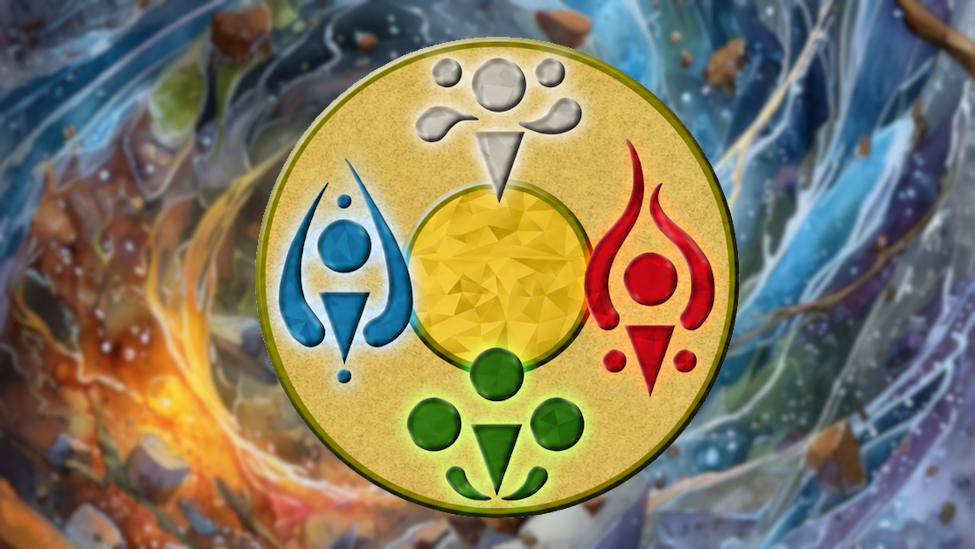
The Primarchs share a circular emblem containing four elemental marks around a common center. Earth is shown in green, fire in red, water in blue, and air in silver.
The complete emblem represents the Quadrumvirate together. Shrines devoted to one Primarch may use only that deity's mark or give it greater prominence within the larger design.
Origin and the Dawn War
The Primarchs came into being during the struggle against the Primordial Titans, when Lyrael's power was already failing.
Feonar preserved fragments of her remaining divine essence by joining them with four elemental spirits. The resulting beings carried part of Lyrael's former elemental power while retaining the nature of the spirits from which they had arisen.
Their forms became the first of their kind: Durnathar as a Dao, Kyrion as an Efreet, Nerissa as a Marid, and Velora as a Djinn.
All four entered the Dawn War soon after their creation. Alongside their role in battle, they carried warnings between distant regions and encouraged rulers and communities to coordinate their defenses against the Titans.
All four survived the war. Their connection to Lyrael remained part of their identity afterward, and their worship spread among both mortal peoples and the genie lineages that descended from them.
The Four Primarchs
Depictions of the Primarchs vary between cultures. Some show them in largely humanoid forms, while others allow stone, flame, water, or moving air to form much of their bodies.
Their elemental nature remains visible in nearly all traditions, though their forms are usually kept distinct from the immense and destructive imagery associated with the Primordial Titans.
Durnathar, Primarch of Earth
Durnathar is the first Dao and is most closely tied to the Forge Domain.
He is commonly depicted as broad and heavily built, with skin resembling polished stone or dark mineral. More elemental depictions may show crystal growths or seams of ore beneath his skin.
Durnathar is associated with careful work, sound judgment before commitment, and reliability once others depend upon what has been promised or built.
Builders and craftspeople may invoke him before beginning work whose failure could endanger others.
Teachings
-
Build so others can trust what you leave behind.
-
Consider a commitment carefully before making it.
-
Remain dependable once others rely on you.
Kyrion, Primarch of Fire
Kyrion is the first Efreet and is most closely tied to the Light Domain.
He is often depicted with bronze or darkened skin surrounded by controlled flame. In more elemental forms, fire rises from his body or replaces parts of it entirely.
Kyrion is associated with acting when delay would allow a danger to worsen. His faith also places importance on keeping anger under control when decisions must be made quickly.
He is commonly invoked when dangerous circumstances require prompt action or difficult judgment.
Teachings
-
Act when delay will allow danger to grow.
-
Do not let anger make your decisions.
-
Accept necessary change rather than delaying it without cause.
Nerissa, Primarch of Water
Nerissa is the first Marid and is most closely tied to the Life Domain.
She is often depicted with blue or green skin and hair that moves like water. Some traditions show parts of her body flowing out of a fixed shape before gathering again.
Nerissa is associated with preserving life and knowing when circumstances require a change of course. Her followers are taught that persistence loses its value when it causes greater harm.
She is widely invoked by healers, sailors, and others whose work depends upon adapting to conditions that cannot always be controlled.
Teachings
-
Change course when continuing will cause greater harm.
-
Preserve life when you can.
-
Do not waste lives to preserve a failing plan.
Velora, Primarch of Air
Velora is the first Djinn and is most closely tied to the Tempest Domain.
She is commonly depicted in a slender humanoid form surrounded by constant wind. More elemental depictions allow parts of her body to fade into cloud, mist, or moving air.
Velora is associated with travel, curiosity, and learning through direct experience. Her followers are encouraged to listen carefully, seek unfamiliar places and ideas, and revise their conclusions when experience gives them reason to do so.
She is frequently invoked before long journeys or travel beyond familiar regions.
Teachings
-
Listen before deciding.
-
Go beyond what is familiar.
-
Change your mind when experience gives you reason to.
Their Elemental Seats
Each Primarch maintains a seat of power within the Elemental Plane tied to their nature.
Durnathar resides in the Diamond Bastion on the Plane of Earth, a fortress built among immense mineral formations.
Kyrion is tied to the City of Brass on the Plane of Fire, where his influence remains closely connected to the Efreet and the city's foundries.
Nerissa rules from the Coral Sanctum on the Plane of Water, a settlement grown from living coral in the deeper reaches of the plane.
Velora holds the Galeheart Court on the Plane of Air. The Court moves with the currents and has no fixed location.
Worship and Influence
The Primarchs may be worshipped individually or together. Local conditions and traditions usually determine which receives the greatest attention.
Collective worship often draws on their shared history during the Dawn War. The four came from different elements but worked together against the same threat, and they are still invoked together when cooperation between different communities is especially important.
Their worship remains widespread among the genie peoples that trace their origins to them, as well as among mortal communities connected to their elements or teachings.