
Serpentfolk
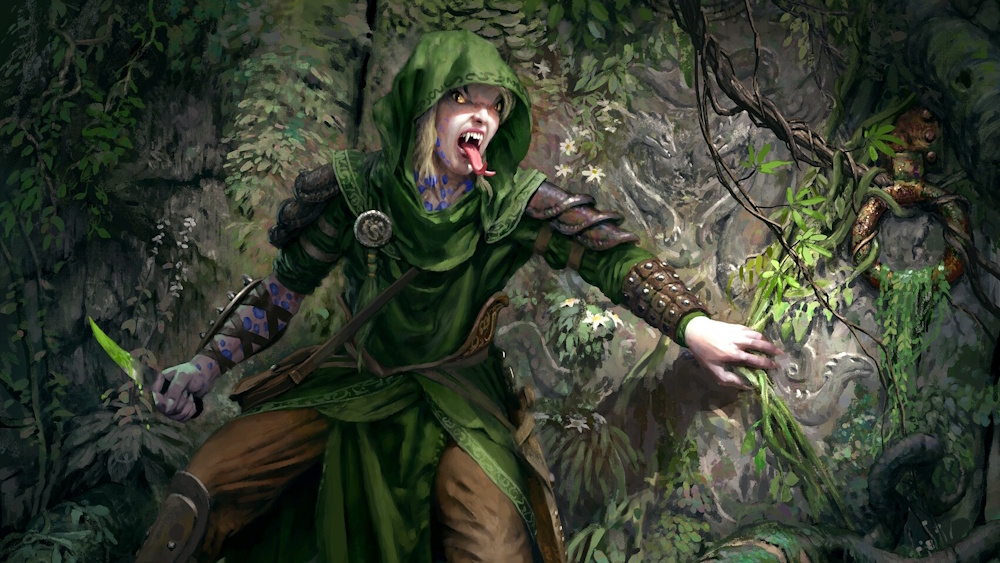
The Ssith'katha are a serpentine people whose origins lie in Zalthyx, the serpent kingdom south of Avermont and Shahoya.
Their ancestors belonged to ancient southern peoples related to the Tavaska. Long before the Ssith'katha emerged, these communities had developed traditions distinct from those of their northern relatives. Their Shifting increasingly reflected the reptiles and serpents of the southern lands, and serpentine features had already become more common among them.
Lessarith later intervened among these southern peoples. Known among the Ssith'katha as Sszal'Zirith, she offered some of their ancestors power and transformation beyond the forms they had inherited.
Through ancient pacts and ritual changes, Sszal'Zirith altered those bloodlines further. The transformation became hereditary, and over the generations that followed their descendants developed into the first Ssith'katha.
Tavaska traditions remember this event differently. They know Lessarith as Zhanna, Snake-in-Smoke, and describe the transformation as the betrayal of Kihowa by southern kin who accepted the Deceiver's promises. Ssith'katha traditions preserve their own accounts of those events and of the choices made by their ancestors.
Sszal'Zirith's role in their creation does not require allegiance to her. Ssith'katha religious traditions have changed considerably since their origins, and many have no devotion to Lessarith at all.
Over time, the Ssith'katha established societies of their own throughout Zalthyx. Their history became closely intertwined with the temples, ruling families, and institutions that developed there.
The Anath'iss are the most numerous Ssith'katha lineage and the one most often encountered beyond Zalthyx. Families have lived abroad for generations, and their connection to the old kingdom varies greatly. Some remain closely involved with its religion or politics, while others regard Zalthyx primarily as the homeland of their ancestors.
Identity and Culture
Anath'iss have largely humanoid bodies with visible serpentine features. Fine scales commonly appear across parts of the body, while vertical pupils, forked tongues, and elongated canine teeth are also common.
The extent of these traits varies considerably between families. Some Anath'iss appear mostly human from a distance, while others possess extensive scales or more pronounced serpentine features.
Older Zalthyx court and temple traditions place considerable value on careful observation, deliberate speech, and discretion. Families influenced by these customs often teach children to listen closely, consider what has already been said, and understand a situation before committing themselves to an answer or course of action.
The handling of private knowledge also carries particular weight in traditional Zalthyx society. Knowing when information should be shared, withheld, or entrusted to someone else can be treated as an important part of judgment.
Different factions have developed sharply different views about how these principles should shape political and family life.
The Gilded Coil
The Gilded Coil teaches that information should be gathered carefully and revealed with purpose.
Its traditions treat knowledge as a form of influence. Members are encouraged to understand the people and circumstances around them before deciding what should be shared.
This approach has given the Coil considerable influence within Zalthyx politics and has also earned it a reputation for secrecy. Practices that Coil members regard as prudent judgment can appear manipulative to those who expect greater openness.
The Dawncoil
The Dawncoil developed among Ssith'katha who sought to reform older Zalthyx institutions while preserving parts of the culture from which they came.
Dawncoil traditions retain the older emphasis on discipline, measured speech, and self-control. They place stronger limits on the use of authority and private information, particularly where either is used to compel obedience or restrict another person's choices.
The Dawncoil is also more willing to question established rulings and to work openly with communities beyond Zalthyx.
The Xal'Tarothi
The Xal'Tarothi preserve a stricter interpretation of Zalthyx law, temple teaching, and social hierarchy.
They hold that recognized authority creates obligations and establishes who bears responsibility within a family, institution, or state. Rank therefore carries duties as well as privileges, and challenges to established authority are expected to follow accepted procedures.
These beliefs place the Xal'Tarothi in frequent conflict with the Dawncoil, whose reforms they see as weakening structures that have governed Zalthyx society for generations.
Ssith'katha Across Eldareth
Anath'iss have lived beyond Zalthyx for generations and remain the Ssith'katha most familiar to people elsewhere in Eldareth.
Communities abroad differ greatly in how closely they remain connected to their ancestral homeland. Some preserve strong religious, political, or family ties to Zalthyx, while others have become part of the cultures in which they now live.
Anath'iss raised in traditional households may retain habits of deliberate speech and discretion even after settling elsewhere. For others, those customs survive only through older relatives or family stories.
The reputation of Zalthyx can still affect how Ssith'katha are treated abroad. Regions that have experienced political interference or covert activity from Zalthyx factions may regard visiting agents with suspicion, and ordinary Anath'iss families can encounter the same assumptions regardless of their own loyalties.
As communities outside Zalthyx have grown older, their relationship with the kingdom has become increasingly varied. Some continue to look toward its temples and institutions for guidance. Others regard Zalthyx as an ancestral homeland whose authority ended when their families built lives elsewhere.
Anath'iss Traits
Ability Score Increase. When determining your character's ability scores, increase one score by 2 and increase a different score by 1, or increase three different scores by 1. You can't raise any of your scores above 20.
Creature Type. You are a Humanoid.
Size. You are Medium.
Speed. Your walking speed is 30 feet.
Darkvision. You can see in Dim Light within 60 feet of yourself as if it were Bright Light and in Darkness within that range as if it were Dim Light. You discern colors in that Darkness only as shades of gray.
Magic Resistance. You have Advantage on saving throws against spells.
Poison Resilience. You have Resistance to Poison damage. You also have Advantage on saving throws you make to avoid or end the Poisoned condition.
Serpentine Spellcasting. Choose Intelligence, Wisdom, or Charisma when you select this species. Your chosen ability is your spellcasting ability for the spells granted by this trait. Your choice can't be changed.
You know the Poison Spray cantrip.
Starting at character level 3, you can cast Speak with Animals with this trait. When you cast Speak with Animals through this trait, you can comprehend and verbally communicate only with snakes rather than with all Beasts.
Starting at character level 5, you can cast Suggestion with this trait.
You can cast each leveled spell granted by this trait once without expending a spell slot, and you regain the ability to cast that spell in this way when you finish a Long Rest. You can also cast these spells using any spell slots you have of the appropriate level.
When you cast Speak with Animals using a spell slot through this trait, its restriction to snakes still applies.
This trait doesn't allow you to cast Speak with Animals as a Ritual. If another feature separately allows you to cast that spell as a Ritual, you follow the rules of that feature instead.
When you cast a spell through this trait, the spell requires no Material components unless a Material component has a specified cost or is consumed by the spell. You must provide any such component as normal.
Languages. Your character can speak, read, and write Common and two other Standard Languages that you and your DM agree are appropriate for the character. The Player's Handbook offers a list of Standard Languages to choose from. The DM is free to modify that list for a campaign.