
Rootwardens
The Thal'Ruun descend from the Elaren Enclave, a druidic community of Elves, Firbolgs, and Orcs that once lived near the northern Greyspires and adjoining highlands.
When the Creeping Rot spread through the region around 2000 B.U., the Enclave could no longer safely remain on the surface. Thal'Ruun tradition remembers a senior druid receiving recurring visions that suggested refuge and living places could be found beneath the mountains. Later generations often interpret those visions as guidance from Yssarel, though the surviving accounts describe no spoken command or direct revelation.
After scouting the caverns below, the Elaren began an organized evacuation through Whispering Hollow. Families carried livestock, supplies, tools, and whatever else could support a permanent community if returning home proved impossible.
Their first settlements were places of refuge. Over time, exploration carried them deeper into the caverns now known as the Murmuring Depths, where they learned to cultivate new foods, raise subterranean livestock, and build communities around reliable water and stable ground.
One of their most important discoveries was Thalradir, the immense root system of Faelar'dor extending deep beneath the Northern Highlands. The settlement of Thalvethar eventually developed around those roots and became one of the oldest centers of Thal'Ruun life.
Conditions on the surface eventually improved. Some descendants of the Elaren returned or dispersed elsewhere, while others chose to remain below in communities that had long since become their homes.
The Thal'Ruun emerged gradually during the centuries that followed. Mixed ancestry within the Enclave, life in the Murmuring Depths, and generations of adaptation produced a people distinct from the Elves, Firbolgs, and Orcs from whom they descended.
On the surface, Thal'Ruun are sometimes referred to collectively as Rootwardens. Among the Thal'Ruun themselves, Rootwarden has a more specific meaning and refers to those trained to care for the environments their communities depend upon.
Identity and Culture
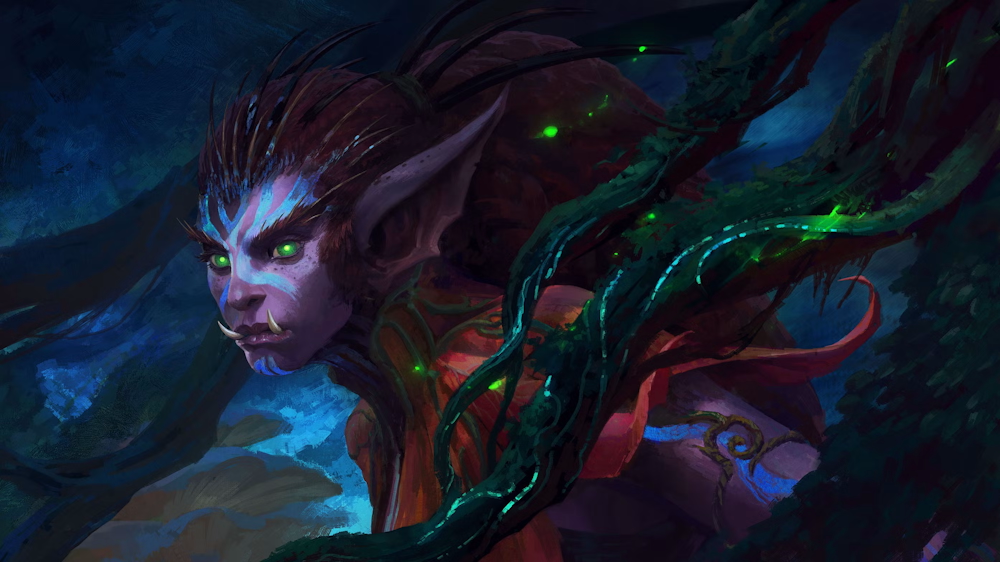
Thal'Ruun are tall and commonly broad or powerfully built. Their features preserve traces of their mixed ancestry, with pointed ears, strong facial structure, and broad or flattened noses appearing frequently. Small tusks or pronounced lower canines occur in some families.
Their skin varies widely, with grey, muted purple, brown, green, teal, and blue-grey tones all known among different communities. Fine fur can appear across parts of the body, though its extent differs considerably between individuals.
Hardened thornlike growths are among their most distinctive features. They commonly develop along the limbs, shoulders, back, or face and vary greatly in size and density. Some Thal'Ruun also possess unusually bright eyes or faint natural markings, though these are less common.
Some individuals deliberately cultivate harmless moss or similar growth along their thorns or skin. The practice is personal rather than universal and can reflect local custom, preference, or simple familiarity with the living environments of the Murmuring Depths.
Clothing is adapted to life below and to the thorn growths of the wearer. Materials depend heavily on what a settlement can cultivate, hunt, produce, or acquire through trade.
Thal'Ruun settlements are scattered throughout the Murmuring Depths. Most exist for ordinary practical reasons: dependable water, stable caverns, productive farmland, workable routes, or access to resources that can sustain a community.
Some settlements are associated with Thornvaults, protected sites maintained because something there requires long-term stewardship. A Thornvault might preserve an important living system, guard something vulnerable, or contain a danger that cannot simply be removed. Some support large settlements, while others are cared for by only a small community.
Thalradir is one such site, with Thalvethar developing around the great roots over generations.
Most Thal'Ruun continue to worship Yssarel. Her traditions were carried below by the Elaren and changed alongside the communities that preserved them, with stewardship increasingly shaped by the demands of subterranean life.
Rootsong
Rootsong is the traditional language of the Thal'Ruun.
It developed from the languages spoken within the Elaren Enclave, with particularly strong Elven and Firbolg influence. Rootsong makes frequent use of deep vocal tones and layered resonance. Skilled speakers can sustain a low note while shaping higher sounds above it.
Everyday conversation uses these qualities lightly. Formal song, prayer, storytelling, and ceremonial recitation make greater use of sustained tones and harmonics, producing a sound similar to overtone throat singing.
Rootsong is an ordinary spoken and written language. Its sounds are not inherently magical.
Rootchanters are specialists in its formal use and in the preservation of Thal'Ruun history. They maintain oral and written traditions, and some are trained in rites that allow selected memories to be preserved within suitable living roots.
Such rites are reserved for memories considered worth preserving in that form. Most Thal'Ruun history continues to be kept through ordinary writing, oral tradition, and community record keeping.
The Rootwardens
Rootwardens are Thal'Ruun trained to understand and protect the environments that sustain their communities.
They watch for changes that could threaten water, food, wildlife, cultivated growth, or the stability of the caverns themselves. Their work depends heavily on observation and on understanding what is normal for a particular environment before deciding that intervention is necessary.
Decay, predation, and death are ordinary parts of the living world within Rootwarden teaching. Intervention becomes necessary when disease, contamination, or another disturbance begins spreading beyond the balance of the surrounding environment.
Some Rootwardens are druids, while many are not. Primal magic can be useful, but practical knowledge of the Murmuring Depths remains central to the role.
The memory of the Creeping Rot remains part of Rootwarden teaching. The loss of the Elaren homeland left later generations particularly attentive to threats that begin locally and then spread through otherwise healthy environments.
Rootwarden traditions developed differently between settlements because the environments under their care are different. A community built around deep roots may require different knowledge from one dependent on underground rivers, fungal agriculture, or livestock.
Thal'Ruun Across Eldareth
Most Thal'Ruun still live within the Murmuring Depths beneath Vel'Nathar.
Their communities were largely separated from the surface for much of their history, though they were never entirely alone underground. Trade and contact with other peoples of the Depths developed over time, particularly along established subterranean routes.
Surface stories about the Thal'Ruun are especially common around the Greyspires. Miners, explorers, and travelers have occasionally encountered them near passages leading into deeper cavern systems, while old traditions surrounding Whispering Hollow preserve fragmented memories of the Elaren disappearance.
Contact with the surface has increased somewhat in recent generations. Thal'Ruun may travel above ground for trade, study, family matters, or to investigate changes that could affect the caverns below.
Nearly three millennia of life beneath Vel'Nathar have given the Thal'Ruun their own language, settlements, and traditions. Their ancestry remains part of their history, while the people they became were shaped within the Murmuring Depths.
Thal'Ruun Traits
Ability Score Increase. When determining your character's ability scores, increase one score by 2 and increase a different score by 1, or increase three different scores by 1. You can't raise any of your scores above 20.
Creature Type. You are a Humanoid.
Size. You are Medium.
Speed. Your walking speed is 30 feet.
Darkvision. You can see in Dim Light within 120 feet of yourself as if it were Bright Light and in Darkness within that range as if it were Dim Light. You discern colors in that Darkness only as shades of gray.
Natural Resilience. You have Resistance to Poison damage. You also have Advantage on saving throws you make to avoid or end the Poisoned condition.
Thorned Hide. Hardened thornlike growths form a natural layer of protection across your body. While you aren't wearing armor, your base Armor Class equals 12 plus your Constitution modifier. You can use a Shield and still gain this benefit.
If you retain this trait while transformed, including when you assume a Beast form using Wild Shape, your thorn growth manifests across the transformed body. When determining your Armor Class this way, use the Constitution modifier of your current form. A Shield provides its normal benefit only while your current form is physically capable of using it.
Thornshield. When a creature within 5 feet of you hits you with an attack roll, you can take a Reaction to deal 1d8 Piercing damage to that creature.
You can use this trait a number of times equal to your Proficiency Bonus, and you regain all expended uses when you finish a Long Rest.
If your thorn growth remains present while you are transformed, you can continue to use this trait.
Ancestral Magic. Choose Intelligence, Wisdom, or Charisma when you select this species. Your chosen ability is your spellcasting ability for the spell granted by this trait. Your choice can't be changed.
You know the Thorn Whip cantrip.
When you cast Thorn Whip through this trait, the spell requires no Material components.
Rootform. Starting at character level 5, you can reshape your body into one of two specialized forms adapted for travel through difficult environments: a Thorn Bat or Root Serpent.
As a Bonus Action, choose one of these forms and transform into it for 10 minutes. You remain in the chosen form for the duration and can't change to the other Rootform as part of the same use. The transformation ends early if you are Incapacitated, if you die, or if you end it as a Bonus Action.
Except for the changes described by your chosen Rootform, your game statistics remain unchanged.
All equipment you are wearing or carrying merges into your Rootform. While merged, that equipment has no effect and can't be accessed, manipulated, used, or activated. When Rootform ends, the equipment reappears on or with you.
While transformed, you can't make attacks, cast spells, wield weapons, use tools, activate magic items, or speak normally, though you continue to understand the languages you know. You can maintain Concentration on a spell or other effect that was already active when you transformed.
Rootform can't combine with Wild Shape or another effect that transforms your body into another creature or physical form. Assuming another such form ends Rootform, and entering Rootform ends any such transformation already affecting you.
Once you transform using this trait, you can't do so again until you finish a Long Rest. Ending the transformation early doesn't restore the use.
Thorn Bat. While in this form, your Size is Small, your Speed is 10 feet, and you have a Fly Speed of 40 feet. You also have Blindsight with a range of 30 feet. This Blindsight represents echolocation and doesn't function while you are Deafened.
Root Serpent. While in this form, your Size is Medium, your Speed is 30 feet, and you have a Burrow Speed of 20 feet. You can use this Burrow Speed to move through earth, soil, sand, mud, dense fungal matter, and similarly yielding natural material. You can't burrow through solid rock, worked stone, metal, or similarly rigid material unless another feature specifically allows you to do so.
You also have Tremorsense with a range of 30 feet while you are in contact with the ground.
Languages. Your character can speak, read, and write Common and two other Standard Languages that you and your DM agree are appropriate for the character. The Player's Handbook offers a list of Standard Languages to choose from. The DM is free to modify that list for a campaign.