
Ringtails
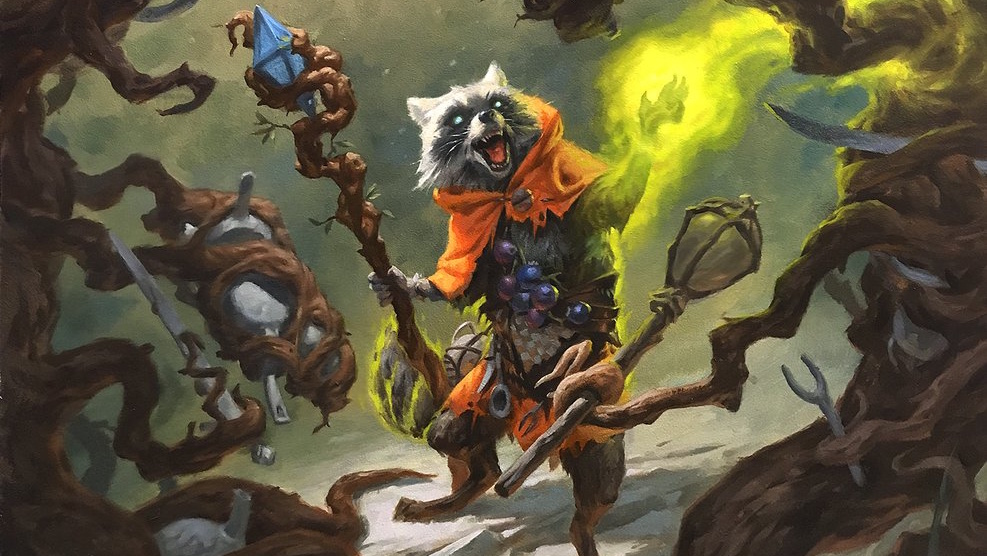
The Rakkari, commonly called Ringtails, are raccoon-like humanoids whose oldest known communities come from the wilds of Shahoya.
Some of their oldest stories connect their origins to Feonar, though the nature of that relationship remains uncertain. Different communities preserve different versions, and no single account is accepted as definitive.
Repair and reuse are familiar parts of Rakkari life. Damaged objects are often mended or adapted when they still have some use, while existing spaces are commonly altered rather than abandoned simply because they no longer serve their original purpose.
Ordinary possessions can also acquire lasting importance through the people and events associated with them. An object does not need to be rare or valuable to remain within a family for generations.
Identity and Culture
Rakkari are small and lightly built, with furred bodies and long ringed tails. Their hands are especially dexterous, with long fingers suited to detailed work. Fur color and markings vary between families, though most have the dark facial pattern that gave rise to the common name Ringtails.
Rakkari homes are commonly called dens. In Shahoya, older dens often make use of natural shelter or existing structures. In towns and cities, families may adapt parts of buildings that were constructed for other purposes. A den can change gradually over many years as the household changes with it.
Household history is often preserved through objects that remain in use or are kept because of the stories attached to them. The significance of an item comes from what it represents to the family rather than from its material value.
Two broad Rakkari traditions are commonly recognized: the Rootwise and the Scuttlers.
Rootwise
Rootwise Rakkari are most closely associated with Shahoya and with communities that preserve older regional traditions.
Knowledge of the land surrounding a den carries considerable importance. Stories often preserve how an area has changed over time and what earlier generations learned about living there.
In parts of Shahoya, Rootwise communities maintain long-standing relationships with nearby Tavaska. Their knowledge may be sought when dealing with local spirits or unfamiliar supernatural activity, particularly where the two peoples have lived alongside one another for generations.
The history preserved within a household is closely connected to this wider local knowledge. Family stories often place older objects and events within the history of the land around them.
Scuttlers
Scuttler traditions developed as Rakkari established themselves in larger towns and cities.
Their dens are often adapted from existing buildings and may change repeatedly as families move, expand, or make use of space that becomes available. Privacy is often achieved through careful use of the structure itself rather than through any single architectural style.
The older Rakkari preference for repairing and repurposing remains strong in many Scuttler communities. Urban life simply gives it different materials and opportunities.
Household histories can also reflect generations of movement between neighborhoods or cities. Objects from newer homes may eventually sit beside keepsakes carried from Shahoya or from places the family lived long before.
The Den Root
Most Rakkari households maintain a Den Root, a collection of objects chosen to preserve parts of the family's history.
The objects are often ordinary. Their importance comes from the story attached to them and the person, place, or event they represent.
Adding something to the Den Root is usually a deliberate choice. The story behind the object is told and preserved along with it, allowing later generations to understand why the family kept it.
A Den Root is not tied permanently to one location. When a family moves, the collection moves with them. In this way, a household can carry parts of its history through several dens and across generations.
Den Roots vary greatly in size and form. Some contain only a small number of carefully preserved objects, while others have accumulated material across many generations.
Rakkari Across Eldareth
Rakkari gradually spread beyond Shahoya through older trade routes and growing settlements.
Established communities can now be found in Vel'Nathar, Célaine, and the ports of Calvessa, alongside smaller populations elsewhere. Shahoya remains the region most closely associated with their early history and with many of the oldest Rootwise traditions.
Urban Rakkari communities have developed differently according to the places in which they settled. Scuttler traditions in one city may therefore differ considerably from those found elsewhere.
Older dens can preserve family memories of neighborhoods, businesses, disasters, migrations, and other local events that may no longer be remembered outside the household. These stories remain family history first, even when they also preserve details about the places in which Rakkari have lived.
Rakkari communities across Eldareth continue to change with their surroundings while retaining familiar ideas about reuse, household memory, and the importance of giving old things new purpose.
Rakkari Traits
Ability Score Increase. When determining your character's ability scores, increase one score by 2 and increase a different score by 1, or increase three different scores by 1. You can't raise any of your scores above 20.
Creature Type. You are a Humanoid.
Size. You are Small.
Speed. Your walking speed is 30 feet.
Darkvision. You can see in Dim Light within 60 feet of yourself as if it were Bright Light and in Darkness within that range as if it were Dim Light. You discern colors in that Darkness only as shades of gray.
Scamper. You have a Climb Speed equal to your Speed.
Keen Smell. You have Advantage on Wisdom (Perception) checks that rely on smell.
Scrappy Reflexes. When you fail a Dexterity saving throw, you can take a Reaction to roll a d4 and add the number rolled to the saving throw, potentially turning the failure into a success.
You can't use this trait while you have the Prone condition or while your Speed is 0.
Scrapcraft. You can spend 10 minutes assembling discarded, salvaged, or otherwise suitable nonmagical materials into a crude but functional object.
Choose one nonmagical item from the Adventuring Gear table that has a listed cost of 10 GP or less. You must have access to enough suitable material to reasonably construct the chosen item.
The item can't be a weapon, armor, shield, ammunition, tool, spellcasting focus, poison, alchemical substance or item, food, drink, medicine, or any object whose normal function depends on expendable charges, doses, ammunition, or other consumable contents.
The object functions as a normal version of the chosen item for 1 hour, after which it becomes unusable.
An object created with this trait has no monetary value, can't be used to satisfy the cost of a spell's Material component, and can't be used as material for crafting another item.
You can have only one object created with this trait at a time. If you create another, the previous object immediately becomes unusable.
Languages. Your character can speak, read, and write Common and two other Standard Languages that you and your DM agree are appropriate for the character. The Player's Handbook offers a list of Standard Languages to choose from. The DM is free to modify that list for a campaign.