
Orcs
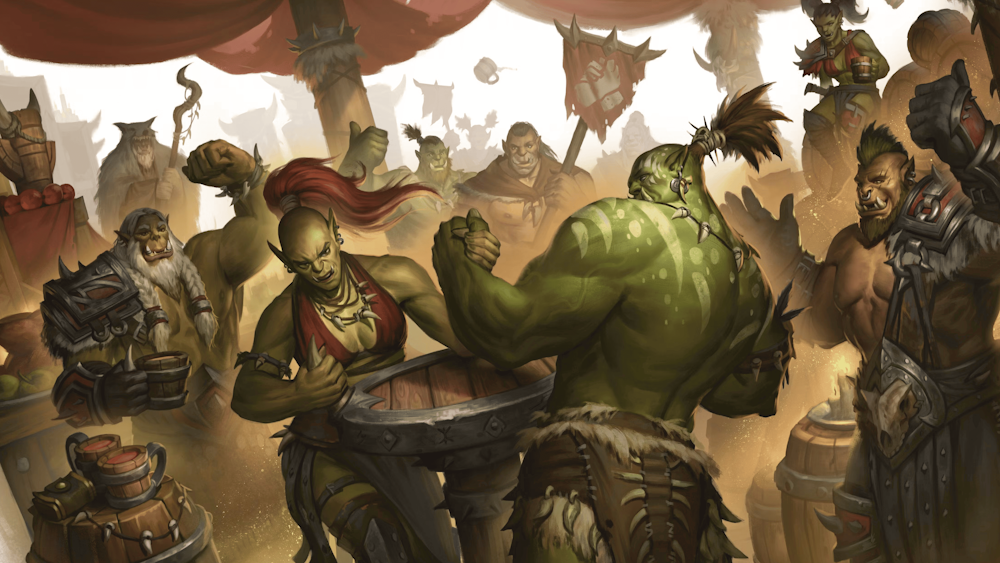
Orcs were created by Yssarel, the Wildmother. Their descendants spread across Eldareth and settled in lands far removed from one another. Over thousands of years, those populations changed with the places in which they lived, eventually giving rise to the Varokh, Vashkari, Mok'tan, and Zhanyin.
The four lineages share the same distant ancestry but developed distinct physical traits and histories. An Orc's lineage comes from ancestry, while their culture comes from the family and community in which they were raised.
The Orc Lineages
Varokh
Varokh are found across Ethelra. They are generally broad and heavily built, with prominent tusks and considerable variation between families. Green and grey skin tones are common.
Their communities have developed throughout the continent and reflect very different regional histories.
Some of the best known Varokh settlements lie among the northern mountains. Difficult winters and the distance between communities have made clan gatherings important for maintaining ties between families that may otherwise spend much of the year apart.
These northern customs are only one expression of Varokh life. Elsewhere in Ethelra, communities have developed alongside the peoples and regions around them, often with little connection to the traditions of the northern clans.
Vashkari
Vashkari are most closely associated with Avermont and Zalthyx. They are usually tall and powerfully built, and their horns are one of the most recognizable features of the lineage. Their shape varies widely, and some families or individuals decorate them according to local custom.
Much of Vashkari history in Avermont traces back to ancestors who escaped enslavement and established settlements of their own. The memory of that period remains important in many communities, where broken chains still appear in ceremonies and memorials associated with their liberation.
The societies that grew from those settlements developed strong ideas about responsibility and the proper use of authority. Service to the community remains important in some Vashkari traditions, though its meaning differs considerably between places and has continued to change over time.
Vashkari families now live far beyond those early settlements, and many belong primarily to the cultures of the regions in which they were raised.
Mok'tan
Mok'tan have their oldest roots in Nurathar. They tend to have more athletic builds than Varokh or Vashkari, with bronze and green skin common among many families.
Their communities developed across very different parts of Nurathar, often building an intimate knowledge of the land around them through generations of settlement.
Many Mok'tan communities also maintain relationships with local spirits. The nature of those traditions depends heavily on place, since the spirits known to one community may be entirely different from those encountered elsewhere.
Stories and ritual often preserve the history of these relationships alongside the history of the community itself. Their importance varies widely, and Mok'tan raised elsewhere may have little connection to them.
Zhanyin
Zhanyin are most closely associated with Shen-Su. They are generally leaner and lighter in build than Varokh and Vashkari while remaining recognizably Orcish.
They have been part of Shen-Su for generations and share fully in the wider life of the region.
Monastic orders are prominent within some Zhanyin communities and have preserved their own teachings and histories over long periods. These institutions form an important part of Zhanyin history without defining the lineage as a whole.
Many Zhanyin grow up entirely outside monastic life, shaped instead by the families and communities in which they were raised.
Orcs Across Eldareth
The regions associated with each Orc lineage are ancestral homelands rather than boundaries.
Orcs have migrated throughout Eldareth for generations. Families may preserve strong ties to the traditions of their ancestors, adopt the customs of a new homeland, or carry elements of both.
A Vashkari raised in Shen-Su remains Vashkari, just as a Zhanyin family that has lived in Avermont for generations remains Zhanyin. Lineage describes ancestry rather than prescribing culture.
The same is true within the ancestral regions themselves. Two Varokh communities in different parts of Ethelra may have developed very different customs, while Mok'tan or Vashkari families separated by centuries of migration may share little beyond their lineage.
Orc life across Eldareth is therefore shaped by both ancestry and place. The four lineages remain physically distinct, while the cultures associated with them continue to change wherever Orc families make their homes.
Orc Traits
Choose one of the following Orc lineages when you select this species: Varokh, Vashkari, Mok'tan, or Zhanyin. You gain the Common Orc Traits and the traits of your chosen lineage. Your choice can't be changed.
Common Orc Traits
Ability Score Increase. When determining your character's ability scores, increase one score by 2 and increase a different score by 1, or increase three different scores by 1. You can't raise any of your scores above 20.
Creature Type. You are a Humanoid.
Size. You are Medium.
Speed. Your walking speed is 30 feet.
Darkvision. You can see in Dim Light within 120 feet of yourself as if it were Bright Light and in Darkness within that range as if it were Dim Light. You discern colors in that Darkness only as shades of gray.
Adrenaline Rush. As a Bonus Action, you can take the Dash action. When you do so, you gain Temporary Hit Points equal to your Proficiency Bonus.
You can use this trait a number of times equal to your Proficiency Bonus, and you regain all expended uses when you finish a Long Rest.
Relentless Endurance. When you are reduced to 0 Hit Points but not killed outright, you can drop to 1 Hit Point instead.
Once you use this trait, you can't use it again until you finish a Long Rest.
Languages. Your character can speak, read, and write Common and two other Standard Languages that you and your DM agree are appropriate for the character. The Player's Handbook offers a list of Standard Languages to choose from. The DM is free to modify that list for a campaign.
Varokh
Powerful Build. You count as one Size larger when determining your carrying capacity and the weight you can push, drag, or lift.
You also have Advantage on any ability check you make to end the Grappled condition on yourself.
Savage Attacks. When you score a Critical Hit with an attack using a weapon or an Unarmed Strike and that attack rolls one or more damage dice, you can roll one of the attack's damage dice one additional time and add it to the attack's damage.
Vashkari
Powerful Build. You count as one Size larger when determining your carrying capacity and the weight you can push, drag, or lift.
You also have Advantage on any ability check you make to end the Grappled condition on yourself.
Horns. You can use your horns to make Unarmed Strikes. When you use your horns to deal damage with an Unarmed Strike, you can deal 1d6 Piercing damage plus your Strength modifier instead of the strike's normal damage.
When you use your horns for the Shove option of an Unarmed Strike and choose to push the target, you can push it up to 10 feet away from you instead of 5 feet if it fails the saving throw.
Mok'tan
Fleet. Your Speed is 35 feet.
Canopy Climber. You have a Climb Speed equal to your Speed.
Zhanyin
Fleet. Your Speed is 35 feet.
Quick Reflexes. You have Advantage on Initiative rolls.