
Half-Elves
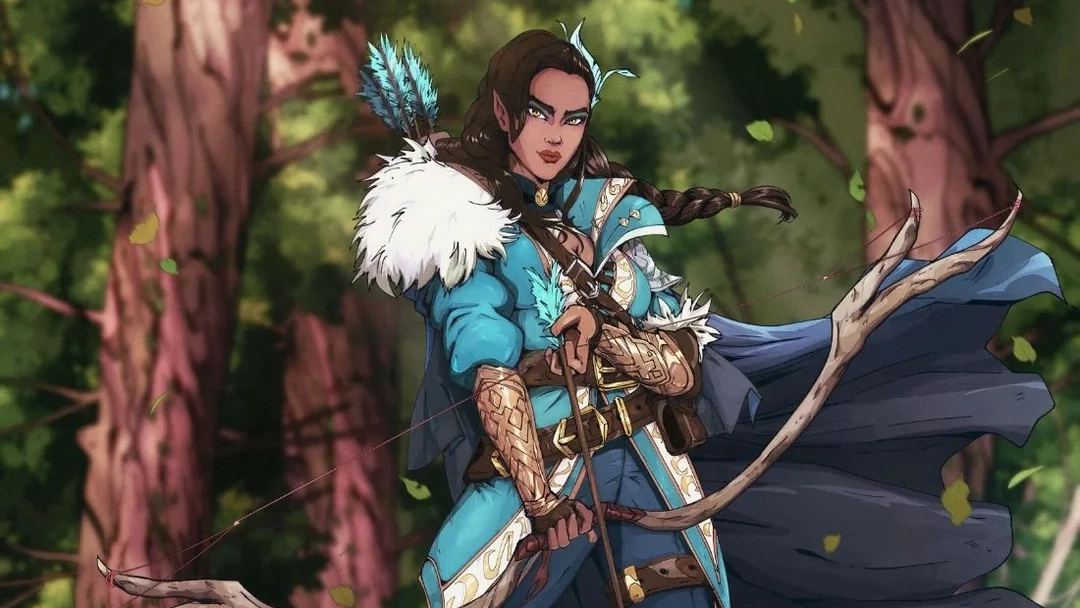
Half-Elves are born to human and elven families and are common across Ethelra and Avermont, particularly in regions where the two peoples have lived alongside one another for generations.
Their upbringing varies considerably. A Half-Elf raised primarily among humans may have little direct connection to elven traditions, while one raised among elves may learn them from childhood but experience family and community life differently because of their shorter lifespan.
Most belong primarily to the culture of their household and the place in which they were raised. Mixed families may preserve traditions from both sides, while others are more closely connected to one branch of the family.
Identity and Culture
Half-Elves usually inherit features from both sides of their family. Their ears are generally shorter than those of elves, and they mature at roughly the same rate as humans while living considerably longer.
Their elven ancestry can also leave recognizable traces. Sera'drin heritage may appear in warmer gold or ivory tones and unusually bright eyes, while Vaela'drin ancestry can bring cooler silver, lavender, or blue-grey coloring. Falha'drin ancestry may show through darker violet, charcoal, or muted tones. Ela'drin ancestry can sometimes produce subtler shifts in coloration that reflect their seasonal heritage.
These features vary greatly between families and are often less pronounced than those of their elven relatives.
There is no single Half-Elven culture across Eldareth. Most grow up within the customs of their family and community, and two Half-Elves from the same region may still have very different relationships with their ancestry.
A Half-Elf raised close to elven relatives may inherit religious practices, family customs, or stories associated with that lineage. Others may know those traditions only distantly, especially when several generations have passed since an elven ancestor joined the family.
People sometimes assume a Half-Elf understands both human and elven customs simply because of their ancestry. In practice, that knowledge depends entirely on upbringing and experience.
Their lifespan can shape family relationships in ways neither humans nor elves experience in quite the same manner. A Half-Elf may outlive human relatives by many decades while aging much faster than elven members of the same extended family.
Communities with long-established mixed populations are generally more accustomed to these differences and the family arrangements that develop around them.
Half-Elves Across Eldareth
Half-Elves can be found throughout Ethelra and Avermont wherever human and elven communities have remained in regular contact.
Their numbers are often highest in mixed cities, coastal regions, trade centers, and older settlements where families of both peoples have lived together for generations. No single region serves as a Half-Elven homeland.
Local culture therefore matters considerably. A Half-Elf raised in an Avermont city may have little in common with one from an Ethelran community where Vaela'drin or Falha'drin traditions remain especially strong.
Half-Elves share the histories of the families and regions in which they live rather than a separate history created by their mixed ancestry. Their connection to elven heritage can remain important, but its place in everyday life differs from one family to another.
Half-Elf Traits
Choose one of the following Elven heritages when you select this species: Sera'din, Vaela'din, Falha'din, or Ela'din. You gain the Common Half-Elf Traits and the traits of your chosen heritage. Your choice can't be changed.
Common Half-Elf Traits
Ability Score Increase. When determining your character's ability scores, increase one score by 2 and increase a different score by 1, or increase three different scores by 1. You can't raise any of your scores above 20.
Creature Type. You are a Humanoid. You are also considered an Elf for any prerequisite or effect that requires you to be an Elf.
Size. You are Medium.
Speed. Your walking speed is 30 feet.
Darkvision. You can see in Dim Light within 60 feet of yourself as if it were Bright Light and in Darkness within that range as if it were Dim Light. You discern colors in that Darkness only as shades of gray.
Fey Ancestry. You have Advantage on saving throws you make to avoid or end the Charmed condition. In addition, magic can't put you to sleep.
Keen Senses. You gain proficiency in one of the following skills of your choice: Insight, Perception, or Survival.
Skillful. You gain proficiency in one skill of your choice other than the skill selected for Keen Senses.
Elven Heritage. Your chosen heritage grants the corresponding traits described below.
If your heritage grants you spells, choose Intelligence, Wisdom, or Charisma when you select this species. Your chosen ability is your spellcasting ability for those spells. Your choice can't be changed.
You can cast each leveled spell granted by your heritage once without expending a spell slot, and you regain the ability to cast that spell in this way when you finish a Long Rest. You can also cast those spells using any spell slots you have of the appropriate level.
When you cast a spell through your Elven Heritage, the spell requires no Material components.
Languages. Your character can speak, read, and write Common and two other Standard Languages that you and your DM agree are appropriate for the character. The Player's Handbook offers a list of Standard Languages to choose from. The DM is free to modify that list for a campaign.
Sera'din Heritage
Arcane Affinity. When you select this species, choose Prestidigitation or another cantrip from the Wizard spell list. You know the chosen cantrip, and your choice can't be changed.
Starting at character level 3, you can cast Detect Magic with this trait. You can also cast Detect Magic as a Ritual.
Starting at character level 5, you can cast Mirror Image with this trait.
Vaela'din Heritage
Moonlit Magic. You know the Starry Wisp cantrip.
Starting at character level 3, you can cast Sleep with this trait.
Starting at character level 5, you can cast Invisibility with this trait. When you cast Invisibility through this trait, whether using its free casting or a spell slot, you can target only yourself.
Falha'din Heritage
Midnight Magic. You know the Minor Illusion cantrip.
Starting at character level 3, you can cast Faerie Fire with this trait.
Starting at character level 5, you can cast Darkness with this trait.
Ela'din Heritage
Fey Step. As a Bonus Action, you can magically teleport up to 30 feet to an unoccupied space you can see.
Before character level 5, once you use this trait, you can't use it again until you finish a Long Rest.
Starting at character level 5, you can use this trait a number of times equal to your Proficiency Bonus, and you regain all expended uses when you finish a Long Rest.
This version of Fey Step doesn't grant the seasonal effects available to a full Ela'din.