
Goliaths
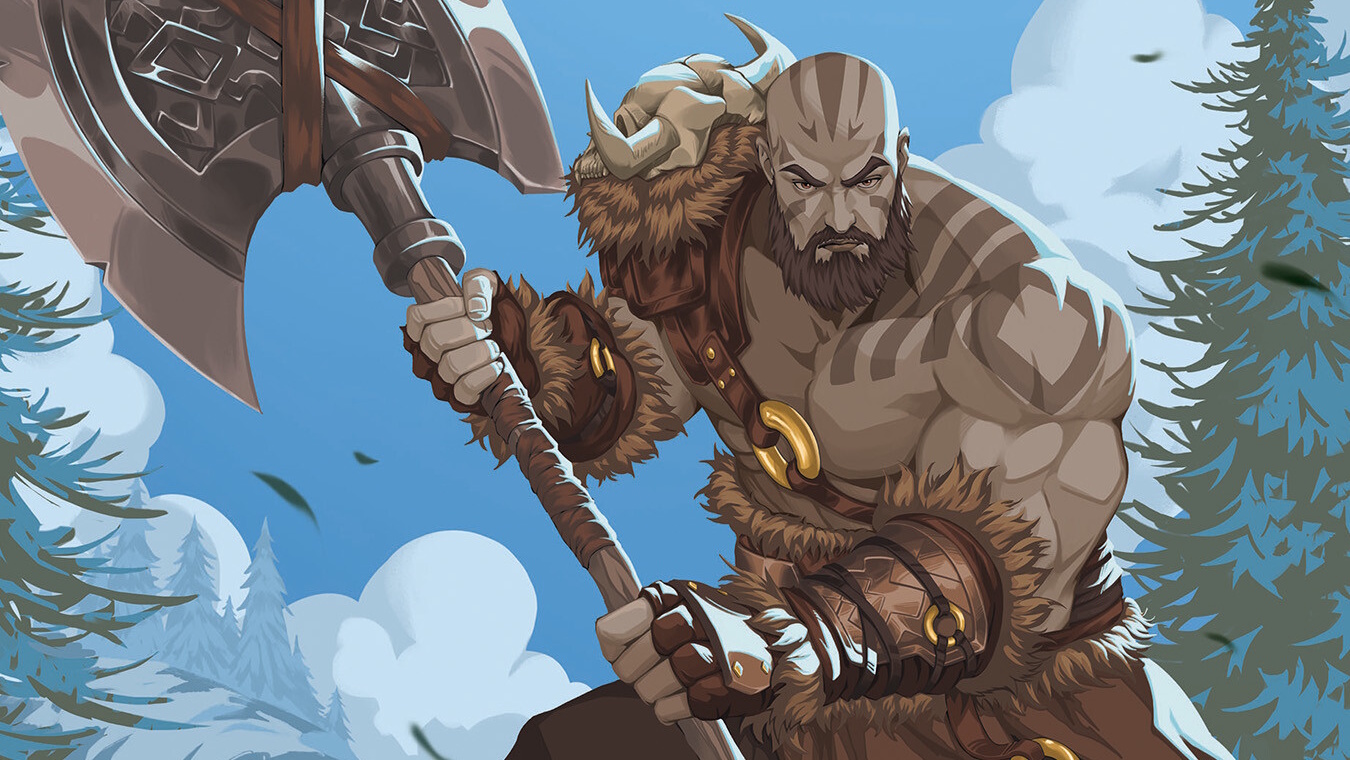
Goliaths descend from ancient giantkin whose communities once spread through the highlands and mountain regions of Eldareth.
Many of their oldest settlements developed in remote country where difficult terrain and long winters made cooperation essential. Over generations, clan traditions placed increasing importance on reliability, practical ability, and the responsibilities a person could be trusted to carry.
Giant ancestry remains an important part of clan history, though descent alone carries little status. Respect is more often earned through demonstrated ability and the trust a person has built within the community.
Many clans use trials or tests of readiness when someone takes on a new responsibility. The form depends on the clan and the role involved. Completing a trial shows that the individual is considered prepared rather than placing them above those who have not attempted it.
Identity and Culture
Goliaths are among the tallest humanoid peoples of Eldareth and are usually heavily built.
Their skin commonly has a stone-like quality, ranging from pale grey to deep basalt and other mineral tones. Giant ancestry can create further variation in complexion, hair, eyes, and other features, giving individual clans and families recognizable differences without erasing the broader Goliath appearance.
Hair may be worn short, shaved, or braided according to family and clan custom.
Responsibility to the clan carries considerable weight in many Goliath communities. Physical strength is respected where it is useful, but reliability and sound judgment are valued just as highly.
A person who can be trusted to guide others safely through dangerous terrain may earn as much respect as someone known for success in battle.
Failure during a trial or difficult task is not automatically treated as disgrace. A person may train further and try again, and asking for help is generally preferable to concealing a problem that could endanger others.
Giant Heritage
Every Goliath carries some trace of giant ancestry. The form of that heritage varies between clans and families and can influence both appearance and inherited supernatural abilities.
Clans preserve their own histories concerning the giants from whom they descend. Some maintain detailed stories or memorial traditions, while others treat those ancestors as distant figures whose importance lies mainly in explaining the origins of the clan.
The meaning attached to giant ancestry therefore differs considerably between communities. For some it is central to clan identity, while elsewhere it is only one part of a much longer local history.
Clans familiar with a particular giant heritage often develop their own ways of teaching younger Goliaths how to understand and control the abilities associated with it.
Goliaths Across Eldareth
Goliath communities remain concentrated in mountainous regions, particularly in high valleys, remote passes, and other areas where their giantkin ancestors settled long ago.
Many clans maintain detailed knowledge of the high country around them. Travel routes, seasonal hazards, and difficult terrain may remain familiar to the same communities for generations.
Some clans maintain long-standing relationships with nearby settlements that depend upon those routes. These arrangements can involve trade, passage through clan territory, or cooperation when conditions in the mountains become dangerous.
Clan history is commonly preserved through spoken accounts and local memorials. The details vary widely, with each community maintaining its own understanding of the people and events that shaped it.
Although Goliaths share ancient giant ancestry, their clans have developed independently across different regions. Traditions surrounding responsibility, trials, inherited abilities, and the giants themselves can therefore differ considerably from one community to another.
Goliath Traits
Ability Score Increase. When determining your character's ability scores, increase one score by 2 and increase a different score by 1, or increase three different scores by 1. You can't raise any of your scores above 20.
Creature Type. You are a Humanoid.
Size. You are Medium.
Speed. Your walking speed is 35 feet.
Powerful Build. You count as one Size larger when determining your carrying capacity and the weight you can push, drag, or lift.
You also have Advantage on any ability check you make to end the Grappled condition on yourself.
Giant Ancestry. When you select this species, choose one of the following giant ancestries: Cloud, Fire, Frost, Hill, Stone, or Storm. Your choice determines the benefit you gain from this trait and can't be changed.
You can use your chosen benefit a number of times equal to your Proficiency Bonus, and you regain all expended uses when you finish a Long Rest.
Cloud's Jaunt. As a Bonus Action, you magically teleport up to 30 feet to an unoccupied space you can see.
Fire's Burn. When you hit a target with an attack roll and deal damage to it, you can deal an extra 1d10 Fire damage to the target.
Frost's Chill. When you hit a target with an attack roll and deal damage to it, you can deal an extra 1d6 Cold damage to the target and reduce its Speed by 10 feet until the start of your next turn.
Hill's Tumble. When you hit a Large or smaller creature with an attack roll and deal damage to it, you can give that creature the Prone condition.
Stone's Endurance. When you take damage, you can take a Reaction to roll 1d12. Add your Constitution modifier to the number rolled and reduce the damage by that total.
Storm's Thunder. When a creature within 60 feet of you deals damage to you, you can take a Reaction to deal 1d8 Thunder damage to that creature.
Large Form. Starting at character level 5, as a Bonus Action, you can become Large for 10 minutes, provided you have enough room to increase your Size.
While Large, you have Advantage on Strength checks, and your Speed increases by 10 feet.
You can end the transformation early with no action required. Once you use this trait, you can't use it again until you finish a Long Rest.
Languages. Your character can speak, read, and write Common and two other Standard Languages that you and your DM agree are appropriate for the character. The Player's Handbook offers a list of Standard Languages to choose from. The DM is free to modify that list for a campaign.