
Goblins
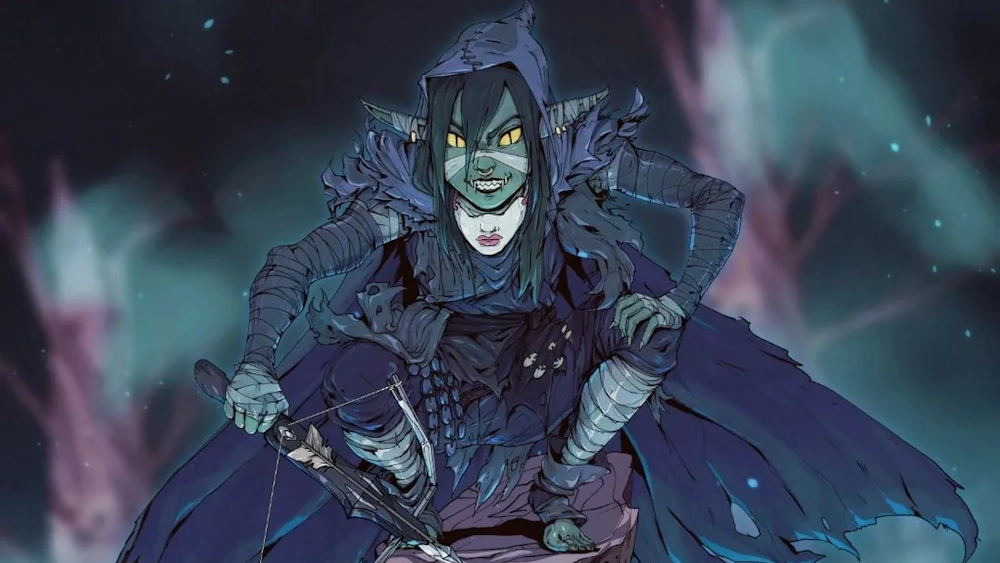
Goblins trace their ancestry to the Feywild, though their earliest history there is poorly recorded. Some ancient goblin communities eventually crossed into Eldareth, and over generations their descendants developed the two broad cultural traditions now known as the Murrkin and Giznat.
Other goblins remained in the Feywild. Their descendants are commonly known as Brownies and retain a stronger connection to the plane's fey environment, having developed separately from their Material relatives.
Murrkin and Giznat
Murrkin communities live mostly away from large settlements, relying on hunting, gathering, scavenging, and the resources available in the regions they inhabit. Their customs vary considerably according to the lands in which they live.
The Giznat developed very differently. Over generations, their communities became closely associated with mechanical work, experimentation, and finding new uses for discarded or damaged objects. Taking something apart to understand how it works is a common part of Giznat training, and rebuilding it differently is often considered just as useful as restoring it.
Murrkin and Giznat are cultural traditions rather than separate kinds of goblin. Mixed families, movement between communities, and goblins raised outside either tradition are all common enough that neither should be treated as a fixed path.
The reputation of the Giznat across Eldareth is mixed. Their engineers and artificers have contributed to many important mechanical and arcane developments, though a long history of ambitious experiments has also given some workshops a reputation for treating safety as something best improved after the first accident.
Identity and Culture
Giznat goblins are usually taller and more lightly built than Murrkin. Their hands are large for their size, with long fingers well suited to delicate mechanical work.
Their skin ranges from olive green to teal, with copper tones appearing among some families. Giznat who regularly work with machinery, alchemical materials, or Galarium often carry burns, stains, or other marks accumulated through years spent in workshops.
Clothing commonly reflects a person's work. Tool belts, reinforced gloves, protective lenses, aprons, and other practical equipment are common among those working with machinery or alchemy, while frequently used tools are usually kept within easy reach.
Many Giznat communities are organized into guild-clans, where apprenticeship and shared work can be as important as family relationships. A young Giznat may train with one guild-clan before joining another as their skills develop or their interests change, and long-standing workshops can include members of several families alongside generations of former apprentices.
Experimentation is encouraged from an early stage of training. Failed designs are commonly dismantled to determine what went wrong, with useful components incorporated into later attempts. Even a machine that works perfectly well may not remain untouched for long if someone believes it can be made faster, smaller, stronger, or easier to repair.
Giznat work in many professions, though engineers, artificers, mechanics, alchemists, and researchers are particularly common. Large communities can be found in Tessarion and Vel'Nathar, while smaller workshops operate throughout Eldareth, sometimes well beyond the reach of city guilds and their regulations.
Workshops and Innovation
Giznat inventions are generally intended to solve practical problems, even when the methods used to reach the solution are unconventional. Their workshops produce tools, vehicles, arcane devices, machinery, and experimental equipment for both local use and wider trade.
Designs are frequently revised. A successful machine may pass through several versions as materials improve, components become available, or another engineer devises a better approach. Older designs are often dismantled for useful parts rather than discarded intact.
Credit for an invention is taken seriously. Workshop marks and maker signatures are commonly incorporated into finished devices, particularly when several people or guild-clans contributed to their construction. Larger projects may carry several marks identifying different stages of the work.
Disputes over design, ownership, and technical decisions are common enough that many guild-clans maintain records of individual contributions. Deliberately damaging another person's work or claiming an invention as one's own is considered a serious offense.
Safety standards vary between workshops. Established guilds often maintain written procedures for dangerous materials and machinery, while smaller independent workshops may rely more heavily on the judgment and experience of whoever is present.
One of the most important Giznat contributions to arcane engineering came from their early work with Galarium. Although the crystal was already known in some form, Giznat artificers developed reliable methods for refining, charging, controlling, and incorporating it into repeatable magical technology. Their breakthroughs helped begin the Galarium Revolution and laid the foundations for many of the arcane industries that later became central to the Age of Wonders.
Goblins Across Eldareth
Goblins have lived in Eldareth for thousands of years, and their communities have developed far beyond whatever society their distant Feywild ancestors once knew.
Murrkin remain more common in rural and less densely settled regions, where individual communities have been shaped strongly by their surrounding environment. Giznat populations are particularly visible in places where mechanical and arcane industries have taken root, including Tessarion and the cities of Vel'Nathar.
Giznat devices can now be found far beyond their own settlements. Individual engineers, artificers, and guild-clans travel widely in search of work, materials, or problems worth solving.
Within many Giznat communities, reputation is tied more closely to demonstrated work than ancestry or formal title. A craftsperson may become respected for a successful invention, a difficult repair, decades spent teaching apprentices, or an improvement that made an existing design substantially more useful.
The Murrkin and Giznat have followed very different cultural paths, but both belong to the long history of goblins in Eldareth and share the same distant origins in the Feywild.
Goblin Traits
Ability Score Increase. When determining your character’s ability scores, increase one score by 2 and increase a different score by 1, or increase three different scores by 1. You can't raise any of your scores above 20.
Creature Type. You are a Humanoid. You are also considered a goblinoid for any prerequisite or effect that requires you to be a goblinoid.
Size. You are Small.
Speed. Your walking speed is 30 feet.
Darkvision. You can see in dim light within 60 feet of you as if it were bright light and in darkness as if it were dim light. You discern colors in that darkness only as shades of gray.
Fey Ancestry. You have advantage on saving throws you make to avoid or end the charmed condition on yourself.
Fury of the Small. When you damage a creature with an attack or a spell and the creature’s size is larger than yours, you can cause the attack or spell to deal extra damage to the creature. The extra damage equals your proficiency bonus.
You can use this trait a number of times equal to your proficiency bonus, regaining all expended uses when you finish a long rest, and you can use it no more than once per turn.
Nimble Escape. You can take the Disengage or Hide action as a bonus action on each of your turns.
Artificer's Lore. Whenever you make an Intelligence (History) check related to alchemical, or technological items, you can add twice your proficiency bonus instead of any other proficiency bonus that may apply.
Goblin Artifice. You know the Mending and Prestidigitation cantrips.
Tinker. You have proficiency with artisan tools (tinker's tools).
Using these tools, you can spend 10 minutes casting Prestidigitation to create a Tiny clockwork device (AC 5,1 HP), such as a toy, a fire starter, ora music box. Casting the Spell in this way consumes 10 GP worth of raw material (string, gears, and the like),which you provide during the casting.
When you create the device, you determine its function by choosing one effect from Prestidigitation; the device produces that effect whenever you or another creature takes a Bonus Action to touch the device and activate it. If the chosen effect has options within it, you choose one of those options for the device when you create it. For example, if you choose the spell’s ignite-extinguish effect, you determine whether the device ignites or extinguishes fire; the device doesn’t do both.
You can have three such devices in existence at a time, and each one dismantles itself 8 hours after its creation. You can also touch one of your devices and dismantle it as an Action. After a device is dismantled, the 10 GP of materials used to create it can be reclaimed.
Here are a few examples:
- Clockwork Toy. This toy is a clockwork animal, monster, or person, such as a frog, mouse, bird, dragon, or soldier. When placed on the ground, the toy moves 5 feet across the ground on each of your turns in a random direction. It makes noises as appropriate to the creature it represents.
- Fire Starter. The device produces a miniature flame, which you can use to light a candle, torch, or campfire. Using the device requires your action.
- Music Box. When opened, this music box plays a single song at a moderate volume. The box stops playing when it reaches the song's end or when it is closed.
Languages. Your character can speak, read, and write Common and one other language that you and your DM agree is appropriate for the character. The Player’s Handbook offers a list of languages to choose from. The DM is free to modify that list for a campaign.