
Gnomes
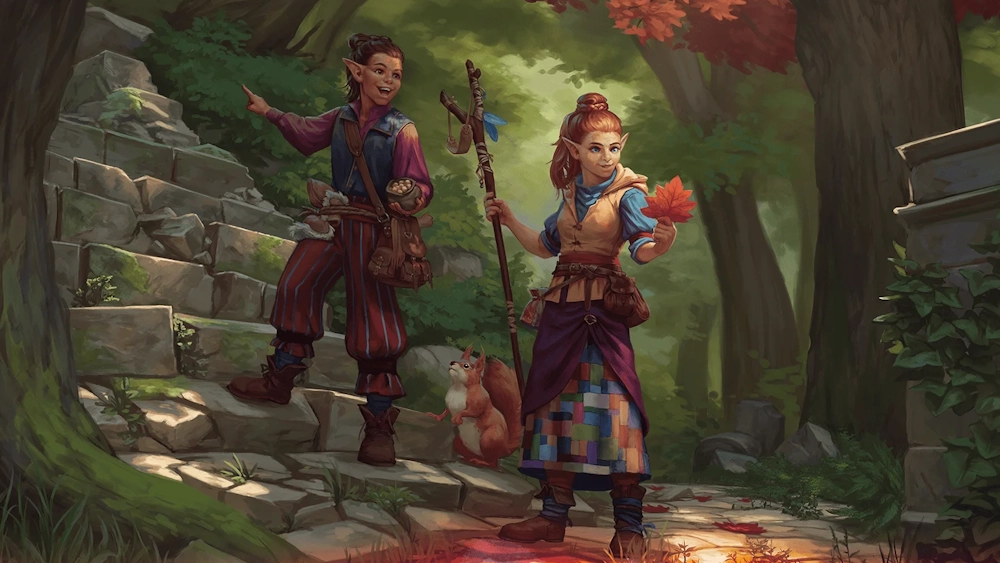
Gnomes are a small people with a long history in woodland regions across Eldareth. Many of their older communities developed in forests and valleys where families remained for generations, building a close familiarity with the surrounding land.
These settlements are often kept private. Homes may be difficult to find without knowing the area, especially where buildings are worked into hillsides, roots, or natural stone. Some communities also use magic to make paths or entrances less obvious, though concealment is not limited to illusion.
Gnomes are not uncommon across Eldareth, but their tendency to establish smaller communities away from major roads can make them less visible than their numbers suggest. Others live openly in mixed settlements, cities, and centers of learning.
Identity and Culture
Gnomes are small and lightly built, with skin ranging from fair to warm tan. Their hair is often thick or curly, while their eyes tend to be large and expressive.
Many older woodland settlements are built closely into the surrounding terrain. Homes may extend beneath large roots, into hillsides, or around existing stone formations rather than requiring the landscape to be cleared first.
Knowledge of the surrounding region is important in many such communities. Gnomes who have lived in the same area for generations often develop a detailed understanding of local plants, animals, weather, and changing conditions.
Herbalism, cultivation, and healing traditions are particularly well developed in some woodland communities. Elsewhere, Gnomes carry those practices into towns, cities, and mixed settlements where they continue to change alongside local customs.
Storytelling is also used to preserve family and community memory. Oral traditions often retain practical knowledge alongside accounts of the people and events connected to a particular place.
Privacy varies greatly between communities. Some settlements maintain regular trade and close relationships with their neighbors while keeping the location of individual homes discreet. Others are more open, particularly where Gnomes have lived alongside other peoples for generations.
Gnomes Across Eldareth
Gnomish history is largely regional. Many communities developed independently from one another, and local traditions often reflect the forests, valleys, towns, or cities in which they formed.
Woodland communities may preserve forms of herbal knowledge, cultivation, and practical magic adapted to their surroundings. These traditions can differ considerably even between settlements within the same wider region.
Gnomes are also well established beyond secluded communities. They can be found in mixed settlements and scholarly institutions, where local knowledge and older practices exist alongside wider academic and magical traditions.
Their settlements range from discreet woodland homes to ordinary neighborhoods within larger cities. What connects them is less a single way of life than a long tradition of adapting closely to the places in which their communities take root.
Gnome Traits
Ability Score Increase. When determining your character's ability scores, increase one score by 2 and increase a different score by 1, or increase three different scores by 1. You can't raise any of your scores above 20.
Creature Type. You are a Humanoid.
Size. You are Small.
Speed. Your walking speed is 30 feet.
Darkvision. You can see in Dim Light within 60 feet of yourself as if it were Bright Light and in Darkness within that range as if it were Dim Light. You discern colors in that Darkness only as shades of gray.
Gnomish Cunning. You have Advantage on Intelligence, Wisdom, and Charisma saving throws.
Speak with Small Beasts. Through sounds and gestures, you can communicate simple ideas to Small or smaller Beasts. You have Advantage on Charisma checks you make to influence them.
Children of the Woods. Choose Intelligence, Wisdom, or Charisma when you select this species. Your chosen ability is your spellcasting ability for the spells granted by this trait. Your choice can't be changed.
At 1st level, choose either Druidcraft or Minor Illusion. You know the chosen cantrip, and your choice can't be changed.
Starting at character level 3, you can cast Entangle with this trait.
Starting at character level 5, you can cast Pass without Trace with this trait.
You can cast each leveled spell granted by this trait once without expending a spell slot, and you regain the ability to cast that spell in this way when you finish a Long Rest. You can also cast these spells using any spell slots you have of the appropriate level.
When you cast a spell through this trait, the spell requires no Material components unless a Material component has a specified cost or is consumed by the spell. You must provide any such component as normal.
Languages. Your character can speak, read, and write Common and two other Standard Languages that you and your DM agree are appropriate for the character. The Player's Handbook offers a list of Standard Languages to choose from. The DM is free to modify that list for a campaign.