
Faun
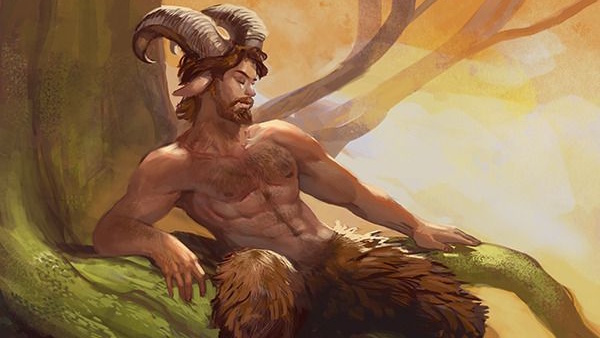
Faun trace their ancestry to the Feywild, though most families in Eldareth have lived in the Material Plane for many generations. The circumstances that first brought their ancestors across are not recorded as clearly as the great elven migrations, and Material Faun communities have long since developed histories of their own.
Older communities are especially common in regions where fey influence has remained strong, though Faun now live throughout Eldareth in both rural settlements and large cities.
Music and oral storytelling remain important in many Faun communities. Seasonal gatherings and traditions of hospitality also have deep roots, though their expression differs considerably from one region to another.
Identity and Culture
Faun have humanoid upper bodies and goatlike lower bodies, with furred legs and cloven hooves. Their horns vary greatly in size and shape, with some forms appearing repeatedly within particular families.
Many long-established Faun communities maintain close ties to the places in which they live. Some have occupied the same region for generations, while others are more dispersed and gather at particular times of year before families or individuals travel elsewhere again.
Songs and stories are commonly used to preserve family and local history. Events remembered within a community may survive through oral tradition long after the details have disappeared from written records.
Gatherings differ according to the history of each settlement. Some follow older seasonal traditions, while others developed around events or customs particular to the communities that observe them.
Strong emotion is generally treated openly in many Faun communities. Grief, affection, anger, and celebration may be shared with relatives or neighbors rather than regarded as entirely private matters.
Faun who live beyond older community centers take part fully in the societies around them. Generations of settlement alongside other peoples have produced considerable variation in how individual families understand and maintain older Faun traditions.
Feywild Heritage
The Feywild remains an important part of Faun ancestry, but the communities of Eldareth have changed considerably since their ancestors first crossed into the Material Plane.
Some traditions still show clear similarities to those practiced by Faun in the Feywild, while others developed entirely within Eldareth. Customs preserved in one world may have changed or disappeared in the other over the course of many generations.
Faun communities remain widespread within the Feywild. Their relationships with the Seelie Court, Unseelie Court, and Courtless societies vary according to local history and allegiance.
Contact between Feywild and Material Faun can therefore bring both familiarity and difference. Shared stories may survive in altered forms, while practices regarded as ordinary in one community may be unfamiliar in another.
Faun Across Eldareth
Faun have lived throughout Eldareth for many generations. Older communities remain particularly common near regions with a long history of fey influence, while later migration has carried Faun families much farther afield.
Relationships with the Feywild differ between communities. Some preserve knowledge of nearby Fey Crossings or local customs for dealing with fey neighbors. Others have little direct contact with the plane beyond family stories and inherited tradition.
Today, Faun can be found in settlements of every size. Music, festivals, food, and other local traditions have influenced neighboring communities in regions where Faun and other peoples have lived together for generations.
Material Faun culture continues to develop independently from its Feywild origins, even as renewed contact occasionally brings distant branches of the same people together again.
Faun Traits
Ability Score Increase. When determining your character's ability scores, increase one score by 2 and increase a different score by 1, or increase three different scores by 1. You can't raise any of your scores above 20.
Creature Type. You are a Fey.
Size. You are Medium.
Speed. Your walking speed is 35 feet.
Ram. You can use your horns to make Unarmed Strikes. When you use your horns to deal damage with an Unarmed Strike, you can deal 1d6 Bludgeoning damage plus your Strength modifier instead of the strike's normal damage.
Magic Resistance. You have Advantage on saving throws against spells.
Mirthful Leaps. Your jump distance is always calculated as though you had a running start. Additionally, when you jump, you can roll a d8 and add the result to the distance of a Long Jump or the height of a High Jump. This extra distance costs movement as normal.
Community Traditions. You gain proficiency in the Performance and Persuasion skills, and you gain proficiency with one musical instrument of your choice.
Languages. Your character can speak, read, and write Common and two other Standard Languages that you and your DM agree are appropriate for the character. The Player's Handbook offers a list of Standard Languages to choose from. The DM is free to modify that list for a campaign.