
Dwarves
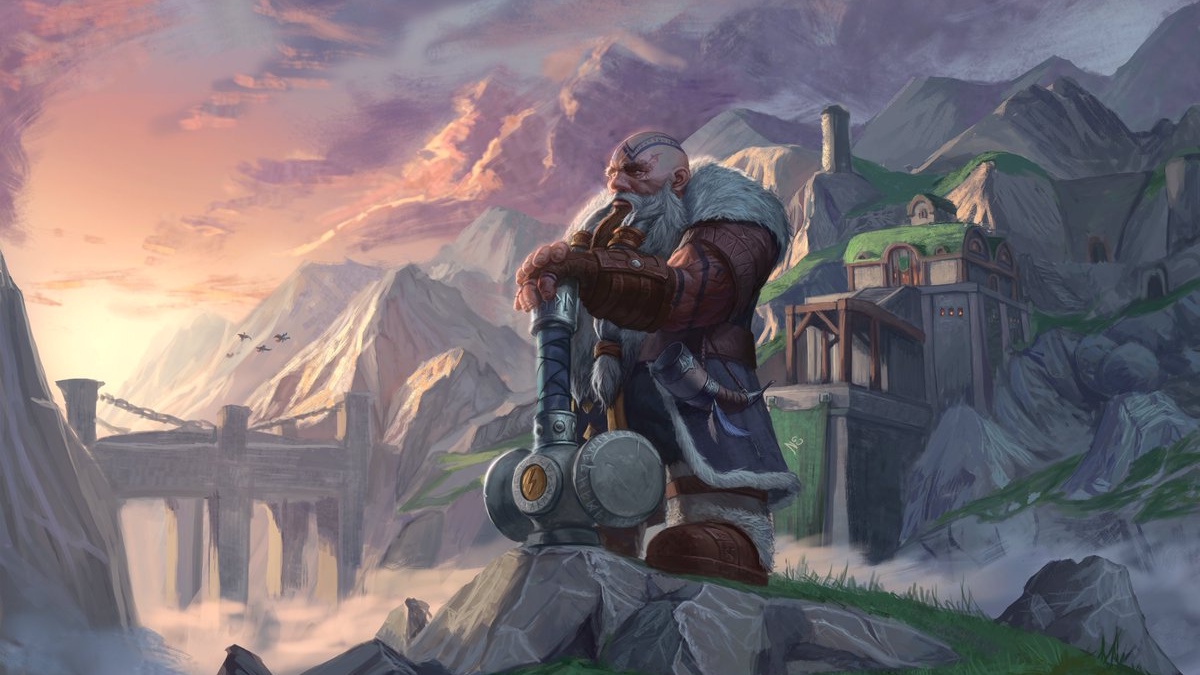
The dwarves of Eldareth trace their beginning to Thuradun, the vast complex known as the Forge of Wills beneath the mountains of Skorrheim.
Its creators were Thalkor of the Stone Giants, Saaktar of the Fire Giants, and Thorden of the Storm Giants, three jarls who had been granted portions of the power of the defeated Primordial Titans. With the aid of their giant kin, they raised Thuradun and formed the Anima Core from much of the power they had received.
Using the Core and portions of their own divine essence, the three Jarls created the first dwarves. Thalkor created the Ironcrest, Saaktar the Emberforge, and Thorden the Runeborn.
Though their origins lie in the Forge of Wills, dwarves are living mortals rather than constructs. The three lineages have long since developed cultures, settlements, and traditions of their own, shaped as much by thousands of years of history as by the circumstances of their creation.
Ironcrest Dwarves
Ironcrest dwarves are broad and heavily built, with skin that often resembles slate, clay, or grey stone. Their hair is commonly dark, red, or iron-grey and is traditionally worn in thick braids.
Braids often carry personal meaning. Rings, clasps, and other ornaments may mark family ties, years of service, or the memory of someone who has died. Customs differ between clans, and a well-decorated braid may preserve several parts of a person's life.
The Ironcrest trace their lineage to Thalkor, the Sentinel of Stone. Many of their oldest communities were established among mountain valleys and fortified passes, and traditions of construction, defense, and careful stewardship remain strong among them.
Ironcrest settlements are often built with longevity in mind. Walls, roads, halls, and fortifications may be repaired and expanded for generations rather than replaced outright, while family histories and important agreements are preserved with similar care.
This respect for continuity can make some Ironcrest communities cautious about sudden change, particularly when new practices would replace something that has served reliably for centuries. Individual clans vary considerably, however, and Ironcrest life beyond the older holds has developed in many different directions.
Emberforge Dwarves
Emberforge dwarves commonly have copper, bronze, brown, or soot-dark skin. Some bear ember-like markings beneath the skin that brighten in intense heat or during strong emotion.
They trace their lineage to Saaktar, the Flamewright. Many Emberforge communities developed around regions rich in heat and mineral resources, helping establish the traditions of smithing, engineering, and metalwork for which they later became known.
Craft remains important in many Emberforge settlements. Skilled smiths, engineers, and other craftspeople often hold considerable respect, while tools, weapons, jewelry, and household objects may remain within a family for generations. Such objects are frequently valued as much for the people who made and used them as for the materials from which they were fashioned.
Fire also holds an important place in many Emberforge teachings. The controlled heat of a forge is often used when discussing patience, discipline, and strong emotion. Some families and guilds use the comparison when teaching younger dwarves to recognize anger or frustration before allowing it to govern their actions.
These traditions are widespread without being universal. Emberforge dwarves have lived far beyond the great forge settlements for millennia, and individual communities have developed customs reflecting the lands and peoples around them.
Runeborn Dwarves
Runeborn dwarves usually have pale grey or white skin. Many bear natural rune-like markings that glow faintly when they use magic.
Their lineage traces back to Thorden, the Storm-Runed Seer. Runic magic, preserved knowledge, and the maintenance of magical wards have remained closely associated with Runeborn communities throughout much of their history.
Runes appear throughout daily life. They may be incorporated into records, architecture, wards, contracts, tools, and other forms of formal work. Learning the traditional rune systems remains an important part of education in many settlements, particularly for those who intend to work with magic, archives, or civic protections.
Larger Runeborn communities often maintain extensive protected archives, preserving records for future generations rather than only for immediate use. This gives many Runeborn institutions a considerable body of precedent upon which to draw, though older procedures can sometimes prove difficult to replace when circumstances change.
Runeborn traditions are especially visible in their architecture. Runes may reinforce stonework, regulate heat, redirect water, or strengthen structures against difficult conditions, allowing practical craftsmanship and magic to exist side by side.
Dwarven Culture
No single culture encompasses every dwarven community, but several traditions recur across the three lineages.
Record keeping is particularly common. Family histories, property, major agreements, service, and other matters considered important are rarely left entirely to memory. Different clans preserve such records in different ways, ranging from written archives and carved inscriptions to personal objects maintained across generations.
Names are treated with similar care. Memorials frequently preserve the names of those whose work or service mattered to a family, clan, or settlement, sometimes alongside accounts of what they contributed.
Dwarven construction often reflects the same concern for continuity. Halls, homes, workshops, roads, and defensive works may remain in use for generations, expanding and changing as the communities around them grow. Older settlements consequently contain structures from many different periods rather than belonging to a single moment in their history.
Clan traditions remain influential, but the Ironcrest, Emberforge, and Runeborn are not isolated peoples. They have lived alongside one another for thousands of years, and mixed communities and families are common wherever the lineages have settled together.
Regional identity can matter just as much as lineage. A Runeborn raised in a mixed coastal town may have more in common with their neighbors than with a distant Runeborn hold, while two Ironcrest clans separated by centuries of migration may preserve very different customs.
Dwarves Across Eldareth
Dwarven communities can now be found throughout Eldareth, from old mountain holds and mining settlements to mixed cities far from the lands where their ancestors first settled.
Their largest populations remain associated with mountainous and volcanic regions, where generations of dwarven engineering have produced extensive roads, mines, fortifications, workshops, and settlements both above and below ground.
The three lineages retain recognizable traditions without being confined by them. Ironcrest communities remain strongly associated with construction and defense, Emberforge settlements with metalworking and engineering, and Runeborn communities with runic magic and the preservation of knowledge.
Thousands of years of migration, trade, conflict, intermarriage, and local history have produced far more variation than those broad associations suggest.
All three lineages nevertheless share the same beginning at Thuradun and remember the Jarl Triumvirate as the creators of the first dwarves.
Common Dwarf Traits
Combine the following traits with the traits associated with the lineage you select.
Ability Score Increase. When determining your character’s ability scores, increase one score by 2 and increase a different score by 1, or increase three different scores by 1. You can't raise any of your scores above 20.
Creature Type. You are a Humanoid. You are also considered a dwarf for any prerequisite or effect that requires you to be a dwarf. Size. You are Medium.
Speed. Your base walking speed is 25 feet. Your speed is not reduced by wearing heavy armor.
Darkvision. You can see in dim light within 120 feet of you as if it were bright light and in darkness as if it were dim light. You discern colors in that darkness only as shades of gray.
Dwarven Resilience. You have advantage on saving throws you make to avoid or end the poisoned condition on yourself. You also have resistance to poison damage.
Forge Wise. Your dwarven heritage gives you an uncanny affinity for working with stone or metal. You gain Tool Proficiency with two of the following options of your choice: Calligrapher's supplies, Mason’s Tools, Smith’s Tools, or Woodcarver's Tools.
Sturdy Stance. You have advantage on saving throws you make to avoid or end the prone condition on yourself, and you have advantage on saving throws against effects that would move you against your will.
Languages. Your character can speak, read, and write Common and one other language that you and your DM agree is appropriate for the character. The Player’s Handbook offers a list of languages to choose from. The DM is free to modify that list for a campaign.
Ironcrest Lineage Traits
Ironcrest Toughness. Your Hit Point Maximum increases by 1, and it increases by 1 again whenever you gain a level.
Stonecunning. As a Bonus Action, you gain Tremorsense with a range of 60 feet for 1 minute.
You must be on a stone surface or touching such a surface to use this Tremorsense. The stone can be natural or worked.
A creature with tremorsense can detect and pinpoint the origin of vibrations within a specific radius, provided that the creature and the source of the vibrations are in contact with the same ground or substance.
Tremorsense can't be used to detect flying or incorporeal creatures.
You can use this ability a number of times equal to your Proficiency Bonus, and you regain all expended uses when you finish a Long Rest.
Emberforge Lineage Traits
Volcanic Resilience. You have resistance to Fire damage.
Blazing Transformation. Starting at 5th level, you can use a bonus action to cause flames to wreathe your body without causing harm to you. This transformation lasts for 1 minute or until you end it as a bonus action.
Until the transformation ends, you shed bright light in a 10-foot radius and dim light for an additional 10 feet, and once on each of your turns, you can deal extra fire damage to one target when you deal damage to it with an attack or a spell. The extra damage equals your proficiency bonus.
Once you use this trait, you can’t do so again until you finish a long rest.
Runeborn Lineage Traits
Runic Resistance. You have advantage on saving throws against spells.
Runes and Wards. You know the Blade Ward cantrip.
Starting at 3rd level, you can cast the Sanctuary spell with this trait without requiring a material component.
Starting at 5th level, you can also cast the Aid spell with this trait without requiring a material component.
Once you cast Sanctuary or Aid with this trait, you can’t cast that spell with it again until you finish a long rest. You can also cast either of those spells using any spell slots you have of the appropriate level.
Intelligence, Wisdom, or Charisma is your spellcasting ability for these spells when you cast them with this trait (choose when you select this race).