
Dragonborn
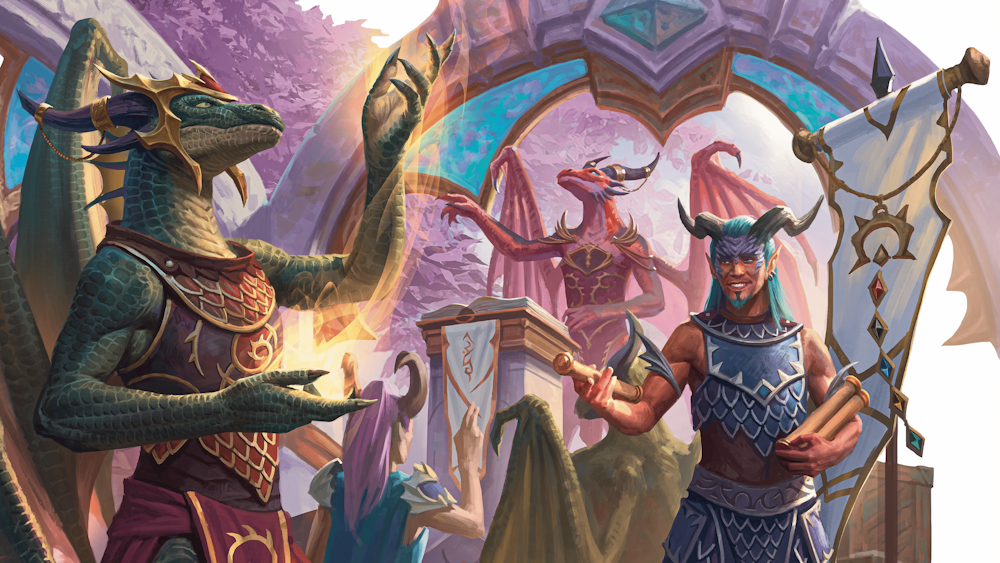
Dragonborn begin life as the Unshaped. During this stage, their scales shift through prismatic colors, and their scales and elemental nature have not yet settled into the form they will carry through adulthood.
That change occurs during the Zhar'vexin, an important rite in which a Dragonborn's shifting scales are shed and their permanent color is revealed. Its timing differs for every Dragonborn and cannot be predicted in advance, though it often occurs during a period of greater self-understanding or after an experience that brings clarity about who they are and what matters to them.
As the Zhar'vexin takes place, the prismatic scales of the Unshaped crack and fall away, revealing their permanent color beneath. Their breath changes with them, settling into its mature elemental form.
Color is not inherited and carries no moral meaning. Dragonborn traditions associate each color with certain ideals and cautions, but these are teachings rather than rules governing personality. Two Dragonborn of the same color may understand those traditions very differently or place little importance upon them at all.
Another important rite is the Zhal'vorrak, in which a Dragonborn chooses the form they use when living among other peoples. The chosen visage may resemble another mortal people or take on a more individual appearance, and the transformation is physical rather than illusory.
Among Dragonborn, this form is understood as another expression of the same person rather than a disguise. Some favor their draconic form whenever circumstances allow, others spend much of their lives in their chosen visage, and many move comfortably between the two.
Identity and Culture
Many of the oldest Dragonborn traditions are preserved in the Aldramar Isles, where individual clans maintain their own customs surrounding identity, adulthood, family, and personal responsibility.
The Zhar'vexin and Zhal'vorrak are among the most important rites in many of these traditions, but Dragonborn identity is not considered fixed once either has taken place. A person's experiences, relationships, responsibilities, and choices continue to shape who they are throughout life.
The five Dragon Ascendants, Nelashra, Ezavion, Syldaxa, Yverian, and Nyladria, remain central figures within Dragonborn culture. They are remembered as the creators of the first Dragonborn and as ancient paragons whose stories have been preserved across generations.
Their lives are often used to explore different ideals and the consequences of pursuing them too rigidly. Young Dragonborn are encouraged to consider these teachings for themselves rather than being assigned a path by their family or clan.
The same principle surrounds color. A family may speculate about the color an Unshaped child will eventually reveal, but tradition strongly discourages treating those expectations as certainty. The Zhar'vexin belongs to the individual, and its outcome cannot be chosen by parents, teachers, or elders.
Customs surrounding the Zhal'vorrak tend to be personal. Some clans mark the decision with a family ceremony, a keepsake, or a visit to a place important to their history. Elsewhere, the choice may be made quietly with little formal observance.
The Zhar'vexin is more commonly witnessed by family and friends. Once the transformation is complete, the Dragonborn is formally recognized in their permanent color, with individual clans preserving their own ways of marking the occasion.
Neither color nor chosen visage determines a Dragonborn's profession, social standing, or expected way of life. Both may become important parts of identity, but neither is treated as a complete definition of the person.
Colors and Ideals
Dragonborn traditions associate each draconic color with ideals worth considering and cautions against allowing those same qualities to become harmful. These associations have developed through generations of teaching and interpretation rather than representing fixed traits inherent to the color itself.
| Dragon Type | Ideals | Possible Flaws |
|---|---|---|
| Gold | Nobility, protection, generosity, leadership, inspiration | Arrogance, condescension, excessive pride, controlling behavior |
| Silver | Loyalty, honor, guidance, compassion, mercy | Self-righteousness, rigidity, blind loyalty, refusal to compromise |
| Bronze | Curiosity, mentorship, discovery, humor, defending others | Meddling, poor boundaries, manipulation, intellectual arrogance |
| Brass | Storytelling, hospitality, joy, openness, freedom of expression | Deceit, selfishness, broken promises, manipulation through charm |
| Copper | Playfulness, wit, friendly rivalry, teaching through humor | Cruel mockery, harmful tricks, belittling others, insensitivity |
| Red | Passion, courage, conviction, decisiveness | Ruthlessness, temper, domination, selfish ambition |
| Blue | Precision, patience, strategy, discipline, leadership | Coldness, manipulation, obsession with control, scheming |
| Green | Adaptability, observation, insight, clever problem-solving | Paranoia, secrecy, deceit, manipulation |
| Black | Endurance, resourcefulness, survival, acceptance of difficult truths | Vindictiveness, opportunism, cruelty, obsession with suffering or decay |
| White | Clarity, persistence, instinct, directness | Brutality, impulsiveness, territorial behavior, reliance on instinct over reason |
| Amethyst | Balance, wisdom, perspective, guardianship | Detachment, fatalism, superiority, treating individual lives as insignificant |
| Sapphire | Focus, clarity, intellect, protection of knowledge | Obsession, isolation, arrogance, hoarding knowledge |
| Emerald | Curiosity, creativity, empathy, understanding | Intrusiveness, obsession, manipulation, poor boundaries |
| Topaz | Independence, irreverence, humor, questioning authority | Recklessness, destructive behavior, irresponsibility, disregard for consequences |
| Crystal | Hope, healing, encouragement, peacemaking | Naivety, passivity, avoidance of conflict, ignoring obvious danger |
A Dragonborn may identify strongly with the teachings associated with their color, reject parts of them, or understand them differently as they grow older. Their purpose is to provide a language for reflection rather than prescribe who a Dragonborn is expected to become.
Dragonborn Across Eldareth
The Dragonborn trace their beginning to the Second Forging within Thuradun.
During the Incursion, the five Dragon Ascendants awakened the Forge of Wills for only the second time in its history. Each contributed part of their own draconic and divine essence to the Anima Core, and from that act the first Dragonborn emerged.
They were created during a time of war, but they were never bound to that purpose. The first Dragonborn were living mortals with identities and lives of their own, and later generations were born as naturally as those of other mortal peoples. Their connection to the Ascendants is therefore one of origin and heritage rather than an ongoing dependence upon the Forge.
The Aldramar Isles, already the ancient domain of the five Ascendants, became the principal center of Dragonborn culture. Many of their oldest clans and traditions developed there, including the customs surrounding the Zhar'vexin and Zhal'vorrak, and the Ascendants remain closely woven into the history of the Isles.
Shrines dedicated to the five can be found throughout the region. Dragonborn generally honor them as their creators and ancient paragons rather than worshiping them as gods, though individual beliefs and practices vary between communities.
Some Dragonborn report unusual experiences during the Zhar'vexin, when their shifting scales are shed and their permanent color is revealed. These may take the form of vivid dreams, visions, or a brief sense of contact with one of the Ascendants. Such accounts are taken seriously, but no single explanation for them is universally accepted.
Families and clans have developed many interpretations over the centuries. Some regard these experiences as guidance from the Ascendants themselves, while others understand them as part of the profound magical change taking place during the rite.
The Zhar'vexin marks an important stage in a Dragonborn's life, but it is not treated as the point at which their identity becomes complete. Their color, chosen visage, relationships, responsibilities, and the choices they make throughout life all contribute to who they become.
Dragonborn tradition therefore places as much importance on the life that follows these rites as on the rites themselves. The Zhar'vexin may reveal something important about a Dragonborn at that moment, while the Zhal'vorrak gives them another way to express themselves in the world, but neither determines the course their life must take.
Dragonborn Traits
Ability Score Increase. When determining your character's ability scores, increase one score by 2 and increase a different score by 1, or increase three different scores by 1. You can't raise any of your scores above 20.
Creature Type. You are a Humanoid.
Size. You are Medium.
Speed. Your walking speed is 30 feet.
Darkvision. You can see in dim light within 60 feet of you as if it were bright light, and in darkness as if it were dim light. You can't discern color in darkness, only shades of gray.
Draconic Nature. Your permanent color determines the elemental nature of your breath and the damage resistance associated with it. Choose a Dragon Color from the table below.
| Dragon Color | Damage Type | Dragon Color | Damage Type | Dragon Color | Damage Type |
| Black | Acid | Brass | Fire | Amethyst | Force |
| Blue | Lightning | Bronze | Lightning | Crystal | Radiant |
| Green | Poison | Copper | Acid | Emerald | Psychic |
| Red | Fire | Gold | Fire | Sapphire | Thunder |
| White | Cold | Silver | Cold | Topaz | Necrotic |
Damage Resistance. You have resistance to the damage type associated with your Dragon Color.
Chosen Visage. Through the Zhal'vorrak, you have chosen another physical form through which you can present yourself.
At character creation, choose the appearance of a Medium Humanoid people, such as a human, elf, or orc, or work with your DM to describe a similarly humanoid form.
As an action, you can shift between your draconic form and your Chosen Visage. The transformation is physical, but it does not alter your size, abilities, or game statistics, and you gain no traits from the people whose appearance you adopt.
Your Chosen Visage may retain subtle signs of your draconic nature, such as faint scales, unusual eyes, small horns or crests, claws, or other features you choose.
Once selected, your Chosen Visage does not normally change, though unusual magic or circumstances determined by the DM may allow it.
Breath Weapon. When you take the Attack action on your turn, you can replace one of your attacks with a breath attack in a 15-foot cone or a 30-foot line. Each creature in that area must make a Dexterity saving throw (DC = 8 + your Constitution modifier + your Proficiency Bonus). On a failed save, the creature takes 1d10 damage of the type associated with your Dragon Color. On a successful save, it takes half as much damage.
This damage increases by 1d10 when you reach 5th level (2d10), 11th level (3d10), and 17th level (4d10). You can use your Breath Weapon a number of times equal to your Proficiency Bonus, and you regain all expended uses when you finish a Long Rest.
Draconic Flight. Starting at 5th level, whenever you finish a Long Rest, you may invoke the essence of your draconic heritage. As a Bonus Action, you manifest wings on your body. These wings last for 10 minutes. For the duration, you gain a Fly Speed equal to your Speed and can hover.
Once you use this ability, you can't do so again until you finish a Long Rest.
Languages. Your character can speak, read, and write Common and one other language that you and your DM agree is appropriate for the character. The Player's Handbook offers a list of languages to choose from. The DM is free to modify that list for a campaign.