
Catfolk
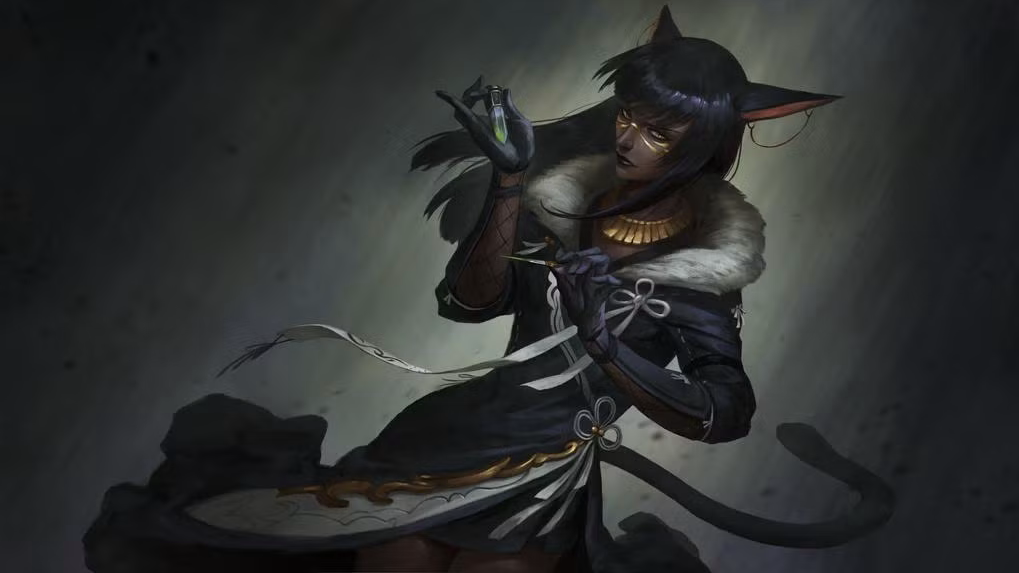
The Ashera are feline humanoids whose oldest known communities come from the deserts of Malkaret and the coasts of Akkareth. Many early communities developed along routes connecting settlements across the south, and travel became a familiar part of Ashera life long before they spread farther across Eldareth.
Daharan, the Trickster Wind, has been part of Ashera tradition for much of their recorded history. Stories about him often deal with luck and knowing when a risk is worth taking. They remain familiar even among Ashera who do not worship him.
Ashera communities gradually spread beyond Malkaret and Akkareth. They are now common in parts of Nurathar and can also be found in Shahoya and along much of the southern coast. Some families still move between settlements at different times of year. Others have lived in the same towns and cities for generations.
Identity and Culture
Ashera are humanlike in their overall anatomy and facial structure. Their skin and hair fall within the same broad range seen among humans. Their feline traits are most visible in the ears, tail, eyes, and teeth.
Their ears and long tails are covered in fine fur. Coloration and markings vary between families and may resemble those of different feline animals. Small patches of fur can appear elsewhere on the body, though most Ashera have ordinary skin across the face and body.
Their eyes often have a slightly feline shape, and slit pupils are common. Their canine teeth are somewhat longer than those of most humans.
Ashera tend to have lean builds and move with an easy sense of balance. Their tails shift naturally with their posture, especially when climbing or crossing uncertain footing.
Ashera society is traditionally matrilineal, with family lines commonly traced through the mother. Clans can include adopted members and families joined through long-standing ties. Adoption and those relationships can carry full clan membership.
Family history is often preserved through storytelling. Settled communities may also keep written records, particularly where property or agreements between families are concerned.
Coming of age is marked differently between communities. In some, a young Ashera receives a personal epithet connected to something remembered about them or to an event from their youth. These names can be serious or affectionate, and some remain in use throughout a person's life.
Formal promises carry considerable weight in many Ashera communities. Breaking an important oath can damage trust between several connected families, especially when the promise formed part of a wider agreement.
Ashera Across Eldareth
Ashera have lived along the southern routes of Eldareth for generations. Communities developed in ports, inland settlements, and other places connected by regular movement between the coast and the interior.
Their society remains decentralized. Family connections can extend across great distances, and customs often differ between communities according to where they live and how long they have been settled there.
An Ashera raised in a city may have little experience with the seasonal movement still practiced by some families. Another may grow up travelling between settlements along a route their relatives have followed for generations.
These differences are common among modern Ashera. Distant communities may share older traditions and family connections without following the same way of life.
Ashera Traits
Ability Score Increase. When determining your character's ability scores, increase one score by 2 and increase a different score by 1, or increase three different scores by 1. You can't raise any of your scores above 20.
Creature Type. You are a Humanoid.
Size. You are Medium.
Speed. Your walking speed is 35 feet.
Darkvision. You can see in Dim Light within 60 feet of yourself as if it were Bright Light and in Darkness within that range as if it were Dim Light. You discern colors in that Darkness only as shades of gray.
Feline Agility. When you move on your turn, you can double your Speed until the end of the turn. Once you use this trait, you can't use it again until you move 0 feet on one of your turns.
Feline Leap. When determining the distance of your Long Jump or High Jump, you can use your Dexterity score and Dexterity modifier in place of your Strength score and Strength modifier. In addition, you need to move only 5 feet immediately before the jump to gain the benefits of a running start.
Catlike Grace. You have a Climb Speed equal to your Speed, and you have Advantage on Dexterity (Acrobatics) checks you make to maintain your balance.
In addition, when you take damage from a fall, you can take a Reaction to roll a number of d6s equal to your Proficiency Bonus and reduce the damage by the total rolled.
Languages. Your character can speak, read, and write Common and two other Standard Languages that you and your DM agree are appropriate for the character. The Player's Handbook offers a list of Standard Languages to choose from. The DM is free to modify that list for a campaign.